
Becoming a landlord for the first time can be both exciting and overwhelming.
You’re essentially starting a business, and in Washington State, that business comes with legal obligations, tenant protections, and high expectations.
Our team at SJA Property Management has spent the last 16 years making life easier for hundreds of landlords just like you, and in this guide, we’ll walk you through what first-time landlords in Washington need to know to stay compliant, reduce risk, and protect your investment.
Here’s what we’ll cover:
- The legal requirements you can’t afford to ignore
- How to structure a bulletproof lease
- Screening tenants the right (and legal) way
- Managing rent, repairs, and late payments
- When to DIY and when to bring in a professional
1. Legal Basics for Landlords in Washington
Before you list your rental or sign a lease, you need to understand how landlord-tenant law works in Washington.
This is not a state where you can “wing it” and hope for the best. There are very strict rules protecting tenants, and even small mistakes can lead to legal trouble.
Washington’s rental rules are governed primarily by:
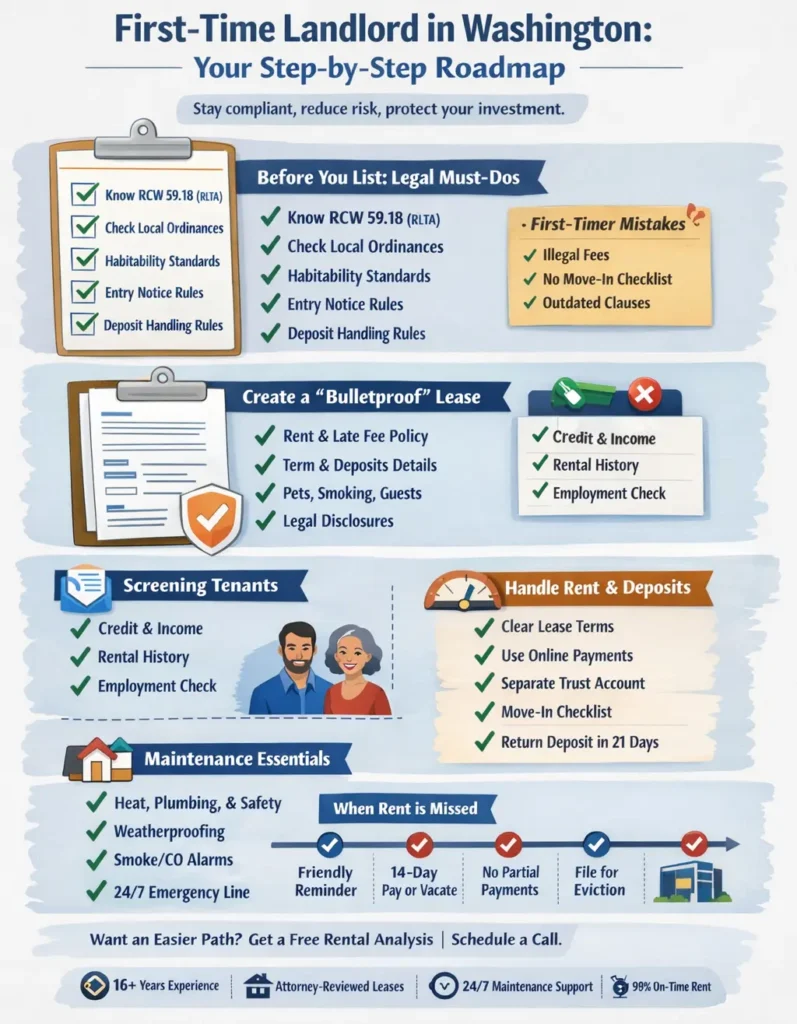
- RCW 59.18 – The Residential Landlord-Tenant Act (RLTA)
This is the backbone of landlord-tenant law in Washington. It covers everything from security deposits to notices of entry to eviction procedures. All rental activity must comply with this law—even if your lease says otherwise. - Local Ordinances
Cities like Seattle, Tacoma, and Burien have their own rules on top of state law. For example, Seattle’s Just Cause Eviction Ordinance limits when and how you can ask a tenant to leave, even at the end of a lease. Other cities require business licenses or registration for rental properties.
If you accidentally violate these laws, even with good intentions, you could face fines, lawsuits, or delays in collecting rent.
Bookmark the Washington State Attorney General’s Landlord Guide for reference. And if your rental is in Seattle or another city with extra rules, make sure you check local requirements too.
2. Get Your Lease Agreement Right
Your lease document is your most important legal protection as a landlord. Even if you do most of what we cover here by yourself, we strongly advise against using a generic lease from the internet, and whatever you do, make sure you don’t copy a lease agreement template from a different state.
Washington has strict laws about what must be included in a residential lease. A compliant lease should clearly outline:
- Rent amount, due date, and late fee policy
- Length of the lease (fixed-term or month-to-month)
- Security deposit details, including where the funds are held
- Maintenance responsibilities (landlord vs. tenant)
- Rules for pets, smoking, subletting, and guests
- Notice requirements for ending or renewing the lease
- Legal disclosures such as mold, fire safety, or lead-based paint if applicable
If your lease doesn’t follow Washington’s Residential Landlord-Tenant Act (RCW 59.18), parts of it may be unenforceable, or even worse, expose you to legal liability.
We’re not saying this to scare you. Everything here is very straightforward for first-time landlords who are paying close attention to detail and approaching this seriously, but we’ve seen more than our fair share of mistakes over the years.
These are the most common first-timer mistakes we see:
- Charging illegal fees (like non-refundable deposits labeled incorrectly)
- Missing the move-in inspection checklist (required when collecting a deposit)
- Using outdated language or terms that violate tenant rights
- Failing to specify what happens after the lease expires
You can purchase a lease from a reputable source like the Rental Housing Association of Washington (RHAWA), or work with a full-service property management company like SJA that provides attorney-reviewed lease agreements tailored to Washington law.
It’s worth doing this right the first time, because cleaning up a bad lease later is much harder than starting with a strong one.
3. Screen Tenants Carefully and Fairly
One of the biggest mistakes first-time landlords make is rushing the tenant selection process. It’s tempting to go with the first person who applies—but a bad tenant can cost you far more than a few extra days of vacancy.
What You Can (and Should) Screen For
Washington law allows landlords to screen tenants based on objective financial and rental history, but you must be careful to avoid discrimination.
Here’s what you can legally evaluate:
- Credit score and history
- Verifiable income (many landlords use a 3x rent benchmark)
- Rental history and references
- Background check, including criminal history (with restrictions in some cities)
- Employment verification
Always apply the same criteria to every applicant, and put those criteria in writing. That way, you stay compliant with Fair Housing laws and protect yourself from bias claims.
What You Cannot Screen For
You may not reject a tenant based on any protected class, including:
- Race, color, national origin
- Religion
- Sex, gender identity, or sexual orientation
- Familial status (e.g., single parents, children)
- Disability
- Veteran status (in some jurisdictions)
Seattle, Tacoma, and other cities have additional tenant protections that limit how and when you can use certain screening criteria. For example, Seattle’s Fair Chance Housing Ordinance restricts the use of criminal history in rental decisions.
At SJA Property Management, we use a consistent, legally compliant process to screen every applicant, and our process works. 98% of the tenants we place pay 100% of their rent on time, and our eviction rate is virtually zero.
4. Collect Rent and Deposits the Right Way
Collecting rent sounds simple until it’s not. First-time landlords in Washington need to follow specific rules when handling rent payments, late fees, and security deposits, or they could face legal pushback.
Here are some collection practices that we recommend:
- Set clear expectations in the lease: Include the rent amount, due date, grace period (if any), and accepted payment methods.
- Avoid accepting cash unless you’re prepared to issue a written receipt every time.
- Use an online system (like AppFolio or Buildium) to track payments, generate receipts, and reduce disputes.
- Stick to your policies, as inconsistent enforcement creates problems if you ever need to issue a notice.
It’s also important to note that while you should absolutely have late fees, Washington has rules for how you charge late fees to your tenants. The state doesn’t set a specific late fee cap, but fees must be reasonable and clearly stated in the lease, with a typical guideline of 10% of the monthly rent.
You aren’t allowed to add extra “processing” or “reminder” fees unless disclosed and agreed to, but we recommend just steering clear of these in general, as they can complicate proceedings if formal action is ever required.
Washington has ever stricter laws on how you handle security deposits:
- Deposits must be held in a separate trust account
- You must give the tenant a written receipt and specify where the funds are held
- A signed move-in condition checklist is required before collecting any deposit
- When the lease ends, you must return the deposit (minus lawful deductions) within 21 days
Failure to follow these rules can result in penalties up to twice the amount of the deposit, plus court costs.
5. Handle Maintenance Like a Pro
Maintenance is one of your core legal duties as a landlord in Washington. If you fail to keep the property in good repair, you could face rent withholding, legal action, or early lease termination.
Washington landlords are required to provide “safe and habitable housing” under the Residential Landlord-Tenant Act. That means:
- Working plumbing, heat, electricity, and hot water
- Safe entryways and exits
- Functioning smoke and carbon monoxide detectors
- Proper weatherproofing (e.g. roof, windows, no mold issues)
- Prompt repairs when things break
Even if your lease tries to assign certain tasks to tenants, you can’t waive your legal obligation to maintain habitability.
It sounds like a lot, but if you set up the right systems, maintenance doesn’t have to be stressful. Here’s what a smart first-time landlord should put in place:
- Emergency contact system for tenants (ideally 24/7)
- A list of vetted, licensed vendors for plumbing, electrical, HVAC, etc.
- A process for documenting requests and response times
- Scheduled preventative maintenance (gutter cleaning, furnace service, etc.)
- A repairs reserve fund: set aside 10–15% of monthly rent for unexpected fixes
Always require tenants to submit maintenance requests in writing. It protects both parties and gives you a paper trail in case of disputes.
At SJA Property Management, our owners never have to field midnight maintenance calls or chase vendors. We coordinate everything, from emergency repairs to routine upkeep, using fully licensed professionals, and keep you informed every step of the way.
6. Be Prepared For Handling Missed Rent
Even with the best tenants, late rent can happen. But as a first-time landlord in Washington, it’s important to handle nonpayment by the book.
Step 1: Start With Communication
If rent is a few days late, reach out with a polite reminder. Sometimes it’s a simple oversight or technical issue. Give them a chance to correct it before escalating.
Document every message, call, or conversation. This paper trail matters later if legal action becomes necessary.
Step 2: Deliver a 14-Day Pay or Vacate Notice
If the rent remains unpaid, you must serve a 14-Day Pay or Vacate Notice, which gives the tenant 14 calendar days to either:
- Pay the full balance owed, or
- Move out voluntarily
This notice is legally required before you can file for eviction. If you skip this step, your case could be thrown out of court.
Step 3: Don’t Accept Partial Payments Without a Plan
In Washington, accepting partial rent after serving a Pay or Vacate Notice may invalidate that notice, which resets the clock. Only accept partial payment if it’s part of a written repayment agreement.
Step 4: File for Eviction If Necessary
If the notice period passes and no payment or resolution is made, you can begin the eviction process (called an unlawful detainer). This must be done through Superior Court. You cannot self-evict by changing locks or cutting off utilities.
Evictions in Washington are heavily regulated, so if it gets to this point, consider hiring a property manager or attorney to handle it for you.
If you want more detail, check out our in-depth guide to handling missed rent payments.
At SJA, we’re proud to say that 98% of our tenants pay on time, thanks to careful screening and clear lease enforcement. But if rent issues ever arise, we handle notices, communication, and legal compliance on your behalf, so you’re never stuck figuring it out alone.
Decide Whether to Self-Manage or Hire Professionals
Managing your first rental can be rewarding, but it’s also time-consuming, detail-heavy, and legally risky if you’re not fully prepared.
So before you go all-in, ask yourself: do you want to self-manage, or would it make more sense to bring in a professional?
Self-Management: Pros and Cons
The biggest benefit of self-management is costs:
- Save money on management fees
- More direct control over tenant selection and maintenance
- Hands-on learning experience
The biggest downside is your time and peace of mind:
- You’re responsible for legal compliance and notice delivery
- You’ll be on call 24/7 for emergencies
- You have to manage screening, rent collection, repairs, accounting, and conflict resolution
- It’s easy to make expensive mistakes, especially with Washington’s complex laws
While we’re a bit biased, it’s our experience that 95% of rental property owners are happier having their properties managed for them, with most of the other 5% treating management as their sole, fulltime job and typically owning 3 or more properties.
Hiring a Property Manager: Pros and Cons
If you want to focus on the investment side and skip the day-to-day stress, a property manager handles everything for you:
- Marketing and leasing
- Tenant screening and placement
- Rent collection and financial reporting
- Maintenance coordination
- Legal compliance and eviction support
There are really only two potential cons:
- You will likely earn a bit less from the property
- An incompetent property manager can cause a lot of problems
That said, if you do your due diligence and work with a highly experienced property management company like SJA, you aren’t going to have to worry about incompetence or mistakes.
And the longer you work with us, the more likely it is that the higher rent, lower turnover, and lack of pricey mistakes will fully offset the cost of management fees, and then some.
We work with first-time landlords across the Seattle and Eastside area to make their experience simple and profitable. We offer:
- Month-to-month contracts
- No cancellation fees
- Attorney-reviewed leases
- 98% on-time rent payments
- 24/7 maintenance coordination
- A full team behind every rental
You don’t have to do it all yourself. We’ll handle the hard parts so you can focus on the upside.
Next Steps For First-Time Landlords
There’s a lot of work that goes into being a landlord, and it can be a steep learning curve initially. If you’ve made it this far, you’re already ahead of the curve.
At SJA Property Management, we work with first-time landlords across Seattle, the Eastside, and surrounding areas to make rental ownership stress-free. We handle the paperwork, the people, the midnight maintenance calls, and we do it all with no long-term contracts, no cancellation fees, and a team you can actually reach.
Ready to take the guesswork out of being a landlord? Request your free rental analysis or schedule a call today.
You can request a free rental analysis from SJA Property Management here: