

Running an Airbnb in Seattle can be a lucrative venture, but it is no secret that the landscape is shifting. Between navigating evolving short-term rental regulations, riding the unpredictable rollercoaster of seasonal tourist demand, and managing the endless cycle of bookings, cleanings, and late-night guest inquiries, many property owners are experiencing “host burnout.”
If you are tired of treating your investment property like a demanding second job, it might be time for a strategic pivot. Converting your Seattle vacation rental into a long-term rental offers a highly appealing alternative: reliable, year-round cash flow, dramatically reduced daily stress, and lower wear-and-tear on your property.
Making this transition, however, requires a clear understanding of Seattle’s strict tenant laws and current market dynamics. That is where we come in. As experts in Seattle property management, SJA Property Management brings 16 years of specialized local experience to the table. Trusted to manage over 1,000 homes and over half a billion dollars in real estate assets, our team has the proven expertise to seamlessly transition your property from a high-maintenance short-term rental into a stable, profitable, and truly passive long-term investment.
Why Convert Your Seattle Airbnb to a Long-Term Rental?
While short-term rentals can yield high nightly rates during peak tourist seasons, the hidden costs—both financial and emotional—add up quickly. Here is why savvy investors in the Pacific Northwest are increasingly making the switch to long-term leasing:
Consistent, Reliable Income
Seattle’s tourism heavily favors the summer months, leaving Airbnb hosts vulnerable to steep income drops during the rainy, off-season winters. A long-term lease guarantees a steady, predictable monthly cash flow for 12 months out of the year, completely eliminating seasonal vacancy anxiety.
Significantly Less Daily Management
Running a successful Airbnb is essentially a hospitality job. It requires coordinating back-to-back cleanings, managing a constant stream of guest messages, restocking toiletries, and handling midnight lockouts. Long-term rentals allow you to step back and treat your property like a true investment rather than a demanding side hustle.
Lower Maintenance Costs
The constant turnover of short-term guests accelerates wear-and-tear on your home’s flooring, paint, and appliances. Long-term tenants, on the other hand, move in with their own belongings and tend to treat the property as their actual home. This drastically reduces your ongoing maintenance expenses and the need to constantly replace damaged furniture or linens.
Favorable Seattle Market Conditions
Seattle remains a thriving hub for top-tier tech talent, healthcare professionals, and young families. Despite economic shifts, the demand for quality, well-maintained housing in desirable Seattle neighborhoods remains incredibly strong. By converting your property, you tap into a massive pool of highly qualified renters looking for stability.
Less Regulatory Risk in Seattle
Seattle’s short-term rental rules are not just strict, they are layered. Between licensing, required listing disclosures, operating limits, and inspection rules for certain dedicated units, staying compliant takes time and attention. Converting to a long-term rental can dramatically simplify ownership and reduce exposure to fines, renewals, and shifting local rules.
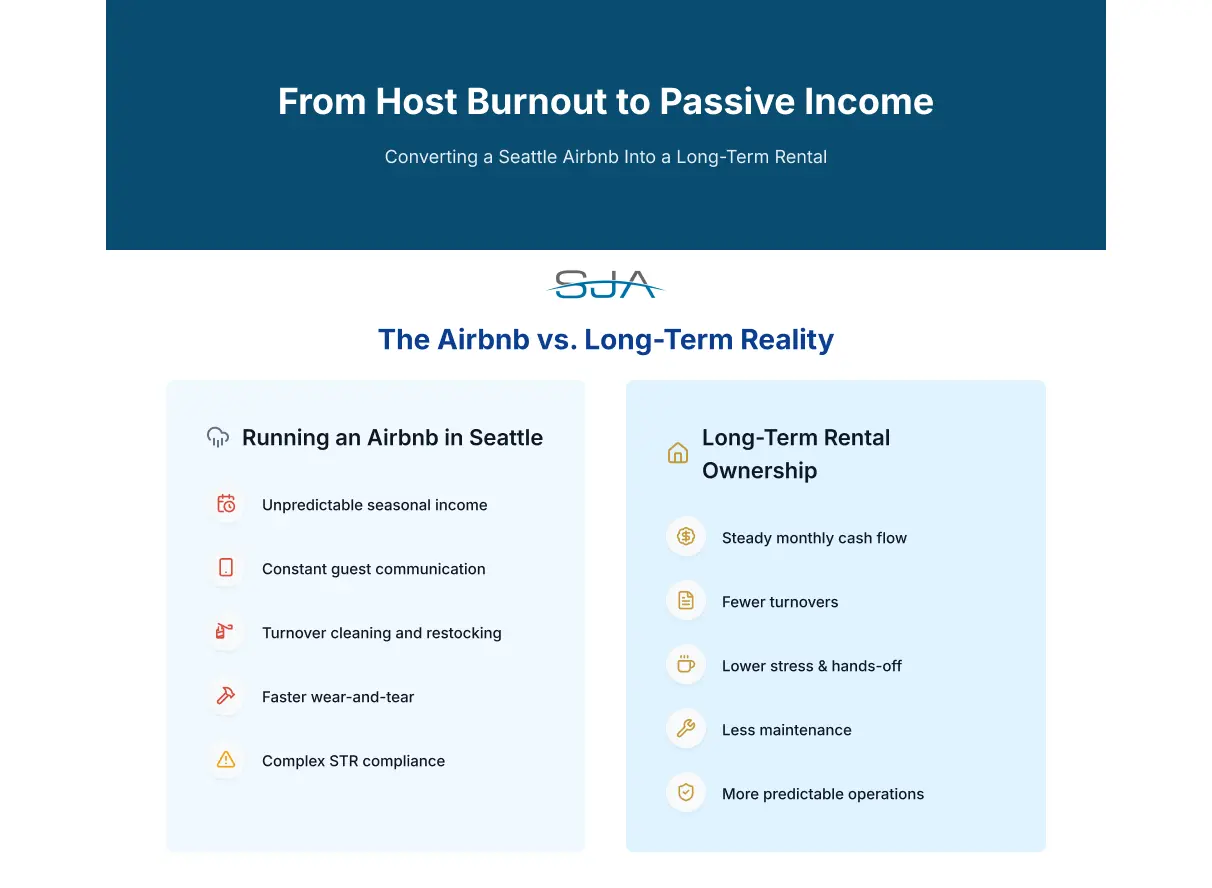
*** click to make infographic larger
Step 1: Navigate Seattle’s Long-Term Rental Laws
Transitioning to a long-term rental means shifting from hospitality regulations to landlord-tenant laws. Seattle has some of the most heavily regulated renter protections laws in the country. While this can seem daunting, understanding these three core regulations is your first step to a compliant and profitable rental:
Rental Registration & Inspection Ordinance (RRIO)
Before you can legally lease your home to a long-term tenant, your property must be registered with the Seattle Department of Construction and Inspections. The RRIO program requires owners to register their units, renew that registration every two years, and pass a safety and habitability inspection. Attempting to rent your property without an active RRIO registration can result in heavy daily fines and severely limit your legal rights as a landlord in the event of a dispute.
The "First-in-Time" Rule
Seattle’s tenant screening laws are incredibly strict. Under the “First-in-Time” ordinance, landlords are legally required to publicly post their exact screening criteria, carefully timestamp every application received, process them in strict chronological order, and offer the lease to the very first applicant who meets the stated criteria. You cannot hold out for a “better” or preferred applicant if the first one fully qualifies.
Just Cause Eviction Ordinance (JCEO)
In Seattle, you cannot simply ask a tenant to leave or refuse to renew a month-to-month lease without a legally recognized reason. The Just Cause Eviction Ordinance dictates that a landlord must have one of several specific, city-approved reasons (such as failure to pay rent, the owner moving back in, or selling the single-family home) to end a tenancy.
The SJA Advantage
We completely understand if reading through Seattle’s municipal code makes you want to stick with the headaches of Airbnb! Navigating this complex legal landscape is exactly why partnering with a professional property manager is invaluable. At SJA Property Management, our dedicated compliance team handles all RRIO paperwork, strictly adheres to First-in-Time screening requirements, and ensures your lease agreements are bulletproof—keeping you fully protected and completely hands-off.
Step 2: Prepare Your Property for Long-Term Tenants
Making the physical transition from a bustling Airbnb to a welcoming long-term residence requires a different approach to how you present and maintain your space. While short-term guests expect a hotel-like experience, long-term renters are looking for a blank canvas they can make their own.
Here is what you need to consider when prepping your property:
Decide Between Furnished vs. Unfurnished
Your Airbnb is likely fully stocked, right down to the coffee maker and silverware. However, the vast majority of long-term Seattle renters already own their own furniture and prefer an unfurnished space. While there is a niche market for corporate housing, listing your home as unfurnished generally attracts a much larger pool of long-term applicants. You will need a plan to either sell, donate, or place your existing furniture and decor into storage.
Prioritize Deep Cleaning and Deferred Maintenance
Short-term rentals experience accelerated wear-and-tear from suitcases hitting walls and constant foot traffic. The transition period is the perfect time to give your investment a true reset. Plan for a professional deep clean, touch up scuffed paint, professionally clean or replace worn carpets, and fix any nagging maintenance issues (like a running toilet or a sticky door) that you may have put off during busy booking seasons.
Ensure Safety Compliance
As mentioned in Step 1, your property will need to pass an RRIO inspection to be legally rented long-term in Seattle. This means ensuring your home’s safety features are strictly up to code. Double-check that all smoke detectors and carbon monoxide alarms are fully functional and properly placed, confirm that all windows and doors have working locks, and ensure stairs have secure handrails.
Taking the time to properly prep your property not only ensures you remain compliant with city safety standards but also allows you to command top dollar when you list the home on the long-term rental market.
Step 3: Set the Right Monthly Rental Rate
One of the biggest hurdles Airbnb hosts face when transitioning to a long-term model is adjusting their income expectations. It is easy to look at a high nightly summer rate, multiply it by 30 days, and assume that is your new monthly rent. Unfortunately, the long-term rental market operates on an entirely different set of metrics.
Setting the right price is a delicate balancing act. Here is how to approach it strategically:
Conduct a Realistic Market Analysis
Short-term nightly rates simply do not translate directly to long-term monthly rent. While your gross monthly income might look lower on paper with a long-term lease, remember that you are also shedding the heavy expenses of Airbnb hosting—such as nightly platform fees, constant turnover cleaning costs, restocking supplies, and utility bills (which long-term tenants typically cover themselves).
If you need help pricing your Seattle long-term rental, check out our free instant rent analysis tool.
Step 4: Marketing and Tenant Screening
Finding a weekend guest on Airbnb is as easy as relying on the platform’s algorithm and reading a few past reviews. Finding a reliable, long-term tenant to live in your valuable asset for the next year or more requires a completely different—and much more rigorous—approach.
Here is how to effectively market your property and screen for the right long-term renter:
Update Your Photography and Marketing
You likely already have beautiful, professional photos from your Airbnb listing. While these are great to have, use them cautiously. If your photos showcase a beautifully furnished home but you are renting it unfurnished, it can mislead potential applicants. Be sure to explicitly state in your marketing that the home comes unfurnished, or better yet, invest in fresh photos once the furniture is removed so tenants can accurately visualize the space.
Implement Rigorous Screening
Airbnb conducts very basic identity checks, but it does not verify a guest’s income, check their credit score, or look into their eviction history. For a long-term lease, comprehensive screening is your only line of defense against costly evictions or property damage. You must verify employment and income (typically requiring 3x the monthly rent), run a thorough credit and background check, and contact past landlords for references.
Strict Compliance Reminder
As we covered in Step 1, you must perform this rigorous screening while adhering flawlessly to Seattle’s Fair Housing laws and the “First-in-Time” ordinance. Your screening criteria must be explicitly written out, provided to every applicant, and applied evenly. You cannot deny an applicant based on a “gut feeling” if they meet your documented criteria and are the first in line.
Why Partner with SJA Property Management for long-term property management?
Transitioning a property from a short-term vacation rental to a traditional long-term lease involves navigating a maze of local regulations, pricing adjustments, and completely different marketing strategies. You do not have to do it alone.
Here is why Seattle property owners trust us to manage their investments:
- Unmatched Local Expertise: With 16 years of experience specifically navigating the Greater Seattle rental market, we know exactly what it takes to succeed here. We stay ahead of ever-changing local laws so you never have to worry about compliance.
- Proven Track Record: We do not just talk about results; we deliver them. SJA Property Management currently manages over 1,000 homes and oversees over half a billion dollars in real estate assets. We have the scale, resources, and proven systems to protect your valuable property.
- Full-Service, Hands-Off Management: Our goal is to turn your stressful Airbnb into a truly passive investment. From handling RRIO registrations and strictly compliant tenant screening to 24/7 maintenance coordination and monthly rent collection, our dedicated team handles every single detail of the rental cycle.
Conclusion
Swapping the chaotic, unpredictable turnover of an Airbnb for the steady, reliable income of a long-term rental is a smart, strategic move for Seattle property owners experiencing host burnout. By making the switch, you can secure consistent cash flow, drastically reduce wear-and-tear on your home, and reclaim your free time. While the transition requires navigating Seattle’s complex tenant laws and shifting your pricing strategy, partnering with an experienced local property manager ensures a seamless and profitable process.
Ready to transition your Seattle Airbnb into a profitable, hands-off long-term rental?
Get started with SJA Property Management and discover how we can help you maximize your ROI with zero stress.
FAQs
Is it better to rent my Seattle Airbnb as a long-term rental?
For many owners, yes. A long-term rental can provide more predictable monthly income, less day-to-day management, lower turnover costs, and reduced stress compared to operating a short-term rental.
Why are Seattle Airbnb owners switching to long-term rentals?
Many owners are making the switch because of seasonal income swings, host burnout, rising operating costs, and the complexity of short-term rental regulations. Long-term leasing often offers a more stable and hands-off investment model.
Do I need to register my Seattle property before renting it long-term?
Yes. In many cases, Seattle landlords must comply with the Rental Registration and Inspection Ordinance (RRIO). This means registering the property and maintaining compliance before legally renting it to a long-term tenant.
What is Seattle’s First-in-Time rule?
Seattle’s First-in-Time rule requires landlords to advertise their screening criteria in advance, process applications in the order they are received, and offer the rental to the first applicant who meets those criteria. You cannot skip a qualified applicant for someone you prefer more.
Can I remove a tenant whenever I want in Seattle?
No. Seattle has strong tenant protections, including Just Cause Eviction rules. Landlords generally need a legally recognized reason to terminate a tenancy or require a tenant to move out.
Should I rent my former Airbnb furnished or unfurnished?
In most cases, unfurnished rentals appeal to a broader pool of long-term tenants in Seattle. While furnished rentals can work for niche audiences like corporate renters, unfurnished homes usually attract more applicants looking for a traditional lease.
Is Seattle a good market for long-term rentals?
Seattle remains an attractive market for long-term rentals because of ongoing demand from professionals, healthcare workers, families, and other residents seeking well-maintained housing in desirable neighborhoods.