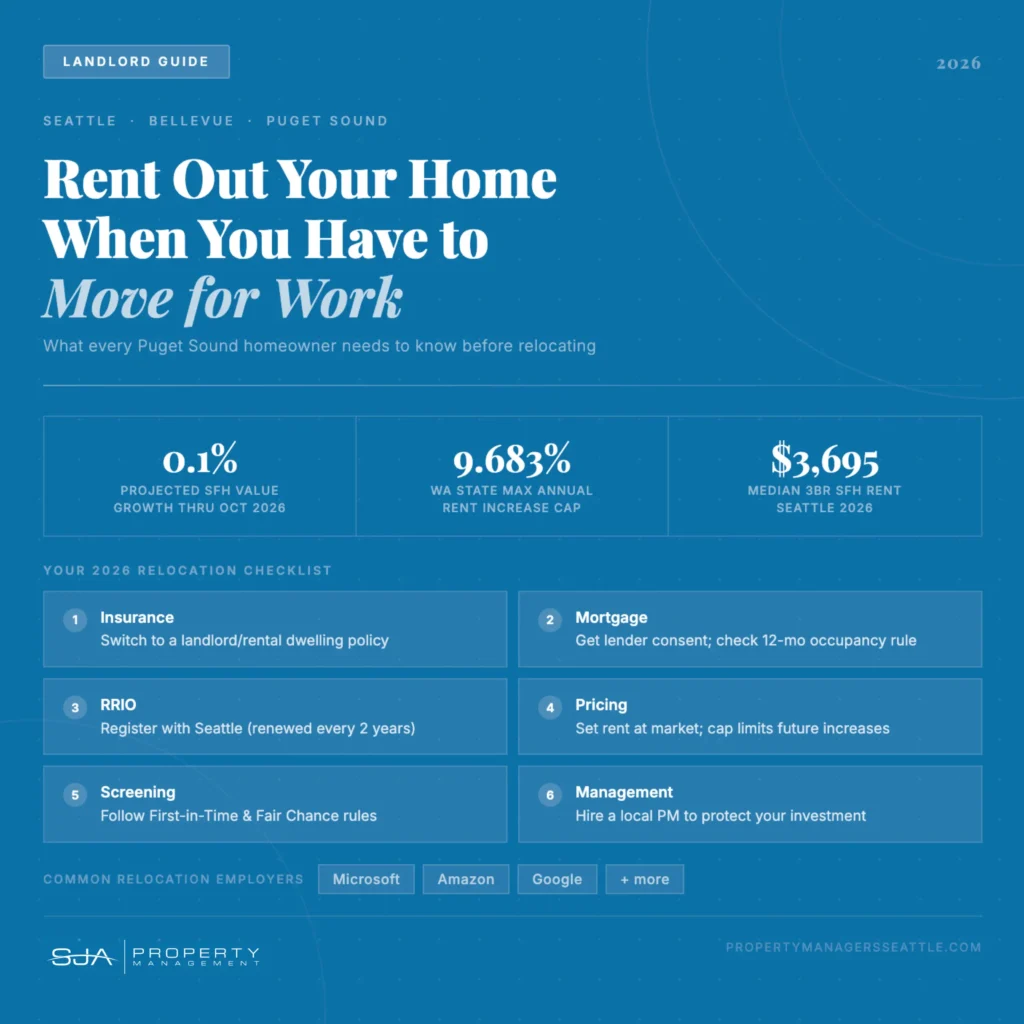
Whether you work for Microsoft, Amazon, Google, or another major employer in the Seattle and Bellevue area, being asked to relocate, whether across the country or overseas, is increasingly common in 2026. Renting out your home when you have to move for work is one of the smartest financial moves a Puget Sound homeowner can make. Instead of selling in a market where single-family home values are projected to grow just 0.1% through October 2026, you preserve your asset, generate rental income, and retain the option to return to a home you already own in one of the most competitive housing markets in the nation.
This guide covers everything you need to know in 2026: insurance updates, Seattle’s RRIO compliance requirements, Washington State rent cap rules, tenant screening laws, and how to find the right property management partner to protect your investment while you are away.
Step 1: Update Your Insurance Before You Leave
Standard homeowner’s insurance does not cover rental activity. Before placing a tenant in your home, you must convert your policy to a landlord or rental dwelling policy. Rental dwelling insurance typically costs 15 to 25 percent more than a standard homeowner’s policy, but it provides coverage your current plan explicitly excludes.
Key coverages to confirm with your insurer include:
- Loss of rental income if the property becomes uninhabitable due to a covered event (fire, water damage, structural failure)
- Liability protection against tenant injury claims
- Coverage for appliances, fixtures, and any personal property you leave at the property
- Protection against tenant-caused damage beyond normal wear and tear
Upgrading your existing policy is generally easier than canceling it and starting with a new carrier. Policy terms and exclusions vary significantly between companies, so compare at least two options before committing. Your property manager can often recommend carriers they have worked with successfully in the Seattle area.
Step 2: Understand Your Mortgage Obligations
If you originally financed your home as a primary residence, your mortgage agreement almost certainly includes an occupancy clause. Most conventional, FHA, and VA loans require the borrower to occupy the property for a minimum of 12 months before converting it to a rental. Renting out your home before meeting this requirement without lender consent can be considered occupancy fraud, which carries serious legal and financial consequences.
Before listing your home as a rental, you should:
- Review your mortgage agreement for occupancy and lease provisions
- Contact your loan servicer and request written consent to lease the property if required
- Ask whether renting will trigger a rate adjustment or require conversion to an investment property loan
- If your HOA has rental restrictions or caps on the number of rentals allowed in the community, confirm compliance with those rules as well
Step 3: Register Your Property and Meet Seattle RRIO Requirements
If your home is located within Seattle city limits, you are required to register it under the Seattle Rental Registration and Inspection Ordinance (RRIO) before renting it out. This requirement applies to all rental property types, from single-family homes and condos to duplexes and ADUs.
Here is what RRIO requires in 2026:
- Register through the Seattle Services Portal. Registration must be completed and renewed every two years. Fines for non-compliance can reach $500 per day.
- Periodic inspections. Properties are inspected at least once every five to ten years on a random selection basis. The city aims to inspect at least 10 percent of registered properties annually. You will receive at least 60 days’ notice before an inspection is required.
- Inspection options. You may hire a City inspector ($241.50 for a single-unit property) or a qualified private inspector from the City’s approved list. A $63 filing fee applies when using a private inspector.
- RRIO checklist compliance. Inspectors verify smoke and carbon monoxide detectors, plumbing function, window and door security, electrical safety, guardrails, and roof integrity, among other items.
Properties located outside Seattle city limits are not subject to RRIO, but may be subject to county or municipal registration requirements. If you are unsure whether your address falls inside Seattle’s borders, you can verify using the Seattle GIS address locator.
Step 4: Prepare Your Home for Rental
Before your first tenant moves in, take time to document and prepare the property thoroughly. This protects you legally and financially and sets clear expectations from day one.
Your pre-rental preparation checklist should include:
- Pre-rental inspection. Document the condition of every room, appliance, and system with dated photos and written notes. This becomes your baseline for security deposit deductions at move-out.
- Decide on furnished versus unfurnished. Furnished rentals tend to attract shorter-term tenants and often command higher rents, but they expose your belongings to wear and damage. If you have valuable furniture, family heirlooms, or irreplaceable items, move them into storage. Seattle has numerous climate-controlled self-storage options at a range of price points.
- Forward your mail and update billing. Set up mail forwarding through USPS and switch recurring bills (mortgage, utilities, HOA dues) to electronic autopay. Establishing a dedicated bank account for rental income and expenses simplifies bookkeeping and tax documentation.
- Secure or remove personal items. Any belongings you leave in the home should be covered under your new landlord policy or removed entirely.
- Check for deferred maintenance. Address any outstanding repairs before listing. Tenants who discover problems shortly after move-in are more likely to escalate complaints and less likely to renew.
Step 5: Know the Rent You Can Charge and What Washington Law Requires
Puget Sound rental rates remain among the highest in the country. As of early 2026, median rents for one-bedroom apartments are approximately $2,365 in Seattle, $2,889 in Bellevue, $2,230 in Redmond, and $2,160 in Kirkland, according to current market data. Three-bedroom single-family homes in Seattle are renting at a median of approximately $3,695 per month, reflecting 4.1 percent year-over-year growth.
Washington State’s rent cap applies to ongoing tenancies. Under HB 1217, the maximum annual rent increase for existing tenants is 9.683 percent through December 31, 2026. This cap applies to rent increases during an existing tenancy. Starting rents on new leases remain uncapped, which makes accurate initial pricing at the start of each tenancy more important than ever. If you set rent below market when a tenant moves in, your ability to catch up through increases is now legally constrained.
Seattle requires 180 days’ notice for rent increases. This is significantly longer than the state minimum. If you plan to raise rent at renewal, the notice must be delivered six months in advance.
Use SJA’s free rental estimate tool to get a current market rate analysis for your specific address, bedroom count, and features. Setting rent accurately at the start of a tenancy protects your long-term income under the rent cap framework.
Step 6: Follow Seattle's Tenant Screening Rules
First-in-Time Ordinance
Seattle’s First-in-Time ordinance requires landlords to publish their screening criteria in writing before accepting any applications, review applications one at a time in chronological order, and offer tenancy to the first qualified applicant who submits a completed application. Reviewing multiple applications simultaneously is a violation. Screening criteria cannot be changed once applications are open.
Fair Chance Housing Ordinance
Seattle’s Fair Chance Housing Ordinance bans adverse actions based on criminal conviction history, with limited exceptions for registered sex offenders. As of June 2023, following a Ninth Circuit ruling, the Seattle Office for Civil Rights no longer enforces the ban on inquiring about criminal history, but still enforces the ban on taking adverse action based on that history.
Source of Income Protections
Seattle prohibits landlords from discriminating against applicants based on their source of income. Applicants using housing vouchers or other lawful income sources must be evaluated using the same income standards as all other applicants.
Violations of Seattle’s screening rules can result in fines, forced approvals, and fair housing complaints. A professional property manager familiar with Seattle’s leasing process eliminates this risk.
Step 7: Find the Right Property Management Company
Managing a rental property from another state or another country is not practical without professional support on the ground. A 3 AM plumbing failure or a lease violation notice cannot wait for you to coordinate across time zones.
A qualified local property management company handles:
- Marketing and listing the property across major rental platforms
- Tenant screening, including credit, income, rental history verification, and Seattle-specific screening compliance
- Lease preparation that reflects current Washington State and Seattle municipal requirements
- Rent collection and direct deposit to your account
- 24/7 maintenance response and coordination with vetted local contractors
- Periodic property inspections to verify tenant compliance with lease terms
- Annual rent review and renewal strategy within the 9.683 percent cap framework
- Representation and documentation in the event of lease violations or necessary notices
Professional property management typically costs 8 to 12 percent of monthly rent. For a $3,500 per month Eastside single-family home, that is $280 to $420 per month in exchange for full management and legal compliance, a straightforward investment when you are not available to handle issues yourself.
The most important factor when choosing a property management company is local expertise. A company that knows Redmond, Kirkland, Bellevue, and greater King County will price your rental accurately, find qualified tenants faster, and manage contractor relationships efficiently. National or out-of-area companies rarely offer the same depth of local knowledge.
SJA Property Management is founded and operated by attorneys in Redmond, Washington, with the full Puget Sound service area covered from Bellevue and Kirkland to Bothell, Sammamish, Issaquah, and Shoreline. SJA’s 8 client guarantees back every management agreement, and the team manages all RRIO compliance, lease preparation, and screening on your behalf. You can review SJA’s services and pricing or request a free rental analysis to get started.
Relocation Rental Checklist for 2026
Use this checklist before your departure date:
- Insurance: Confirm landlord/rental dwelling policy is active and in force
- Mortgage: Contact lender to confirm rental is permitted; obtain written consent if required
- RRIO: Register property at seattle.gov/RRIO (Seattle properties only); renew every two years
- Pre-rental inspection: Complete with dated photos; signed by tenant at move-in
- Rent pricing: Set at or above market using current data; consider rent cap impact on future increases
- Lease: Use a Washington State-compliant lease updated for 2026 requirements
- Screening: Publish criteria in advance; follow First-in-Time rules if in Seattle
- Mail and bills: Forwarding active; autopay established for all recurring obligations
- Property manager: Engaged and authorized to act on your behalf with a signed management agreement
- Tax records: Establish a system for tracking rental income, expenses, and receipts for Schedule E
Moving for Work Does Not Mean Losing Your Home
Renting out your home when you have to move for work is a well-established strategy for Puget Sound homeowners. Seattle-area single-family homes command strong rents, tenant demand from the region’s tech workforce remains high, and a professional property manager can ensure your investment is protected while you are away.
If you are preparing for a relocation and want to explore your options, contact SJA Property Management to schedule a consultation. You can also use the free rental estimate tool to see what your home would rent for in today’s market.