Whether you are relocating for work, buying a new home, or exploring ways to maximize your rental income, the decision to rent your Seattle property furnished or unfurnished has significant financial consequences in 2026. It is not a one-size-fits-all answer. The right choice depends on your property’s location, your income goals, how long you plan to rent, and how much management involvement you are willing to take on.
This guide breaks down the real numbers, the Seattle-specific rules that affect furnished rentals, and the tax implications that have changed since the One Big Beautiful Bill Act was signed in July 2025. Whether you own a condo in South Lake Union, a single-family home in Kirkland, or a duplex in Bellevue, the framework below will help you make the right call for your specific property.
Location Is the Starting Point
The strongest case for a furnished rental is location. Properties near Seattle’s major employer campuses, medical centers, and downtown core have a consistent supply of tenants who need furnished housing for months, not years. These include corporate relocations from Microsoft, Amazon, and Google, traveling healthcare professionals at Harborview Medical Center, UW Medical Center, and Seattle Children’s Hospital, consultants and contractors on temporary assignments, and remote workers and digital nomads seeking a furnished base in the Pacific Northwest.
Properties in suburban Eastside markets, like Sammamish, Bothell, Woodinville, or further-out Snohomish County cities, serve a different tenant pool entirely. The demand for furnished single-family homes in those markets is significantly lower. Families relocating to those areas typically bring their own furniture and sign 12-month-plus leases. Offering a furnished property in a suburb rarely commands a meaningful premium and often results in longer vacancy before finding the right tenant.
The rule of thumb: If your property is within 10 to 15 minutes of a major tech campus, a large hospital, or a downtown business district, furnished may make sense. If it is in a family-oriented suburb, unfurnished is almost always the stronger long-term play.
What the 2026 Numbers Actually Show
Furnished rentals can command a premium of 15 to 50 percent above comparable unfurnished units, according to current market data. In a Seattle market where one-bedroom apartments average $2,365 and three-bedroom single-family homes reach $3,695 per month, the gross income from a furnished unit can look compelling on paper. But the full picture requires accounting for several offsetting costs.
Consider a simplified comparison for a Seattle-area property renting unfurnished at $2,800 per month:
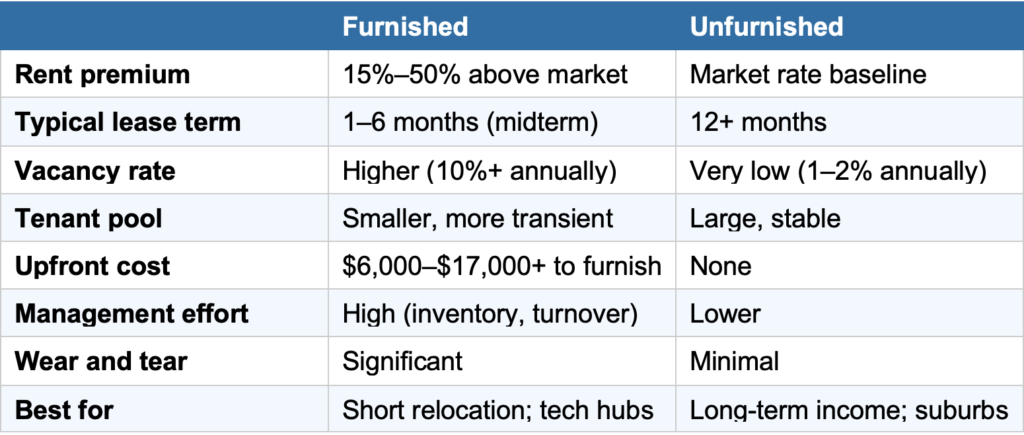
The data from national furnished rental platforms supports a more nuanced view. Furnished listings receive roughly half as many applicant inquiries as unfurnished units, take longer to lease (average 34 days versus 27 days for unfurnished), and have a higher rate of being pulled from the market because owners pivot to selling or switch to short-term platforms. Only 12 percent of furnished long-term listings lease within 30 days, compared to 32 percent of unfurnished units.
When vacancy, turnover, cleaning, inventory management, and furniture replacement costs are factored in, many landlords who assumed furnished would earn more end up making less in the first year. By year two and three, a furnished property near a tech hub can begin to outperform, assuming strong demand and low vacancy. That is a meaningful assumption in the current Seattle market.
Never Rent a Partially Furnished Property
This point from SJA’s original guidance remains just as true in 2026. Partially furnished properties are consistently the hardest to rent and the slowest to lease. A tenant who needs everything provided does not want to figure out what the owner left and what they need to supply themselves. A tenant who plans to bring their own belongings does not want to work around a landlord’s leftover furniture.
Go fully in one direction. If you rent furnished, supply everything a tenant needs to move in with a suitcase: beds, sofas, dining table, kitchen equipment, linens, and basic cookware. If you rent unfurnished, clear the property completely. Leaving behind a few pieces of furniture, a partial set of dishes, or an old television creates ambiguity that hurts your listing and slows your lease-up.
The Short-Term Rental Option: Seattle's Rules in 2026
Some owners who consider furnished rentals are also thinking about short-term rentals through Airbnb or VRBO. These are two distinct strategies in Seattle, and the regulatory framework matters significantly.
Seattle defines a short-term rental as any property rented for fewer than 30 consecutive nights. Under Seattle’s short-term rental ordinance, operating any STR requires two separate licenses: a Seattle Business License Tax Certificate and a Short-Term Rental Operator License ($75 per unit, renewed annually). Every listing must display a valid license number or risk removal from the platform. Additionally, at least one of your STR units must be your primary residence, and you are limited to operating a maximum of two units total under your personal license.
The primary-residence requirement is the critical constraint for most property owners who have relocated or are considering renting while they are away. If you no longer occupy the property as your primary residence, you cannot legally operate it as a short-term rental under your own license. This is a meaningful distinction from midterm furnished rentals, which carry no such restriction.
Midterm furnished rentals (30+ days) are a separate category entirely
The Washington State Rent Cap and Furnished Rentals
Washington State’s 9.683 percent rent cap for 2026 applies to rent increases during existing tenancies. This matters more for furnished rental owners than they may realize. Because furnished tenants tend to sign shorter leases, owners often reset rent between tenancies, and starting rents on new leases remain uncapped. This is one genuine structural advantage of furnished rentals under the current rent cap framework: you are not constrained in setting rent at the start of each new tenancy, which happens more frequently than with long-term unfurnished tenants.
However, this advantage is partly offset by the higher vacancy and turnover cost that comes with shorter lease terms. The math works in your favor if vacancy is minimal. It works against you when a furnished property sits empty for several weeks between tenants.
For unfurnished landlords, the rent cap creates a different challenge: if you set rent below market when a long-term tenant moves in, your ability to close that gap through annual increases is now capped at 9.683 percent. This makes accurate initial pricing even more important for long-term landlord income. Use SJA’s free rental estimate tool to price accurately at the start of every tenancy, furnished or unfurnished.
The Tax Implications of Renting Furnished in 2026
100% Bonus Depreciation on Furniture
Under the OBBBA, 100 percent first-year bonus depreciation is permanently restored for qualified property acquired and placed in service after January 19, 2025. For furnished rental owners, this means that furniture, appliances, window treatments, carpeting, and removable flooring can all be deducted in full in the year they are placed in service rather than depreciated over five to seven years. On a $12,000 furnishing package, this could create an immediate $12,000 deduction. Consult a qualified tax professional to confirm eligibility for your specific property and use case, as classification depends on how the rental is structured and how the IRS categorizes the activity. See IRS Publication 946 and IRS Publication 527 for current rules.
Furniture Depreciation as an Ongoing Deduction
Higher Gross Income Means Higher Tax Liability
The rent premium from a furnished property increases your gross rental income, which increases your taxable income before deductions. After applying depreciation, maintenance, management fees, and insurance deductions, the effective tax impact is usually modest, but it should be factored into your net income projections. Rental income and expenses for long-term furnished rentals are reported on Schedule E (Form 1040).
Short-Term Rental Tax Classification
If average guest stays fall below seven days, the IRS may reclassify the activity as a business rather than a passive rental, which changes how income and losses are reported. Midterm furnished leases of 30 days or more avoid this classification issue entirely and remain on Schedule E.
What a Fully Furnished Seattle Rental Should Include
If you decide to rent furnished, the property must be genuinely move-in ready. Partial furnishings, as noted above, consistently hurt leasing outcomes.
A complete furnished rental in the Seattle market should include:
- Bedrooms: Bed frames and mattresses, dressers or wardrobes, nightstands, bedside lamps, and quality linens for each bedroom
- Living area: Sofa, coffee table, side tables, floor or table lamps, and a mounted television with basic streaming capability
- Dining: Dining table and chairs proportionate to the property size
- Kitchen: Full set of cookware, dinnerware, flatware, glasses, and basic small appliances (toaster, coffee maker)
- Bathroom: Towels, bath mat, and shower curtain if applicable
- Workspace: In 2026, a dedicated desk and chair is now effectively expected by corporate and remote-worker tenants
- Wi-Fi: High-speed internet service, either included in rent or documented as tenant-arranged; tech tenants will ask about speeds before applying
SJA's 2026 Recommendation: Unfurnished Wins for Long-Term Investors
The core SJA recommendation has not changed, and the 2026 data supports it: for property owners focused on stable, long-term rental income, unfurnished is the stronger strategy. The reasons are straightforward.
The average tenancy for an unfurnished long-term rental is two and a half or more years. Over a 30-month tenancy, a landlord with zero vacancy collects every dollar of rent, experiences minimal wear and tear beyond normal use, and faces only one lease renewal cycle. During that same period, a furnished midterm rental property cycling through six-month tenants might experience three to four turnovers, each with vacancy days, cleaning costs, re-staging, and furniture replacement needs.
Unfurnished rentals also attract a larger applicant pool, resulting in faster lease-up, more competitive screening, and a better chance of finding a financially qualified long-term resident. With Seattle’s First-in-Time tenant screening rules requiring landlords to offer tenancy to the first qualified applicant, having a larger pool of qualified applicants at the time of listing gives you the best outcome under that compliance framework.
When furnished makes sense:
When unfurnished is the right call:
You are renting your property as a long-term investment. The property is a single-family home or larger unit in a suburban Eastside market. You want predictable cash flow, low management overhead, and stable tenant relationships. You plan to hold the property for five or more years.
Talk to SJA Before You Decide
The furnished versus unfurnished decision is one of the first and most important choices a new landlord makes, and it is one SJA helps clients navigate every day across Seattle, Bellevue, Redmond, Kirkland, Sammamish, and the broader Puget Sound. The answer depends on your specific property, your timeline, and your financial goals.
Use SJA’s free rental estimate tool to see what your property would earn furnished and unfurnished, based on current market data. Or contact us directly to speak with a property management expert who knows your neighborhood. SJA’s full-service property management covers everything from leasing and screening to rent collection and maintenance, backed by 8 client guarantees and 500+ five-star reviews.