

Rental property tax deductions for Seattle landlords have become significantly more powerful in 2026 thanks to two major developments: the permanent restoration of 100% bonus depreciation under the One Big Beautiful Bill signed in July 2025, and the continued availability of the 20% Qualified Business Income (QBI) deduction for eligible landlords. At the same time, increased IRS scrutiny on documentation means that knowing what you can deduct is only half the battle. Having the records to prove it is the other half.
Whether you own a single-family rental in Redmond, a condo in Bellevue, or a small multifamily property in Kirkland, the principle is the same: the IRS taxes your net rental income, not your gross rent collected. Every dollar you legitimately deduct is a dollar removed from your taxable income. For landlords in the 22% or 24% federal bracket, that translates directly to real savings. Here is every deduction that matters for Puget Sound rental owners this tax season.
Important note: This article is for educational purposes and does not constitute tax or legal advice. Always consult a licensed CPA or tax professional before making decisions that affect your tax return.
Key 2026 Tax Dates for Landlords
Before diving into deductions, mark these dates. The IRS began accepting 2025 tax returns on January 26, 2026. The primary filing deadline is April 15, 2026, with an extension available to October 15, 2026. If you have contractors or vendors to whom you paid $600 or more in 2025, note that the IRS Form 1099-NEC threshold has increased to $2,000 in 2026 for nonemployee compensation. W-2s and 1099s for employees should have been issued by January 31, 2026.
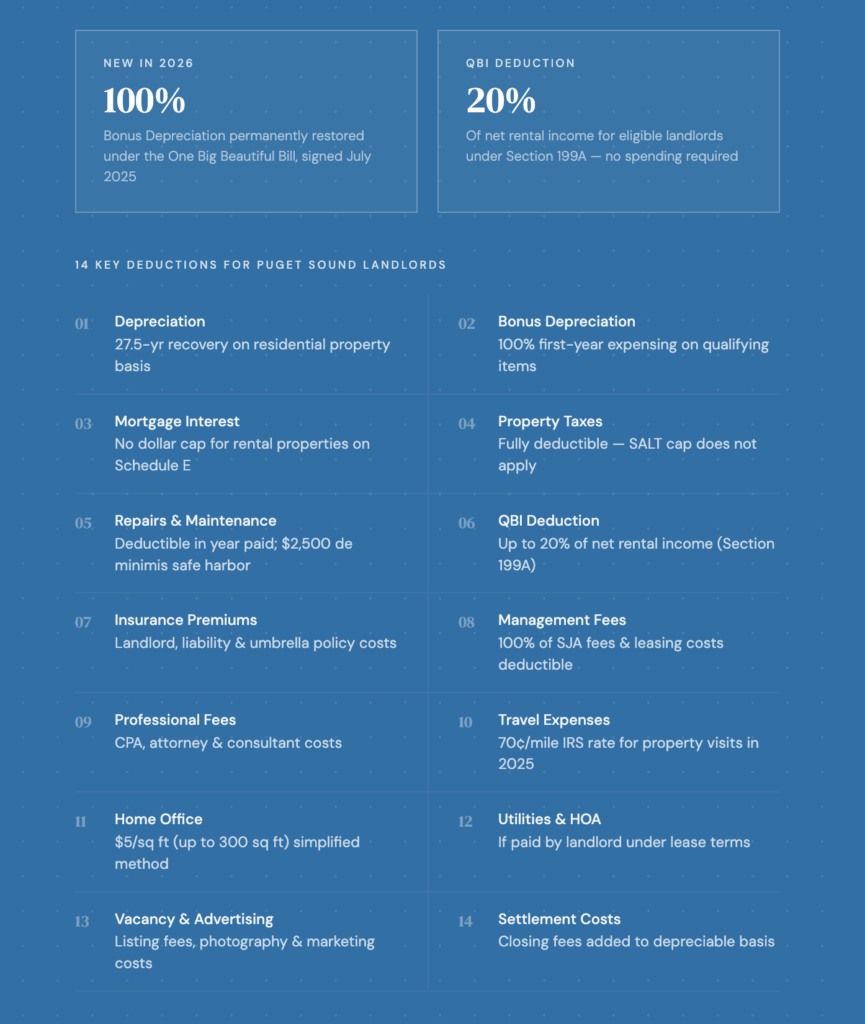
1. Depreciation: The Most Powerful Deduction Available
Depreciation is the single largest deduction most Seattle-area landlords have access to, and it is the one most frequently underused or miscalculated. The IRS allows you to recover the cost of a residential rental property (excluding land value) over 27.5 years using the Modified Accelerated Cost Recovery System (MACRS). Per IRS Publication 527, you calculate your annual depreciation by dividing your property’s depreciable basis by 27.5.
Example: If you purchased a Kirkland rental for $750,000 and the land is assessed at $150,000, your depreciable basis is $600,000. Divided by 27.5 years, that is $21,818 in annual depreciation you can deduct regardless of whether you actually spent a dollar on the property that year.
Critical warning: Even if you choose not to claim depreciation, the IRS will treat it as if you did when you sell the property. You will owe depreciation recapture tax on the unclaimed amount anyway. Always claim your depreciation. If you have missed it in prior years, a tax professional can file a Form 3115 to catch up correctly.
Bonus Depreciation: Permanently Restored at 100% in 2025
This is the biggest tax news for real estate investors in years. The One Big Beautiful Bill, signed into law in July 2025, permanently restored 100% bonus depreciation for qualified property acquired and placed in service after January 19, 2025. Per IRS Publication 527 and confirmed by TurboTax’s updated guidance, landlords can now immediately expense the full cost of qualifying personal property, such as appliances, carpeting, and furniture, in the year of purchase rather than depreciating it over 5 years.
What qualifies: Personal property with a recovery period of 20 years or less. For rental properties, this typically includes appliances, HVAC equipment, carpeting, landscaping improvements, and certain land improvements. Residential rental buildings themselves (27.5-year property) still must be depreciated on the standard schedule.
Component Depreciation (Cost Segregation)
2. Mortgage Interest and Loan Costs
Rental property owners can deduct mortgage interest as a business expense with no SALT-style dollar cap that applies to primary residences. Unlike homeowners who face the $750,000 debt limit under the Tax Cuts and Jobs Act, rental property mortgage interest is deducted on Schedule E as a business expense and is fully deductible regardless of loan size.
Your lender will send Form 1098 each January showing the mortgage interest paid in the prior year. Keep this document. Also deductible are mortgage insurance premiums (PMI), loan origination points (typically amortized over the loan term), and if you refinanced, the remaining unamortized points from the original loan may be deductible in the year of refinance.
HELOC interest: If you took out a home equity line of credit to fund improvements on your rental property, the interest on those funds is deductible as a rental business expense. Document clearly that the funds were used for the rental property.
3. Property Taxes: Fully Deductible with No SALT Cap
One of the most important distinctions between homeowner and rental property taxation: the $10,000 SALT deduction cap that limits homeowners does not apply to rental property. Property taxes paid on your rental are deducted as a business expense on Schedule E and are fully deductible without limit. King County property tax rates have continued to rise, making this deduction increasingly significant for Eastside landlords. Check your current King County assessment at the King County Assessor’s website.
4. Repairs and Maintenance: Deductible in the Year Paid
Repairs that restore your property to working condition are fully deductible in the year you pay for them.
The IRS uses the BAR acronym to help distinguish repairs from improvements:
- Betterment: Does the work fix a defect that existed before purchase or add significant new value? If yes, it may be an improvement.
- Adaptation: Is the property being adapted for a new or different use? If yes, it is likely an improvement.
- Restoration: Is it being returned to like-new condition after deterioration? If yes, it may be an improvement to be depreciated.
Repairs that do not meet any of these criteria are generally deductible immediately. Common examples: fixing a broken water heater, patching a section of a leaking roof, repainting, replacing a broken window, repairing a fence. An entire roof replacement or full kitchen remodel would typically be a capital improvement depreciated over time.
The IRS also provides a de minimis safe harbor allowing landlords to immediately deduct individual items costing $2,500 or less per invoice, even if they might otherwise qualify as improvements. This is an election you make on your tax return each year.
5. The 20% Qualified Business Income (QBI) Deduction
One of the most valuable and least understood deductions available to Seattle landlords is the 20% QBI deduction under Section 199A of the tax code. If your rental activity qualifies as a business under the IRS safe harbor (Revenue Procedure 2019-38), you may be able to deduct up to 20% of your net rental income before calculating your tax. This deduction does not require you to spend any money. It applies simply to your qualifying rental income.
To use the rental real estate safe harbor, you must maintain separate books and records for each property, perform at least 250 hours of rental services per year (or meet one of the alternative tests), and attach a signed statement to your return. See IRS Revenue Procedure 2019-38 for the full requirements. Income thresholds apply: for 2025 returns, phase-outs begin at $197,300 for single filers and $394,600 for married filing jointly.
6. Landlord Insurance Premiums
Standard homeowners insurance does not cover rental activity. You need landlord insurance (also called dwelling fire or non-owner occupied insurance), and the premiums you pay are fully deductible as a rental business expense per IRS Publication 527. Deductible insurance types include landlord liability coverage, loss of rent insurance, umbrella policies covering the rental, and flood or earthquake riders specific to the rental property.
For Puget Sound landlords: given the region’s increased frequency of weather-related damage, loss-of-rent coverage has become particularly important. If you ever have to displace a tenant during repairs, that loss of rental income may be partially offset by insurance, but only if you have the right policy.
7. Property Management Fees
Every dollar you pay to a professional property management company is fully deductible as an operating expense. This includes monthly management fees, leasing fees for finding new tenants, lease renewal fees, and any other charges from your management company. It also extends to the cost of tenant screening services, background check fees, and professional photography for your listings.
For SJA-managed properties, all fees paid to SJA Property Management across Seattle, Bellevue, Redmond, Kirkland, and the broader Puget Sound service area are 100% tax deductible. Your year-end owner statement from SJA provides a clean summary of all fees paid, making it straightforward for your CPA to record this deduction.
8. Professional Fees: Accounting, Legal, and Consulting
Fees paid to CPAs, tax preparers, attorneys, and consultants for services directly related to your rental business are fully deductible. This includes your accountant’s bill for preparing Schedule E, attorney fees for reviewing or drafting leases, and any legal costs related to landlord-tenant matters. Under IRS Topic 414, these qualify as operating expenses of the rental activity.
Practical note: The cost of this very article’s subject matter, hiring professionals to help you optimize your rental operation, is itself deductible. That includes CPAs, property attorneys, and property managers.
9. Travel Expenses for Property Management
If you travel to your rental property to conduct inspections, oversee repairs, meet contractors, or handle tenant matters, those travel costs are deductible. For 2025 returns, the IRS standard mileage rate is 70 cents per mile, per IRS Publication 527. Alternatively, you can deduct actual vehicle expenses including gas, insurance, registration, and depreciation, but you must choose your method in the first year the vehicle is used for the rental activity.
Keep a mileage log. This is one of the deductions the IRS scrutinizes most closely, and without a contemporaneous log of dates, destinations, and purposes, the deduction may not survive an audit.
10. Home Office Deduction
11. Utilities and Operating Expenses
If you pay for any utilities as part of your lease arrangement, those costs are fully deductible. This most commonly applies to multifamily properties where units are not separately metered, or to situations where you cover internet, trash, or water as part of the rent. If the tenant pays all utilities directly, you cannot deduct them. Other deductible operating expenses include landscaping, snow removal, pest control, security system monitoring, and HOA or condo association dues paid for your rental unit.
12. Vacancy Costs and Advertising
Costs incurred to find and place tenants are deductible operating expenses. This includes listing fees on Zillow, HotPads, or Apartments.com, professional photography, signage, and the cost of any rental market analysis you commission. Importantly, expenses incurred during a vacancy period while actively trying to re-rent the property are still deductible, even though no rent is coming in. Per IRS Publication 527, a property held out for rent but temporarily vacant is still treated as a rental property for deduction purposes.
Note on uncollected rent: If you use cash-basis accounting (most individual landlords do), you cannot deduct rent that a tenant owes but has not paid. You were never taxed on income you did not receive, so there is nothing to deduct. The deduction opportunity comes from the costs of pursuing or enforcing the lease, which are deductible as operating expenses.
13. Settlement Costs and Loan Fees
14. The 2026 1099-NEC Threshold Change: What Landlords Must Know
Starting with 2026 payments (reported in early 2027), the IRS Form 1099-NEC threshold for nonemployee compensation has increased to $2,000. However, for your 2025 tax return being filed now, the old $600 threshold still applies. If you paid any contractor, handyman, landscaper, or other self-employed service provider $600 or more in 2025 and did not issue a 1099-NEC by January 31, 2026, you should address this with your CPA immediately. Failure to issue required 1099s can jeopardize the deductibility of those expenses. Collect a signed Form W-9 from every contractor before paying them.
Documentation: What the IRS Expects in 2026
IRS scrutiny on rental property deductions has increased meaningfully. The difference between a clean audit and a costly one comes down to documentation.
Here is what you need to retain for every deduction category:
- Mortgage statements and Form 1098 from your lender for interest deductions
- Property tax payment receipts and county assessment records
- All repair and maintenance invoices with dates, vendor names, and descriptions of work performed
- Insurance policy declarations pages and premium payment receipts
- Property management fee statements and year-end owner reports
- Mileage log with date, destination, purpose, and odometer readings for every trip
- Signed W-9 forms and issued 1099-NEC forms for all qualifying contractors
- Depreciation schedules and prior-year Form 4562
- Closing disclosure from property purchase (retain permanently)
- QBI safe harbor statement if claiming the Section 199A deduction
How SJA Property Management Supports Your Tax Strategy
SJA Property Management provides every owner-client with detailed monthly financial statements and a comprehensive year-end owner report summarizing all income and expenses for the calendar year. These reports are formatted to align directly with Schedule E categories, making your CPA’s job straightforward and reducing the risk of missed deductions.
Our owner portal gives you real-time access to maintenance invoices, vendor payments, lease documents, and financial records at any time of year, not just at tax time. Treating your rental as the business it is, with professional management and clean records, is the foundation of a defensible tax return and a growing portfolio.
If you own a rental property in Seattle, Bellevue, Redmond, or anywhere across the Puget Sound and want to understand how professional management can simplify your tax reporting while protecting your investment year-round, contact SJA for a free consultation.