

In Seattle’s rental market, finding a tenant is rarely the hard part. The hard part is finding the right tenant, placing them correctly under one of the most regulated screening frameworks in the country, and protecting your investment over a lease term that could run two years or longer. In 2026, that challenge is more layered than it has ever been.
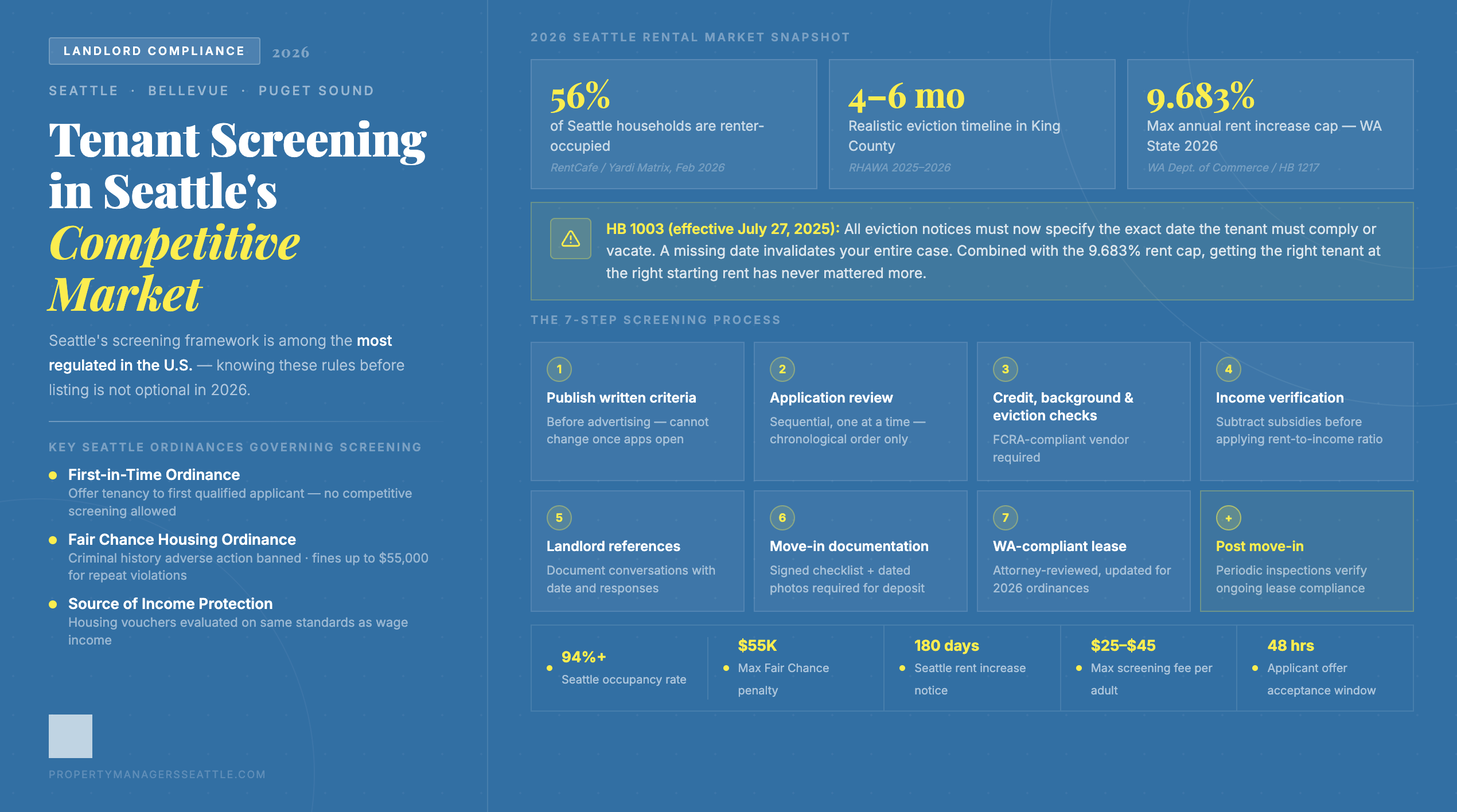
Seattle has 56 percent renter-occupied households as of the most recent data, reflecting a tenant-majority city with sustained demand, a normalized supply environment, and a legal landscape that has grown significantly more complex since the original version of this article was published. The screening ordinances that Seattle has layered on top of Washington State law now govern every stage of the application process, from how you advertise a vacancy to which applicant you must offer the unit to. Getting any step wrong exposes landlords to fines, forced approvals, and fair housing complaints.
This guide has been fully updated for 2026 to reflect current Seattle ordinances, Washington State law changes, market data, and best practices for landlords across Redmond, Bellevue, Kirkland, Sammamish, and the broader Puget Sound.
Why Tenant Screening Matters More Than Ever in 2026
Court backlogs, Washington’s tenant right-to-counsel law under RCW 59.18.640, and rental assistance programs that can delay or dismiss proceedings have dramatically extended realistic eviction timelines beyond the textbook three-to-four-week estimate. A landlord dealing with non-payment in King County should budget for several months of lost rent, court filing fees, attorney costs, and the time cost of managing the process. Per HB 1003, effective July 27, 2025, all eviction notices must now specify the exact date by which a tenant must comply or vacate, adding another procedural requirement that, if missed, can invalidate the entire case.
Washington's 9.683 percent rent cap for 2026 makes initial pricing permanent
Under HB 1217, annual rent increases during an existing tenancy are capped at the lesser of seven percent plus inflation or ten percent. The 2026 limit is 9.683 percent. This cap is an ongoing requirement that resets each year, not a one-time ceiling, and increases are not permitted at all during the first twelve months of a tenancy. A tenant placed at below-market rent cannot be corrected through aggressive annual increases. The tenant you place today sets your rent trajectory for the life of that tenancy. This makes the financial qualification step of screening more consequential than it has ever been.
The market is more balanced, not softer
Seattle’s rental occupancy remains in the low 90s, with vacancy around 7 percent, and demand has held steady as the market normalizes after several years of heavy construction. New supply has pulled back sharply at the same time: deliveries of new units have fallen by more than half from their recent peak, and the development pipeline continues to shrink. What has changed is that tenants have slightly more choices in some segments, making presentation, process, and speed the differentiators between landlords who fill vacancies with qualified applicants and those who wait.
Protecting Against Liability and Property Damage
Building a Stable, Long-Term Tenancy
Reducing Turnover Cost
Seattle's Tenant Screening Framework in 2026
First-in-Time Ordinance
Seattle’s First-in-Time ordinance requires landlords to publish their written screening criteria before accepting any applications. Applications must then be reviewed one at a time in the order they were received. The first applicant who meets all stated criteria must be offered the tenancy. Seattle does not permit competitive screening. You cannot review two applications simultaneously and choose the stronger one. You cannot skip, reorder, or delay a qualified first applicant. Doing so is one of the most common Seattle compliance violations and can result in a forced approval or a complaint filed with the Seattle Office for Civil Rights. If the first applicant declines the offer within 48 hours, you may proceed to the next applicant in chronological order.
Fair Chance Housing Ordinance
Seattle’s Fair Chance Housing Ordinance restricts how criminal history can be used in screening. Following a March 2023 Ninth Circuit ruling, the Seattle Office for Civil Rights no longer enforces the ban on inquiring about criminal history, but continues to enforce the ban on taking adverse action based on criminal conviction records, with the exception of registered sex offenders under specific conditions. Arrests without conviction cannot be used as a basis for denial. First-violation penalties range up to $11,000, with repeat violations reaching $55,000. Exemptions apply to owner-occupied single-family dwellings and to accessory dwelling units where the owner maintains a residence on the same lot.
Source of Income Protections
Seattle prohibits landlords from discriminating against applicants based on lawful source of income. Housing vouchers, Section 8, and other government assistance programs must be evaluated using the same income standards applied to all other applicants. If you use an income-to-rent ratio, you must subtract the housing subsidy amount from the rent before calculating eligibility. You cannot apply a higher ratio or different criteria to voucher holders.
Application Fee Limits
Adverse Action Notice Requirement
If you deny an application, you must provide the applicant with a written adverse action notice explaining the specific reason for the denial. Vague or generic reasons are not sufficient. If a consumer report was used, the notice must include the name and contact information of the reporting agency, a statement that the agency did not make the denial decision and cannot explain the specific reasons for it, the applicant’s right to obtain a free copy of the report from that agency within 60 days, and the applicant’s right to dispute the accuracy or completeness of the information in the report. This documentation also protects landlords if a denial decision is later challenged.
Eastside and Suburban Markets
The Seven Steps of Effective Tenant Screening in 2026
1. Establish and Publish Written Screening Criteria Before Advertising
Your screening criteria must be written, specific, and made available to applicants before you collect any application or fee. This includes your minimum income-to-rent ratio (most Seattle landlords use 2.5x to 3x monthly rent), credit score threshold, rental history requirements, employment verification standards, and pet policy if applicable. Once published, these criteria cannot change mid-process. Tighten your criteria upfront rather than loosening them later, because flexibility in criteria increases legal exposure under First-in-Time.
2. Conduct a Rigorous Application Review
3. Run Credit, Background, and Eviction Checks
A comprehensive screening report covers three distinct areas:
- Credit history: Provides a picture of financial reliability. Look at payment patterns, total debt load, and any collections, charge-offs, or judgments. A low credit score alone is not grounds for automatic denial, but persistent late payment history across multiple accounts is a substantive red flag.
- Eviction history: Past eviction filings are searchable in most jurisdictions. Even dismissed evictions may indicate prior landlord conflict. In Seattle, the use of eviction records in screening is restricted, so confirm current rules before making any denial decision based on eviction history.
- Criminal background: Subject to Seattle’s Fair Chance Housing restrictions as described above. For properties outside Seattle, Washington State law applies. Never use arrest records without conviction as a basis for denial in any jurisdiction.
4. Verify Income and Employment Independently
5. Contact Prior Landlords with Specific Questions
Reference checks from prior landlords are among the most predictive inputs in the screening process. Generic questions produce generic answers. Ask specifically:
- Did the tenant pay rent on time consistently throughout the tenancy?
- Were there any lease violations, complaints from neighbors, or damage beyond normal wear?
- Did the tenant provide proper notice before vacating?
- Would you rent to this applicant again?
A landlord who pauses before answering the last question, or who gives an evasive answer, is telling you something. Two steps make these checks more reliable. Confirm that the person you reach is actually the landlord or management company for the address given, rather than a friend or relative posing as a reference, by verifying the contact independently where you can. And when an applicant is currently renting, contact a previous landlord in addition to the current one, since a current landlord may give a favorable reference to move along a tenant they would rather replace. Document all reference conversations with the date, name of the person contacted, and their responses.
6. Complete a Move-In Documentation Package
Before a tenant takes possession, document the property condition thoroughly. A signed move-in checklist with dated photographs of every room, appliance, fixture, and surface is your legal protection when the tenancy ends. Under Washington State law, you cannot collect a security deposit without providing a written checklist, and deposits must be held in a dedicated trust or escrow account. Seattle additionally caps the total of deposits and non-refundable fees at one month’s rent, with an installment payment option available to tenants under Seattle Municipal Code 7.24.035.
7. Finalize a Washington-Compliant Lease
A lease that fails to include Seattle-required provisions, or that uses outdated language on rent increases, entry notice, or security deposit handling, exposes the landlord to legal risk at every subsequent stage of the tenancy. Generic online lease templates rarely account for Seattle’s 180-day rent increase notice requirement, the Just Cause Eviction Ordinance, or the specific disclosure language required at move-in. SJA Property Management uses an attorney-reviewed, Washington and Seattle-specific lease that is updated as ordinances change.
Best Practices for Compliant Screening in 2026
- Document every decision. Keep a written record of why each application was approved or denied, the specific criteria applied, and the date of each step. This documentation is your defense if a denial is later challenged.
- Apply criteria consistently. Every applicant must be evaluated against the same published criteria. Inconsistent application is the definition of discriminatory screening under fair housing law, even if no discriminatory intent existed.
- Never advertise exclusionary language. Phrases like “no prior evictions” or “no criminal history” in listing copy can violate Seattle’s Fair Chance Housing Ordinance and federal fair housing guidelines. Describe what applicants need to qualify, not what disqualifies them.
- Comply with the federal Fair Housing Act. Screening criteria cannot discriminate on the basis of race, color, national origin, religion, sex, marital status, familial status, or disability. Washington State adds source of income, sexual orientation, gender identity, and veteran status as protected classes.
- Use FCRA-compliant screening vendors. Any third-party service providing credit, background, or eviction reports must comply with the Fair Credit Reporting Act. Using non-compliant services exposes you to federal liability separate from Seattle’s local ordinances.
- Screen pets consistently. Use a dedicated pet-screening tool to verify each animal’s vaccination records, history, and any breed or weight details against your written pet policy, and apply the same process to every applicant. Service and assistance animals are not pets. They are handled as reasonable accommodation requests under fair housing law, not through pet screening, and cannot be charged a pet deposit or pet fee.
- Respond to applications promptly. Under First-in-Time, delayed response to a qualified applicant can constitute a violation. A fast, clean process protects you legally and signals to high-quality tech and professional tenants that this will be a well-managed tenancy.
- Stay current with Seattle ordinance updates. Seattle’s rental regulations have changed materially in each of the past several years. Subscribe to updates from the Seattle Office of Housing or work with a property manager who monitors these changes on your behalf.
- Do not skip post-move-in engagement. Tenant screening does not end at move-in. Regular property inspections, documented in writing, verify lease compliance and property condition. Prompt response to maintenance requests is both a legal obligation and the single most effective tenant retention strategy available.
Why Professional Property Management Is the Compliance Safeguard
The screening regulations described in this article represent the minimum landlord must know. The practical challenge is that these rules change, interact with each other in non-obvious ways, and differ by jurisdiction. A property in Seattle has different screening obligations than an identical property two miles away in Shoreline or Kirkland. Landlords managing their own properties in 2026 are navigating a compliance environment that has more moving parts than at any prior point in the city’s rental history.
Professional property management companies provide structural compliance at every stage. At SJA, our leasing process is built on published criteria, documented timelines, FCRA-compliant screening vendors, attorney-reviewed leases, and move-in documentation that holds up in any legal challenge. We manage properties across Redmond, Bellevue, Kirkland, Seattle, Sammamish, Bothell, and surrounding Puget Sound markets. Our screening outcomes produce long-term, qualified tenants who generate the stable income stream our owners rely on.
SJA is founded and operated by attorneys. That background is not incidental. It means our leasing process, our lease agreements, and our screening practices are built from legal first principles, not assembled from templates. In a regulatory environment as complex as Seattle’s in 2026, that distinction matters.
If you own a rental property in the Puget Sound area and want to ensure your screening process is legally sound and producing the best possible tenant outcomes, contact SJA Property Management for a free consultation. You can also review our full-service property management, pricing and services, and 8 client guarantees to understand what a professionally managed Puget Sound rental looks like in 2026.