Water damage is one of the most common and costly maintenance situations in Seattle rental properties. Whether it is a burst pipe in a Bellevue condo, a leaking roof in a Redmond single-family home, or an appliance overflow in a Kirkland apartment, the question everyone reaches for is the same: who pays for this?
The answer under Washington State law is not always intuitive, and getting it wrong is expensive in both directions. Landlords who do not respond within the legally required repair window expose themselves to tenant remedies including rent deductions, rent escrow, and lease termination. Tenants who fail to report damage promptly in writing can be held partially responsible for costs they believe are the landlord’s problem.
This guide is updated for 2026. It covers the exact legal obligations of both parties, the Washington State repair timelines landlords are legally required to meet, mold disclosure requirements, the tenant remedies available when landlords do not act, and how SJA Property Management handles all of it on behalf of our owner-clients across Seattle and the Eastside.
Key takeaways for 2026:
- Landlords have the primary obligation: Washington’s implied warranty of habitability under RCW 59.18.060 requires landlords to keep the property safe and habitable at all times, including maintaining plumbing, roofs, and structural components.
- Repair timelines are legally defined: Flooding or loss of water requires the landlord to begin repairs within 24 hours. Major plumbing failures within 72 hours. All other repairs within 10 days. Missing these deadlines creates legal exposure.
- Written notice starts the clock: A landlord’s repair obligation only begins after receiving written notice from the tenant. Tenants who report verbally but not in writing lose most of their legal protection.
- Mold disclosure is a legal requirement: Landlords must provide Washington Department of Health mold information to every tenant at move-in under RCW 59.18.060(13). This is not optional.
- Tenant negligence shifts responsibility: If damage was caused by the tenant’s actions or failure to report a known problem, the tenant may bear the repair cost, regardless of who technically owns the fixture that failed.
Landlord Responsibility for Water Damage Under Washington State Law
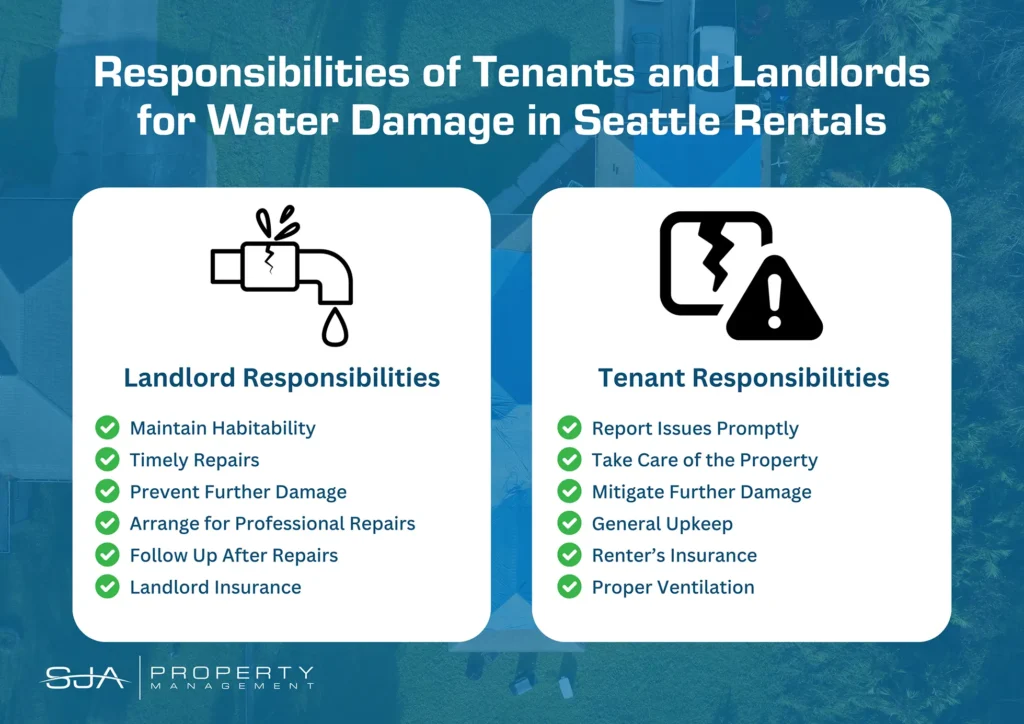
Washington State places the primary burden of property maintenance and water damage response squarely on the landlord. Under RCW 59.18.060 — Washington’s implied warranty of habitability, landlords are required to keep the premises fit for human habitation at all times during the tenancy. That obligation does not pause for inconvenience or cost.
For a full overview of how Washington’s landlord-tenant compliance framework affects property owners in 2026, see our Washington rental law compliance guide for Seattle landlords.
1. Structural Maintenance and Water Intrusion
Landlords are legally required to maintain the roof, walls, floors, foundations, and all other structural components in reasonably good repair. The unit must be weather-tight. Water intrusion through the structure, whether from a failing roof, cracked foundation, or deteriorating wall, is always the landlord’s responsibility when it results from deferred maintenance.
Specific water-related habitability obligations include:
- Maintaining the roof and all exterior elements to prevent water intrusion
- Keeping all plumbing systems in working order and repairing leaks promptly after notice
- Ensuring the unit maintains hot and cold water supply at all times
- Providing adequate ventilation to prevent moisture and condensation buildup
- Addressing mold or mildew that develops as a result of a structural or plumbing failure the landlord was responsible for fixing
2. Legally Required Repair Timelines
This is where most landlords get exposed. Washington State law does not just say repairs must happen “in a reasonable time.” RCW 59.18.070 sets specific deadlines based on severity. Missing these deadlines gives the tenant immediate legal remedies.
| Timeline | Issue Type | Water Damage Examples |
|---|---|---|
| 24 hours | Emergency — health or life hazard | Burst pipe, active flooding, loss of hot or cold water, sewage backup, condition imminently hazardous to life |
| 72 hours | Major plumbing or appliance failure | Major plumbing fixture failure, refrigerator or range supplied by landlord stops working |
| 10 days | All other non-emergency repairs | Minor drips, slow leaks, damaged drywall, non-essential appliance failures |
Not sure if your current lease and maintenance process meet these standards?
Most landlords who self-manage discover a compliance gap only after a problem has already happened. If you have a rental property in Seattle, Bellevue, Redmond, or anywhere on the Eastside, SJA can review your situation before it becomes a dispute.
3. Mold Disclosure: A Legal Obligation Most Landlords Miss
Under RCW 59.18.060(13), every landlord in Washington State is required to provide tenants with written information about indoor mold health hazards at move-in. This information must come from or be approved by the Washington State Department of Health mold resources.
The mold disclosure must be provided:
- In writing to each tenant individually at move-in, or posted in a visible common area of the building
- At the time the lease or rental agreement is signed
- Using materials approved by the Washington State Department of Health
Washington State law does not require landlords to remediate mold itself. What the law does require is fixing the underlying cause of mold growth, a plumbing leak, roof failure, or ventilation defect. Failing to fix the cause after written notice is a habitability violation regardless of whether the visible mold has been cleaned up.
4. Preventing Further Damage After a Water Event
If water damage results from the landlord’s failure to maintain the property, such as an unresolved slow leak or a roof that was never repaired after a prior tenant reported it, the landlord is responsible not just for the immediate repair but for all downstream consequences. That includes mold remediation, structural drywall replacement, flooring, and any temporary relocation costs if the unit becomes uninhabitable.
The longer a landlord waits after receiving notice, the broader that liability becomes. Water that sits for more than 24 to 48 hours begins creating mold conditions. Mold remediation is significantly more expensive than prompt water mitigation. Acting fast is not just legally required. It is financially protective.
Tenant Responsibility for Water Damage
Tenants have real and legally enforceable responsibilities too. These are defined in RCW 59.18.130: tenant duties during a tenancy. Understanding them helps landlords hold tenants accountable when damage is tenant-caused and helps tenants avoid being held responsible for damage that was not their fault.
1. Reporting Issues Promptly: In Writing
This is the single most important tenant obligation, and it is the one most commonly handled wrong. Tenants must report water damage or suspected moisture problems to the landlord as soon as possible, and they must do it in writing.
The Washington Attorney General’s landlord-tenant resources include sample written repair notice letters tenants can use. The written notice matters for two critical reasons: it starts the landlord’s legal repair clock, and it protects the tenant from being held financially responsible for damage that worsened because they stayed silent.
A tenant who notices a slow drip under the sink, says nothing, and three weeks later has a flooded bathroom floor is in a much weaker legal position than they think. If the tenant has no written record of reporting the issue, the landlord may argue successfully that the tenant’s failure to report caused or significantly worsened the damage.
2. Avoiding Negligent Use of Plumbing and Appliances
Under RCW 59.18.130, tenants are required to properly use the facilities and appliances provided by the landlord. Water damage caused by tenant negligence makes the tenant financially responsible for repair costs, regardless of whose name is on the mortgage.
Common tenant-caused water damage situations where cost shifts to the tenant:
- Flushing items not designed for toilets, causing pipe blockages and overflow
- Overloading washing machines or using unsuitable cycle settings that cause appliance leaks
- Leaving faucets running or bathtubs unattended
- Failing to report a known slow leak that eventually causes significant structural damage
- Allowing bathroom condensation to accumulate without ventilation, leading to mold growth
Dealing with a tenant-caused damage situation right now?
This is one of the most common scenarios SJA handles for owner-clients. We document everything from move-in, enforce lease terms professionally, and know exactly how to navigate the repair-and-deduct and security deposit process under Washington State law.
Talk to SJA’s Seattle property management team, free consultation
3. Mitigating Damage After Discovery
Once a tenant discovers water damage, they are expected to take reasonable steps to prevent it from getting worse. This does not mean attempting structural repairs. It means containment and documentation.
- Shut off the water supply to the affected area if the shutoff is accessible and safe
- Place towels, buckets, or mops to contain standing water
- Move furniture and personal belongings out of the affected area
- Open windows or run fans to begin drying, if safe to do so
- Photograph and video document the damage before and after any mitigation steps, with timestamps
4. Ongoing Upkeep That Prevents Water Damage
Beyond responding to active events, tenants have ongoing obligations that can prevent water damage from occurring:
- Cleaning drains in bathrooms and kitchens regularly to prevent buildup
- Replacing water filters in refrigerators and appliances as recommended by the manufacturer
- Running bathroom exhaust fans during and after showers to prevent condensation
- Reporting any early signs of moisture, discoloration, or musty odors promptly in writing
The Real Issue in Most Water Damage Disputes: Communication
In 17 years of managing rental properties across Seattle and the Eastside, SJA has seen the same pattern in almost every water damage conflict. The dispute was rarely about who caused the damage. It was about who knew what, when, and whether it was documented.
Landlords who respond promptly to written repair requests almost never face legal exposure. Tenants who report issues in writing immediately almost never get held responsible for damage they did not cause. The legal framework under RCW 59.18.060 through RCW 59.18.130 is built around notice and response. Put it in writing, act quickly, document everything.
For landlords, having a professional property management team in place means water damage situations are logged immediately, responded to within legal timelines, coordinated with licensed vendors, and fully documented in a management system around the clock.
For a full picture of how Seattle property management services from SJA protect your investment, including our 24/7 maintenance coordination and vendor network, see our services overview.
What to Do When Water Damage Happens: Step-by-Step for 2026
Step 1: Tenant Notifies Landlord in Writing Immediately
The moment water damage is discovered, the tenant’s first action is written notification to the landlord. The notice should include the location, apparent cause, severity, and photographic or video documentation. A text message with a timestamp, an email, or certified mail all qualify as written notice.
The Washington Attorney General’s landlord-tenant resource page includes sample repair notice letters. Tenants should keep a copy of every notice sent and every landlord response received.
Step 2: Tenant Takes Reasonable Mitigation Steps
While waiting for the landlord to respond, the tenant contains the damage using the steps above. They should document every mitigation action with timestamps. This demonstrates reasonable care under RCW 59.18.130 and protects the tenant from claims that they allowed damage to worsen while waiting.
Step 3: Landlord Responds Within the Legal Timeframe
Flooding or loss of water service requires the landlord to begin repairs within 24 hours under Washington’s landlord repair deadline statute (RCW 59.18.070). For the full timeline, refer to the table above. A landlord who misses these windows opens themselves immediately to tenant remedies including repair-and-deduct and, for severe failures, lease termination.
Communicate estimated repair timelines to the tenant in writing throughout the process. Written communication during the repair process is legally protective and reduces friction with tenants.
Step 4: Landlord Arranges Licensed Professional Repairs
All professional repairs are the landlord’s responsibility:
- Licensed plumbers for pipe failures, leaks, or sewage issues
- Licensed roofers for water intrusion through the roof or exterior
- Licensed contractors for structural drywall, flooring, or framing damage
- Certified mold remediation professionals if mold has developed due to prolonged moisture
All repair work in Seattle must comply with applicable building codes. Work requiring permits that is done without them creates insurance and liability exposure for the landlord. For a sense of how SJA coordinates licensed vendors on behalf of owner-clients, see our 24/7 maintenance coordination service.
Step 5: Follow Up and Confirm Habitable Condition
What Tenants Can Do If a Landlord Fails to Act
When a landlord receives written notice and fails to begin repairs within the required timeframe, Washington State law gives tenants specific remedies. These are defined in RCW 59.18.100: tenant repair remedies. For tenant-specific guidance, Washington Law Help’s repair resource is an authoritative nonprofit reference.
- Repair and deduct: After proper written notice and expiration of the repair window, tenants may hire a licensed contractor and deduct the cost from rent. Single repair deductions are capped at two months’ rent. Total deductions in any 12-month period cannot exceed two months’ rent.
- Rent escrow: For conditions that substantially endanger health or safety, tenants may deposit rent into a court escrow account after a local government inspection certifies the dangerous condition. This is a technical process requiring specific steps under RCW 59.18.115.
- Lease termination: For serious habitability failures that go unaddressed after proper notice and the required waiting period, tenants may terminate the lease without further obligation and receive a pro-rata refund of prepaid rent and their full security deposit.
- Legal action: Tenants may sue for costs, damages, and a court order requiring repairs.
Important: Tenants should never simply withhold rent without following the formal escrow process exactly. Doing so exposes them to eviction even when the underlying repair complaint is legitimate.
Insurance: What Is and Is Not Covered
Landlord insurance in most cases covers structural repairs for water damage caused by sudden and accidental events such as burst pipes, roof leaks, and appliance malfunctions. There are important limits:
- Landlord insurance covers: Structural repairs to the property, including plumbing, walls, flooring, and ceilings damaged by a covered water event.
- Landlord insurance does NOT cover: The tenant’s personal belongings. Tenants need their own renter’s insurance for furniture, electronics, clothing, and other personal property.
- Gradual damage may not be covered: Insurance policies typically exclude damage from slow or gradual leaks that a landlord should have caught and repaired. Prompt response to reported issues protects the landlord’s coverage, not just their legal standing.
- Renter’s insurance: SJA recommends that lease agreements encourage or require renter’s insurance. It covers tenants’ personal property, temporary relocation if the unit becomes uninhabitable, and liability for tenant-caused damage and it significantly reduces conflict after a water event.
Why This Matters More in 2026: The Seattle Market Reality
Seattle’s rental market context makes water damage response more consequential than ever. According to Kidder Mathews’ Q4 2025 market research, Seattle’s multifamily vacancy rate held at 7.4% year-over-year, with 17,089 units under construction representing a 23% decline in new supply. In a market where tenants have more options than two years ago and quality properties command premium rents, a unit that sits uninhabitable during a poorly managed water damage event is not just a legal problem it is a direct income loss.
A single unaddressed water event can result in:
- Loss of rental income during repairs if the unit becomes uninhabitable
- Mold remediation costs that routinely run $3,000 to $15,000 or more depending on extent
- Security deposit disputes if damage was not documented at move-in
- Tenant legal action under RCW 59.18.100 if repair deadlines were missed
- RRIO compliance issues in Seattle if the unit is flagged during a city inspection
The landlords SJA works with across Seattle, Bellevue, Redmond, Kirkland, and the broader Eastside avoid most of this because maintenance is systematically logged, responded to within legal timelines, and documented from first report through final sign-off.
SJA Property Management: Built to Handle This Before It Becomes a Crisis
Water damage situations reveal whether a property management process is built correctly. At SJA, 17 years of managing properties across Seattle and the Eastside has given us a system that handles these situations the way they need to be handled: fast, documented, legally compliant, and with licensed vendors who actually show up.
If you are currently self-managing your rental and you have experienced a water damage situation that felt harder than it should have been or if you want to make sure your lease, your maintenance process, and your documentation hold up before a problem occurs this is exactly what SJA is built for.
Find out what your rental property is worth and whether your management process is protecting you.
SJA offers a free, no-obligation rental estimate and consultation for Seattle and Eastside property owners. Trusted by 1,000+ homeowners. 500+ five-star reviews. 17 years in business.
Get your free rental analysis from SJA Property Management →
Disclaimer: This article is intended for informational purposes only and does not constitute legal advice. Laws referenced are current as of April 2026 and subject to change. For legal questions specific to your situation, consult a qualified Washington State attorney or your local housing authority.
Water Damage to Rental Property FAQs
How long does a landlord have to fix water damage in Washington?
In Washington State, the landlord must begin repairs within set timeframes after receiving written notice: 24 hours for emergencies such as flooding or loss of water, 72 hours for a major plumbing fixture or a landlord-supplied appliance, and 10 days for all other repairs under RCW 59.18.070. If the landlord does not act within the applicable window, tenants have remedies including repair-and-deduct, rent escrow, and lease termination. Washington does not allow tenants to simply withhold rent outside the formal escrow process.
Who pays when there is a water leak?
In Seattle, the landlord is typically responsible for repairing water leaks unless the damage is caused by the tenant’s actions. Tenants must promptly notify the landlord, so repairs can be made in a timely manner.
What repairs are landlords responsible for in Washington state?
In Seattle, landlords are responsible for repairs that ensure the rental property is safe and habitable, including fixing issues with plumbing, electrical systems, heating, and structural damage. Tenants are responsible for repairs caused by their own negligence or misuse, such as fixing broken appliances they damaged or paying for damage from leaving a leak unchecked.
What makes an apartment uninhabitable in Washington state?
An apartment is considered uninhabitable in Washington State if it has serious issues like lack of water, heat, or electricity, significant mold, or dangerous structural damage.