
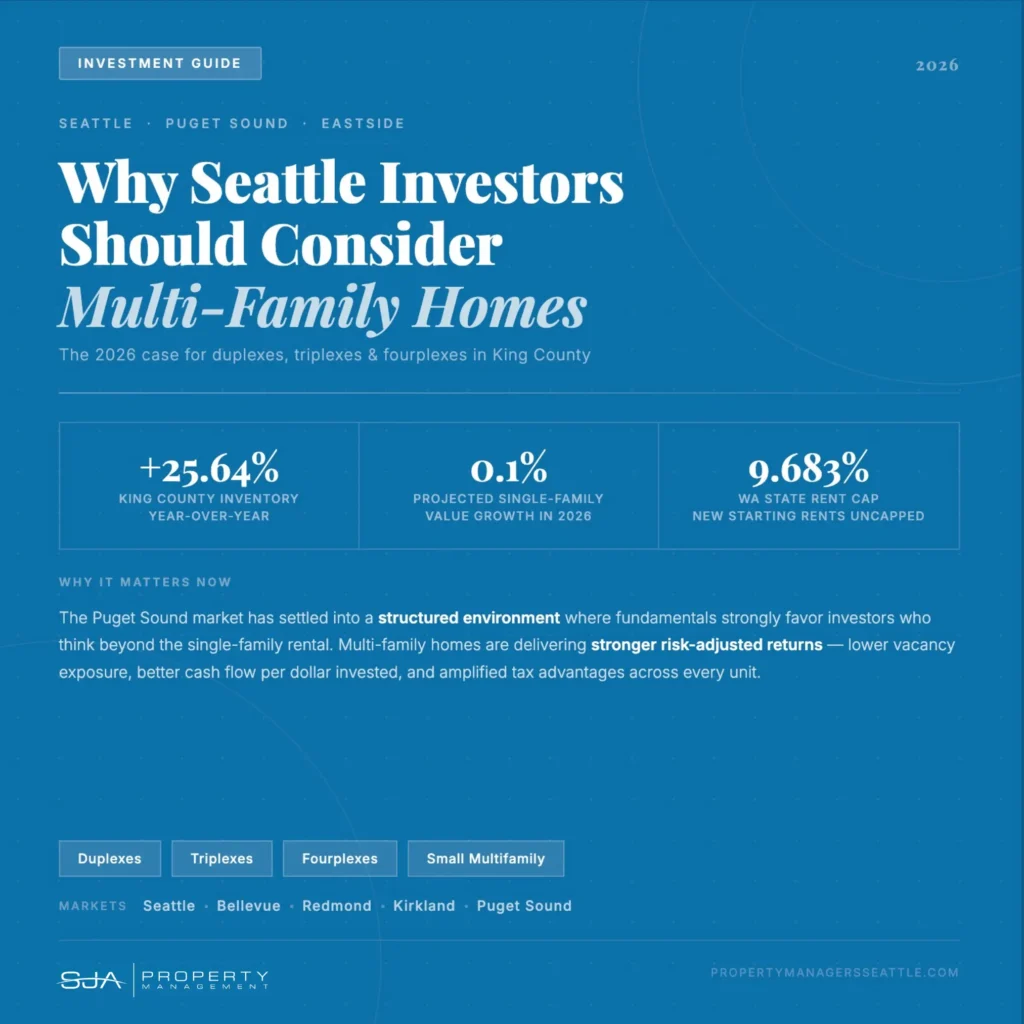
Multi-family homes are one of the most strategically compelling investment options available to Seattle-area real estate investors in 2026. After years of rapid appreciation, rising mortgage rates, and pandemic-era uncertainty, the Puget Sound market has settled into a more structured environment where the fundamentals strongly favor investors who think beyond the single-family rental. King County inventory is up 25.64% year-over-year, single-family home values are projected to grow just 0.1% through October 2026, and Washington State’s new rent cap has permanently changed how landlords must approach initial pricing on every tenancy.
In this environment, multi-family homes, specifically duplexes, triplexes, and fourplexes across Seattle, Bellevue, Redmond, Kirkland, and the broader Puget Sound, are quietly delivering stronger risk-adjusted returns than many investors realize. Here is the full 2026 case for why more Seattle-area investors should be considering multi-family homes right now.
Why Multi-Family Homes Are Outperforming in the 2026 Seattle Market
The Seattle housing market in 2026 is not the chaos of 2021 or the freeze of 2023. Inventory has increased meaningfully, with homes for sale up 36.1% and new listings up 25.5% compared to last year, but overall supply sits at just 2.3 months, well below a balanced market, according to Zillow’s Seattle market data. Demand remains strong particularly in the mid-price band where most small multi-family homes in Seattle and on the Eastside are concentrated.
For rental investors, the fundamentals are equally clear. Seattle’s tech-driven economy continues to generate sustained housing demand. Microsoft’s return-to-office mandate in Redmond, Amazon’s consolidated Bellevue footprint, and Google’s Kirkland campus are pulling high-income professionals back into commutable range of the Eastside. Multi-family homes in these corridors are capturing this demand at strong rent levels heading into the 2026 spring leasing season.
1. Multi-Family Homes Generate Superior Cash Flow Per Dollar Invested
The core financial logic of owning multi-family homes has not changed, but 2026 market conditions make it sharper than ever. A well-located duplex in Ballard or a triplex in Capitol Hill generates two or three income streams from a single acquisition, a single property tax bill, and in most cases a single insurance policy. The cost per unit is meaningfully lower than purchasing an equivalent number of separate single-family rentals, while the rental income per dollar invested is often comparable or better.
The median listing price for multi-family homes in the Seattle area as of early March 2026 is approximately .25 million, per Redfin’s Seattle multifamily market data, with properties averaging 68 days on market. That is considerably more due diligence runway than the sub-7-day frenzy of the pandemic peak.
Under Washington’s 2026 rent cap of 9.683%, the starting rent on any new tenancy is uncapped. For owners of multi-family homes, accurate initial pricing on every unit is critical. Underpricing a unit by 50 per month at signing compounds over years of capped increases into a substantial gap versus market rate. A free rental analysis from SJA gives you precise market data before you set rent on any unit.
2. Multi-Family Homes Carry Lower Vacancy Risk Than Single-Family Rentals
This is the most underappreciated structural advantage of multi-family homes for Puget Sound investors. When a single-family rental goes vacant, rental income drops to zero while mortgage, property taxes, and insurance continue uninterrupted. The carrying cost of a vacancy in King County is severe.
Multi-family homes distribute that risk across units. If one unit turns over, the others continue generating income. A triplex with two occupied units and one vacancy is still cash-flowing at roughly two-thirds capacity. This structural cushion, consistent with NMHC research on multifamily vacancy trends, allows owners to find a genuinely qualified tenant without financial pressure, which matters more than ever under Washington State’s First-in-Time application requirements.
It also allows for smarter maintenance scheduling. With units in the same building or on the same lot, you can batch repairs, negotiate better contractor rates, and coordinate seasonal upkeep across all units simultaneously, a significant efficiency advantage over managing the same number of single-family homes spread across multiple zip codes.
3. Owner-Occupied Multi-Family Homes Are Exempt from the Rent Cap
One of the most compelling and least discussed advantages of small multi-family homes in 2026 is Washington’s new rent stabilization exemption. Under HB 1217, owner-occupied duplexes, triplexes, and fourplexes are exempt from the 9.683% annual rent increase cap in certain jurisdictions. For investors willing to live in one unit while renting the others, this house-hacking model preserves full pricing flexibility on the rental units and reduces personal housing costs at the same time.
According to BiggerPockets’ real estate investing research, house hacking with small multi-family properties remains the most popular entry strategy for new investors nationally. Washington’s owner-occupant rent cap exemption makes it even more financially advantageous here than in most other states, giving Seattle-area first-time investors a meaningful structural edge.
4. Multi-Family Homes Up to Four Units Qualify for Residential Financing
Properties with one to four units qualify for residential mortgage financing, including conventional, FHA, and VA loans. This means lower down payments, lower interest rates, and access to the same mortgage products available for single-family homes, none of which apply to five-unit or larger commercial multifamily properties.
For an investor purchasing a fourplex as a primary residence, FHA financing allows a down payment as low as 3.5%, with rental income from the other three units counted toward loan qualification, per HUD’s FHA lending guidelines. With mortgage rates stabilizing in the low 6% range in early 2026, the financing environment is meaningfully better than the 7% to 8% peaks of 2023, creating an entry window for multi-family homes that has not existed since 2020.
5. The Tax Advantages of Multi-Family Homes Apply Across Every Unit
The tax benefits of rental property ownership apply to every unit in a multi-family home, but the administrative overhead of claiming them is nearly identical to a single-family rental. Depreciation, mortgage interest, property taxes, repairs, property management fees, and the 20% QBI deduction under Section 199A all apply across all units simultaneously.
The 100% bonus depreciation permanently restored under the One Big Beautiful Bill signed in July 2025 applies to qualifying personal property across all units at once. Replace appliances in all four units of a fourplex and you can expense the full cost in year one. See our complete guide on rental property tax deductions for Seattle landlords for the full 2026 breakdown.
6. Long-Term Market Fundamentals Support Multi-Family Homes in the Puget Sound
The structural case for multi-family homes across Seattle and the Puget Sound has not weakened. Seattle continues to rank among the strongest-performing metropolitan economies in the country. Per the UW Runstad Center for Real Estate Studies, King County’s long-term housing supply deficit remains a persistent driver of rental demand. Limited new construction in the small multifamily category keeps consistent pressure on the rental market in ways that directly benefit existing property owners.
The Eastside submarkets are experiencing a demand surge driven by the return-to-office wave hitting Microsoft in Redmond, Amazon in Bellevue, and Google in Kirkland. Professionals relocating for these roles are actively seeking well-managed, stable rental housing. Multi-family homes in commutable corridors near these campuses are consistently outperforming on both tenant quality and vacancy rates.
7. Washington's 2026 Compliance Requirements Favor Professionally Managed Multi-Family Homes
Washington State’s 2026 regulatory environment is the most complex it has ever been for rental property owners. The 9.683% rent cap, 180-day notice requirement for rent increases, Seattle’s Just Cause Eviction ordinance, First-in-Time application rules, and updated move-in documentation requirements all apply across every unit in a multi-family property. Self-managing these obligations across two, three, or four units simultaneously is a substantial operational burden.
This is exactly where professional multifamily property management delivers its clearest value. A management company with deep Washington State expertise handles compliance across every unit simultaneously, coordinates tenant relations, serves notices correctly, and keeps documentation audit-ready. Management fees are also fully tax deductible as a rental operating expense.
What to Look for When Evaluating Multi-Family Homes in the Seattle Area
Not every small multi-family home in King County is equally positioned for investment success.
Here is what SJA’s management team looks for when evaluating a property:
- Below-market rent potential: At turnover, starting rent is uncapped under HB 1217, making underpriced multi-family homes high-value acquisition targets.
- Separately metered utilities: Tenants paying their own utilities reduces operating costs and simplifies management across all units.
- Zoning upside: LR2 or LR3 zoning in many Seattle and Eastside neighborhoods allows future ADU or additional unit development.
- Shared systems condition: Roof, plumbing, and structural systems shared across a multi-family home require thorough inspection before purchase.
- Proximity to Eastside employment: Multi-family homes within commutable range of Redmond, Bellevue, or Kirkland tech campuses consistently outperform on tenant quality and vacancy.
How SJA Manages Multi-Family Homes Across Seattle and the Eastside
SJA Property Management offers dedicated multifamily property management services for owners of multi-family homes across Seattle, Bellevue, Redmond, Kirkland, and the greater Puget Sound. Our model is built specifically for small multi-family home owners who want professional operations without managing multiple tenant relationships and compliance obligations themselves.
We handle leasing, tenant screening, lease execution with current state-compliant documentation, rent collection, maintenance coordination, and owner reporting across every unit. Our owner portal gives you real-time visibility into income and expenses for every unit, and our client guarantees, including a 30-day vacancy guarantee and no-penalty cancellation policy, hold us accountable to results.
If you own or are considering purchasing multi-family homes in the Seattle area and want a professional assessment of your investment options and current market rent potential, contact SJA for a free rental analysis.