
Eastside Seattle rentals in 2026 are operating in a market that national headlines cannot capture. While broad reports describe a flattening rental market and rising inventory across major metros, the Eastside is experiencing something structurally different: a convergence of employer expansion, long-delayed transit infrastructure, and return-to-office mandates that is reshaping where tech workers want to live and how quickly well-positioned rentals are absorbed.
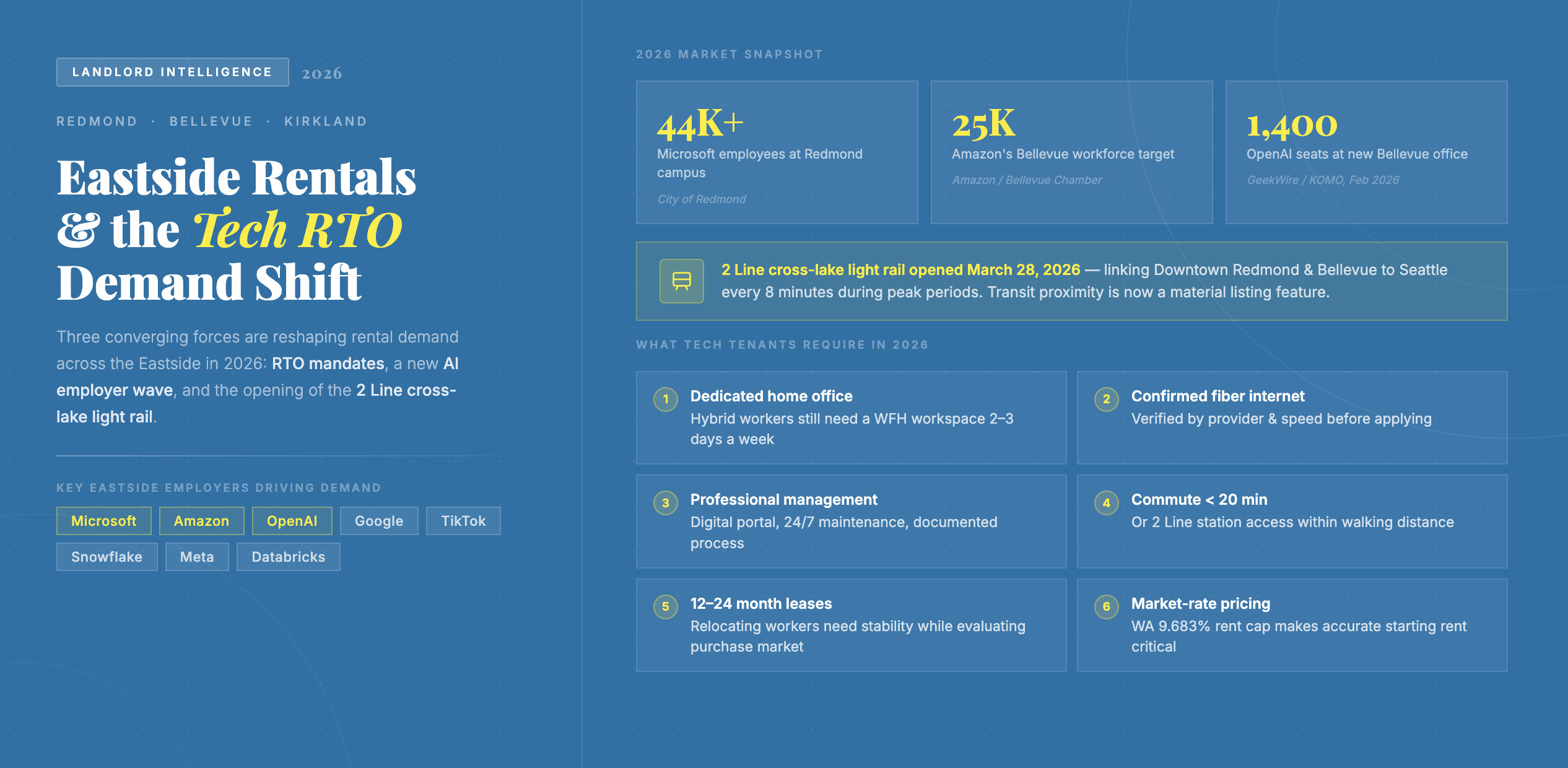
Three developments define the 2026 Eastside rental story. Microsoft formally enacted its three-day-per-week RTO mandate on February 23, 2026, affecting employees within 50 miles of a Microsoft office. The full East Link 2 Line cross-lake light rail connection between Seattle and Bellevue opened March 28, 2026, completing an 18-year infrastructure project that directly links downtown Bellevue and the Microsoft Redmond campus to Seattle. And OpenAI opened its City Center Plaza office in Bellevue in early March 2026, expanding its Eastside footprint fivefold to 296,000 square feet and adding room for more than 1,000 employees near Amazon and Microsoft.
Each development, taken individually, would move the rental market. Together, they are producing a demand environment landlords have not seen on the Eastside in years.
Why National Market Data Does Not Apply to the Eastside
When economists describe a cooling rental market in 2026, they are measuring averages across thousands of zip codes. The Eastside is not average. Redmond, Bellevue, Kirkland, and Sammamish represent a micro-market with a fundamentally different demand driver than most of the country: a highly concentrated, high-income tech workforce that must live within commuting distance of specific campuses.
The Eastside employer story has also grown more complex since 2024. Microsoft is not the only driver anymore. OpenAI’s Bellevue expansion is drawing AI engineers who command some of the highest salaries in the industry. Amazon’s Bellevue workforce, already at roughly 14,000 employees, is on a stated trajectory toward 25,000. New-to-market entrants including Snap, Anduril, Shopify, Snowflake, TikTok, and Databricks have all established or expanded Eastside offices since 2024, drawn by what commercial real estate firm Broderick Group describes as Bellevue’s modern office inventory, business-friendly climate, and skilled technology workforce. The employer concentration that makes the Eastside’s rental market resilient is broader and deeper than it was even two years ago.
Single-family rentals, the product SJA specializes in, are in especially short supply relative to demand. A well-maintained three-bedroom home within 20 minutes of the Microsoft main campus in Redmond is not competing with the broader Seattle rental market.
It is competing with three or four similar homes, and the qualifying applicant pool is full of candidates earning $180,000 or more annually.
The 2 Line Changes the Rental Geography of the Entire Eastside
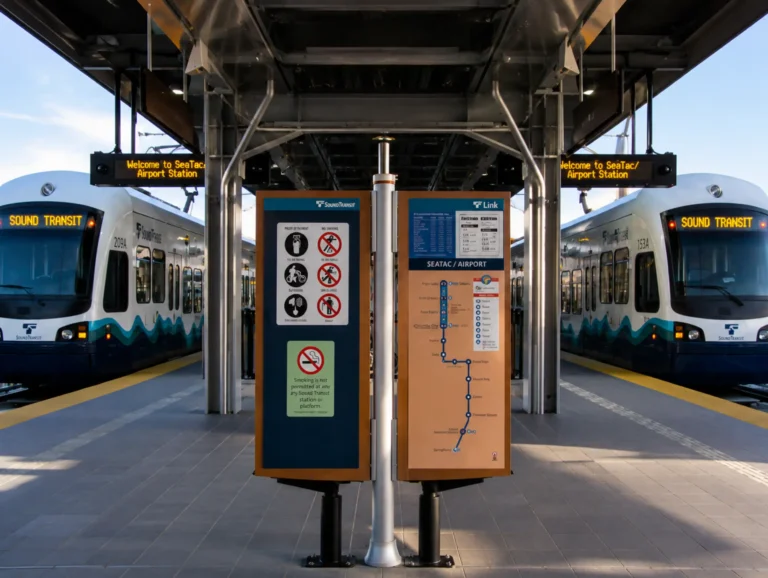
The March 28, 2026 opening of the full East Link 2 Line cross-lake connection is the most significant transportation event to affect Eastside rental demand since the I-90 bridge was built. For the first time, a rider can travel by light rail from the Microsoft Redmond Technology Station directly to downtown Seattle in a single seat, without a car. The 2 Line will operate every eight minutes during peak periods and offers travel times independent of I-90 traffic conditions, which historically made the Eastside commute unpredictable for workers without a car or those commuting from Seattle.
The rental implications are layered. Properties within walking distance of 2 Line stations, including South Bellevue, Downtown Bellevue, BelRed, Overlake Village, Redmond Technology, and Downtown Redmond, now carry a new commute premium. A renter working at Amazon in Bellevue who also has a partner working in Capitol Hill can now make that dual commute work on transit. That household, previously locked out of the Eastside by commute complexity, is now a realistic Eastside tenant. Expect station-adjacent properties to see this reflected in faster lease-up times and competitive application volumes.
The new light rail corridor also expands the practical rental catchment area for Eastside employers. Neighborhoods along the 2 Line in Mercer Island and the Judkins Park area of Seattle are now functionally connected to Bellevue and Redmond in a way they were not before. For landlords, the competitive set for attracting tech tenants just got larger. This is both a challenge and a positioning opportunity.
The Micro-Market Breakdown: Redmond, Bellevue, and Kirkland in 2026
Redmond: Microsoft's RTO Mandate and the Campus Consolidation
Microsoft’s February 23, 2026 RTO policy requires employees within 50 miles of a Microsoft office to work onsite at least three days per week. The company employs more than 44,000 full-time equivalent workers at its Redmond campus according to City of Redmond data, with some campus materials referencing figures as high as 47,000. The policy replaces Microsoft’s previous arrangement, which allowed most employees to work remotely up to half the time without manager approval.
Critically, Microsoft’s real estate moves in 2025 and early 2026 confirm its Redmond concentration strategy. The company renewed its lease for a nearly 400,000-square-foot office at Redmond Town Center, the largest Eastside lease transaction of Q4 2025 per Broderick Group. It also reoccupied 480,000 square feet at Millennium Corporate Park near downtown Redmond after withdrawing the space from sublease. These are not the moves of a company expecting its workforce to stay home. For landlords in Redmond, Sammamish, and Bothell, the combination of RTO enforcement and campus reoccupation is the most direct rental demand signal in years.
Rentals within a five-to-ten-minute drive of campus, particularly those with dedicated office space and confirmed fiber internet, are being absorbed quickly. The Redmond Technology Station on the 2 Line sits directly at the Microsoft campus boundary, funded by a pedestrian tunnel that Microsoft itself paid for under NE 40th Street. This station is already a leasing amenity for properties in the vicinity.
Bellevue: Amazon, OpenAI, and the New Eastside Tech Capital
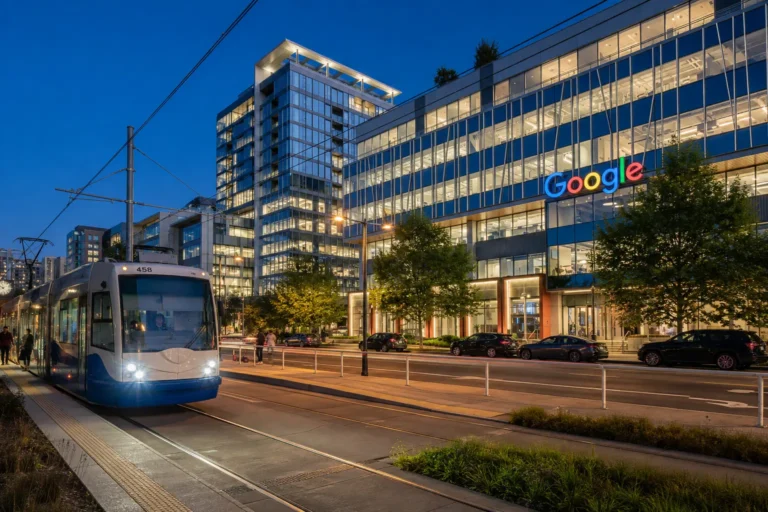
Bellevue’s transformation into the Eastside’s primary tech hub is now well established, but the 2026 additions accelerate it further. Amazon’s Bellevue workforce stands at approximately 14,000 and is on a stated path to 25,000. The company’s Bellevue offices surround the 2 Line’s Downtown Bellevue station, which was a deliberate infrastructure decision Amazon supported financially. On top of Amazon, OpenAI formally opened its City Center Plaza office in Bellevue on March 5, 2026, with capacity for up to 1,400 employees and a ribbon cutting attended by Washington Governor Bob Ferguson.
The broader Bellevue employer landscape now includes TikTok, Robinhood, Meta, Shopify, Snowflake, and Uber alongside the anchor presence of Amazon and OpenAI. Broderick Group’s Q4 2025 report notes that a growing number of new-to-market entrants are choosing the Eastside over Seattle, citing modern office inventory and a business-friendly climate.
Mid-priced single-family rentals in Bellevue neighborhoods like West Bellevue, Factoria, Eastgate, and Crossroads are drawing applicants who would typically be buyers but are choosing flexibility while the purchase market remains constrained. A qualified Bellevue tech renter household in 2026 is often earning combined income in the $300,000 to $400,000 range and is making a deliberate short-to-medium-term decision to rent while monitoring interest rates and home prices.
Kirkland: Google, High Earners, and the Quality-First Renter
What Tech Tenants Are Prioritizing in 2026
The tech renter profile is not monolithic, but consistent priorities have emerged across the Eastside workforce since RTO mandates were confirmed:
- Dedicated workspace. The hybrid model is not dead. Even workers with three to four in-office days per week need a functional home office for their remaining work-from-home days. A property with a converted den, a bonus room, or a clearly staged home office is a meaningful differentiator in listing photography and applicant decision-making.
- Confirmed fiber internet. Tech workers will verify fiber availability before submitting an application. Note the provider and speeds prominently in your listing. This is not optional for Eastside tech tenants.
- Professional management with a real portal. Tenants earning $200,000 annually are not tolerating informal lease processes or slow maintenance responses. They want documented procedures, a digital owner and tenant portal, and 24/7 maintenance availability. SJA’s property management platform satisfies all three.
- Lease stability. Many relocating tech workers are signing 12-to-24-month leases because they need stability while evaluating the purchase market. Long-term lease flexibility is a genuine competitive advantage and should be emphasized in your listing.
- Light rail and commute access. The 2026 opening of the full East Link 2 Line makes transit proximity a new variable in tenant decision-making. If your property is within walking distance of a 2 Line station, that is now a material listing feature. Even properties not on the line benefit from proximity to I-90 or SR-520 HOV access.
- Amazon 5-day context. Amazon’s five-day-per-week RTO policy, effective January 2025, means Amazon employees in Bellevue have the strictest commute constraint of any major Eastside employer. Bellevue rentals within a 15-minute commute of Amazon’s downtown offices command a specific premium from this workforce segment.
How to Position Your Eastside Property to Attract Tech Tenants
Professional photography is non-negotiable
Your listing copy should address commute specifics
Your screening process is itself a signal
A disorganized application process, vague income verification, or slow response time tells a senior engineer that this landlord-tenant relationship is going to be frustrating. A clean, digital application with clear criteria and fast turnaround communicates the opposite. Under Seattle’s First-in-Time ordinance, landlords must offer tenancy to the first qualified applicant who completes the process in chronological order. A fast, clean process means you close on the best applicants before they find an alternative.
Price accurately at the start of each tenancy
Washington State’s 9.683 percent rent cap for 2026 applies to increases during existing tenancies. Starting rents on new leases remain uncapped. Given the demand dynamics in Redmond and Bellevue, underpricing a new tenancy is an expensive mistake because your ability to close the gap through annual increases is now legally constrained. Use SJA’s free rental estimate tool to verify your current market position.
Why Professional Management Is the Differentiator in This Market
SJA manages single-family and small multifamily rentals across Redmond, Bellevue, Kirkland, Sammamish, Bothell, and surrounding Eastside markets. We have watched the RTO shift reshape demand, the East Link opening change commute calculus, and the OpenAI and new-entrant expansions broaden the Eastside employer base beyond anything the market saw in the previous cycle.
Our leasing process is built for high-standard tenants. Professional photography, syndication across all major platforms, thorough income and background screening, and a documented move-in process give our properties the presentation quality that tech professionals expect. Our owner-clients in Redmond and Bellevue are seeing faster lease-up times and stronger average rent achievement compared to self-managed alternatives in the same submarkets.
Contact SJA Property Management for a free rental analysis and learn exactly where your property stands in the current Eastside market. You can also review SJA’s full-service property management and 8 client guarantees to understand what a professionally managed Eastside rental looks like in 2026.