

Keeping up with Seattle rental laws is one of the hardest parts of owning a duplex, triplex, fourplex, or apartment building in this city. Seattle layers its own rules on top of Washington State law, and together they create real legal risk for landlords who are not fully up to date. At SJA Property Management, we were co-founded by two attorneys with a real estate law background. Our 40-person team manages 1,000+ homes and oversees $500M+ in real estate assets across the greater Puget Sound region. We work specifically with multi-family owners every day, and this guide is designed to give you a clear and practical look at what the law requires in 2026.
TL;DR
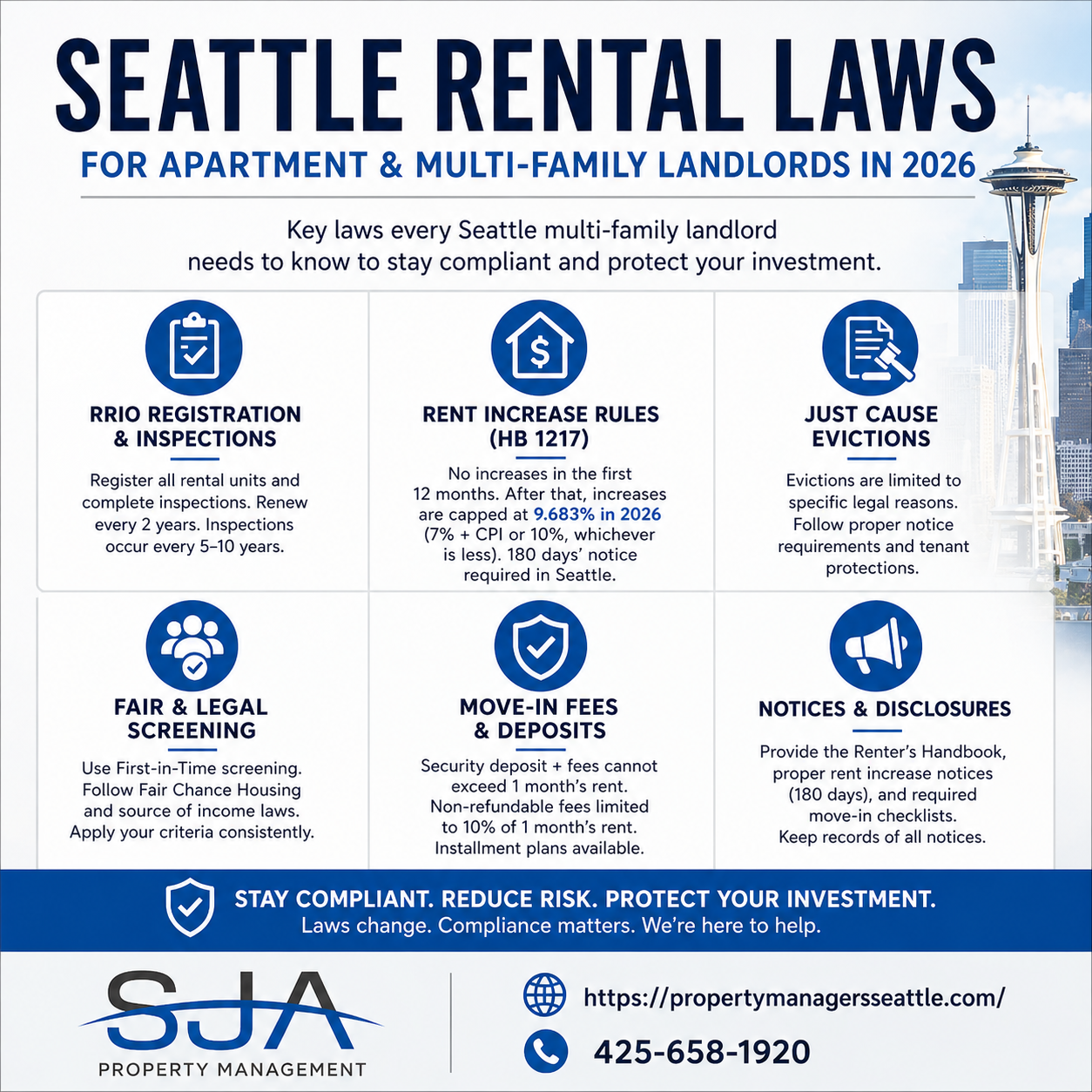
Seattle multi-family landlords face a layered set of rules in 2026. Washington’s HB 1217 caps most rent increases at 9.683% and bans any increase in the first 12 months of a tenancy. Seattle requires 180 days written notice before any rent increase. All rental units, including duplexes, triplexes, fourplexes, and rented ADUs, must be registered under RRIO. Utility billing in multi-unit buildings is governed by Seattle’s Third Party Billing Ordinance, with specific rules for submetering and RUBS. Before selling a qualifying multi-family property, owners must file a Notice of Intent to Sell with the Seattle Office of Housing at least 90 days before listing. Just cause eviction protections require a legally valid reason to remove a tenant, and seasonal restrictions add additional planning complexity. Tenant screening is tightly regulated under the First-in-Time rule, the Fair Chance Housing Ordinance, and source of income protections.
The Legal Landscape for Seattle Multi-Family Landlords
Washington State has its own landlord-tenant laws under the Residential Landlord-Tenant Act (RCW 59.18). Seattle then adds a second layer of local ordinances on top of those. For multi-family landlords, that combination matters a great deal. Duplexes, triplexes, fourplexes, apartment buildings, and properties with accessory dwelling units used as rentals are all subject to registration, inspection, eviction, screening, and rent increase rules that go well beyond what many landlords expect.
The good news is that Seattle remains a strong rental market with consistent demand for multi-family housing. However, strong returns depend on strong compliance. A missed notice requirement, an improperly processed application, or a late registration renewal can all create costly legal exposure. Understanding Seattle tenant-landlord laws is the starting point for every multi-family landlord in this city.
RRIO: Seattle's Rental Registration and Inspection Program
The first obligation for any multi-family landlord in Seattle is registering under the Rental Registration and Inspection Ordinance, known as RRIO, administered by the Seattle Department of Construction and Inspections.
Nearly every rental unit in Seattle must be registered before it can be legally occupied. That includes duplexes, triplexes, fourplexes, apartment units, and rented ADUs. Once registered, properties are subject to periodic health and safety inspections. Operating without RRIO registration can result in enforcement action and may prevent you from pursuing an eviction even when you have a valid legal reason to do so. Properties with a clean compliance history are inspected roughly every ten years. Those with past violations may be inspected more often. Violations found during inspection must be corrected within the timeframes SDCI specifies.
You can find current requirements from the City of Seattle's RRIO program page. RRIO registration is not optional. It is the legal foundation on which everything else rests.
Washington's Rent Stabilization Law: HB 1217
The most significant change to hit Washington landlords in recent years took effect on May 7, 2025. Governor Bob Ferguson signed Washington rent control law HB 1217 into law, making Washington the third state in the country to enact statewide residential rent stabilization after California and Oregon.
For multi-family landlords in Seattle, this law fundamentally changes how rent increases work.
No rent increases in the first 12 months. Landlords may not raise rent during the first year of any tenancy. This applies to both month-to-month and fixed-term leases.
A cap on annual increases after year one. Once a tenancy passes the 12-month mark, increases are limited to the lesser of 7% plus CPI or 10% in any 12-month period. For 2026, the cap is 9.683% as confirmed by the Washington Department of Commerce.
Notice requirements. State law requires 90 days written notice before any rent increase. However, Seattle requires 180 days. Because Seattle's rule is more protective, Seattle landlords must follow the 180-day standard. Notices must be personally served when possible, with certified mail as a backup. Keep an affidavit of service for every notice you send.
Parity between lease types. You cannot charge different base rents for the same unit based on whether a tenant signs a fixed-term or month-to-month lease.
Exemptions for newer buildings. Properties that received a certificate of occupancy within the last 12 years are exempt from the rent cap. Affordable housing with government-restricted rents and units owned by qualifying nonprofits are also exempt. If your building qualifies, document that clearly.
Penalties for violations are serious. Tenants may seek up to three months of excess rent paid. The Washington Attorney General can pursue civil penalties of up to $7,500 per violation. Tenants can also terminate their lease before an unlawful increase takes effect by giving 20 days written notice.
You can review what the 2026 Washington rent cap means in practice, and check the most common HB 1217 compliance mistakes landlords are making right now.
Utility Billing Rules for Seattle Apartment Buildings
Utility billing for multi-family properties in Seattle is governed by the Third Party Billing Ordinance, which has been in effect since 2003 and is codified in Seattle Municipal Code 7.25. For landlords of apartment buildings, duplexes, and other multi-unit properties, understanding this ordinance is essential. Getting utility billing wrong can expose you to tenant complaints, Hearing Examiner proceedings, and fines.
How Landlords Can Bill for Utilities
There are three main approaches landlords use for utility billing in Seattle multi-family buildings.
Direct metering. If each unit has its own individual meter from the utility company, tenants pay the utility directly. This is the simplest and most straightforward approach.
Submetering. Landlords can install individual submeters for each unit and then bill tenants based on their actual usage. Seattle allows submetering for water, wastewater, electric, and gas. The key restriction is that tenants may not be billed more than the actual cost to the property. Administrative fees are limited, and billing must be transparent and clearly documented.
Ratio Utility Billing System (RUBS). RUBS divides a building's total utility bill among units using a formula, typically based on unit size, number of occupants, or a combination of both. Seattle allows RUBS for water and some other utilities, but not for electricity. RUBS is currently a significant point of debate in Seattle. A growing campaign of tenants and advocacy groups is pushing the city to ban or restrict RUBS, arguing the system is unpredictable and can result in overcharging. As of 2026, RUBS remains legal but the regulatory environment around it may change. Landlords using RUBS should monitor city council activity closely.
What Seattle's Third Party Billing Ordinance Requires
If you use a third party to bill tenants for utilities, Seattle's ordinance places specific obligations on both the landlord and the billing company. Key requirements include:
- Tenants must receive itemized bills that clearly show how charges were calculated.
- If units are submetered, bills must include current and previous meter readings, the read date, and the amount consumed.
- Bills must state the due date, the date charges become overdue, any applicable late fees, and the date those fees may apply.
- The name, address, phone number, and dispute resolution process for the billing company must appear on every bill.
- Landlords may not use deceptive billing practices or retain a billing company that does not comply with Seattle's code.
- Third party billing companies may not report utility-related claims to credit reporting agencies except in limited circumstances.
Practical Considerations for Multi-Family Landlords
Any change to how you bill for utilities must be disclosed to tenants before it takes effect. If you are adding utility charges that were not part of the original lease, this may qualify as a housing cost increase and could trigger Seattle's 180-day notice requirement. Consult with a property management professional or attorney before making changes to your billing arrangements.
Whatever approach you use, make sure your lease clearly defines how utilities are handled and that your billing practices comply with Seattle's Third Party Billing Ordinance. The City of Seattle's Renting in Seattle utilities page provides a useful overview of tenant rights and landlord obligations.
Notice of Intent to Sell for Seattle Multi-Family Properties
If you are thinking about selling your apartment building, duplex, triplex, or fourplex in Seattle, there is a specific legal process you must follow before listing the property. Seattle's Notice of Intent to Sell ordinance, codified in Seattle Municipal Code 22.907, applies to multi-family rental properties and creates obligations that many landlords overlook until it is too late.
Who the Ordinance Applies To
The Notice of Intent to Sell requirement applies to owners of buildings with two or more rental units where at least one unit is rented at or below 80% of the Area Median Income (AMI). If your property meets this threshold, the ordinance applies to you.
What You Must Do Before Selling
When you decide to sell a covered property, you must take the following steps before listing or advertising the property for sale.
Notify the Seattle Office of Housing and the Seattle Housing Authority. This notice must be submitted no later than 90 days before the property is listed or advertised for sale. Notifications should be sent by email to IntentToSell@Seattle.gov or by mail to the Seattle Office of Housing.
Post a visible notice in the building. The notice must be placed prominently in a common area that is clearly visible to all building residents. The notice must state the owner's intent to sell and include information about any funding that may be available to help tenants or nonprofits purchase the building.
Submit a signed declaration. The owner must file a declaration with the Office of Housing, signed under penalty of perjury, affirming compliance with the ordinance.
Act quickly if you receive an unsolicited offer. If a buyer approaches you before you have listed the property, and you intend to accept the offer, you must still complete all of the steps above within two days of receiving that offer. This applies even if you never publicly advertised the property for sale.
Tenant and Nonprofit Right of Interest for Larger Buildings
For buildings with five or more units, tenants, nonprofit housing providers, or the Seattle Housing Authority have 30 days after receiving the Notice of Intent to Sell to express interest in purchasing. If they do, the owner must provide unit count and rent information within three business days. The interested party then has 15 days to provide proof of financial ability to purchase, and 90 days after that to submit a formal offer. Sellers are not obligated to accept any offer that comes through this process.
Penalties for Non-Compliance
Failure to comply with the Notice of Intent to Sell requirements can result in a civil penalty of up to $2,000 per violation under Seattle Municipal Code 22.907.030. While $2,000 may seem modest, non-compliance can also complicate your sale and create legal exposure if tenants or the city challenge the transaction.
You can find the full requirements and submission process on the Seattle Office of Housing's information page for landlords.
Selling and Just Cause Eviction
The Notice of Intent to Sell ordinance is separate from just cause eviction rules. Under Seattle's just cause eviction ordinance, selling a single-family home is a valid reason to end a month-to-month tenancy with 90 days written notice. The property must be listed or actively marketed within 30 days of the tenant vacating. If it is taken off the market within 90 days of the tenant leaving, there is a presumption you did not actually intend to sell.
For multi-unit buildings, you generally may not evict tenants simply because you want to sell. Existing leases must be honored after ownership transfers to a new buyer. If you are planning a sale and need to understand your rights around tenant occupancy, consult with a property management company that has a legal background before taking any action.
Just Cause Eviction and Seasonal Restrictions
Seattle landlords cannot remove a tenant without a legally valid reason. Valid reasons include non-payment of rent, material lease violations, property damage beyond normal wear and tear, illegal activity, and certain owner occupancy or sale situations.
Beyond the just cause requirement, Seattle adds two seasonal eviction restrictions. The Winter Eviction Ban runs from November 1 through March 31. During those months, tenants who meet certain income qualifications cannot be evicted for non-payment of rent. The School Year Restriction limits evictions of school staff and families with school-aged children during the school year, generally from mid-September through late June. Every eviction must comply with both Washington State law and Seattle's local ordinances.
Seattle Tenant Screening Rules for Apartments
Seattle has some of the most detailed tenant screening requirements in the country. The First-in-Time rule requires you to offer the unit to the first qualified applicant who meets your posted screening criteria. You must publish those criteria before advertising the unit and apply them consistently to every applicant in order. The Fair Chance Housing Ordinance restricts how you can use criminal history when evaluating applications. Source of income protections prohibit rejecting tenants based on housing vouchers or other assistance programs. All upfront move-in costs combined cannot exceed one month's rent, and tenants can request to pay in installments over six months.
For a detailed walkthrough of how to run a compliant process, our resource on Seattle tenant screening rules is a practical starting point.
Other Key Obligations for Seattle Multi-Family Landlords
Move-in and move-out documentation. Seattle requires a written move-in checklist signed by both parties at the start of each tenancy. Security deposits must be returned within 21 days of the tenant vacating, along with an itemized statement of any deductions.
The Renter's Handbook. Landlords must provide tenants with a printed copy of Seattle's Renter's Handbook at the start of every new tenancy. For renewals, digital delivery is acceptable. Always use the most current version from Seattle's Renting in Seattle portal.
Entry notice requirements. Washington State law requires at least two days written notice before entering a unit for non-emergency purposes.
Pricing software restrictions. Seattle prohibits pricing software that aggregates rent data from other rental properties to set rents. Only data from your own property may be used. Violations can result in civil penalties of up to $7,500.
Habitability and maintenance. Landlords must maintain rental units and shared spaces in habitable condition throughout the tenancy. RRIO inspections verify compliance on a scheduled basis.
Why Multi-Family Property Management in Seattle Is Not a DIY Job
The regulatory environment for Seattle multi-family landlords keeps getting more complex. A single mistake in screening, notice timing, utility billing, or sale procedures can result in fines, lost eviction rights, or costly tenant disputes.
That is why experienced multi-family property management in Seattle makes such a meaningful difference. SJA Property Management was co-founded by two attorneys, including CEO Devin Easterlin, who holds dual credentials as both a licensed real estate broker and an attorney with a focus on real estate transactional law. Our 40-person team manages more than 1,000 homes and oversees $500M+ in real estate assets. If you are looking for a multi-family property manager in King County who understands the full scope of Seattle's regulations, we are ready to help.
Frequently Asked Questions
Does Seattle have rent control for apartments and multi-family properties?
Yes. Washington's HB 1217 enacted statewide rent stabilization effective May 7, 2025. Landlords may not raise rent during the first 12 months of a tenancy. After that, increases are capped at the lesser of 7% plus CPI or 10% per 12-month period. For 2026, the cap is 9.683%. Seattle also requires 180 days written notice before any rent increase.
Do I need to register my duplex or fourplex in Seattle?
Yes. Under RRIO, nearly all rental units must be registered before they can legally be rented. This includes duplexes, triplexes, fourplexes, apartment units, and rented ADUs. Unregistered properties face enforcement actions and may lose access to eviction remedies.
What are the utility billing rules for Seattle apartment buildings?
Seattle's Third Party Billing Ordinance governs how landlords bill tenants for utilities in multi-unit buildings. Submetering and RUBS are both allowed under current law, though RUBS faces increasing regulatory scrutiny in 2026. Tenants cannot be billed more than the actual cost to the property. All bills must be itemized and include a clear dispute resolution process.
When do I need to file a Notice of Intent to Sell in Seattle?
If you own a building with two or more rental units where at least one unit rents at or below 80% AMI, you must notify the Seattle Office of Housing and Seattle Housing Authority at least 90 days before listing or advertising the property. You must also post a notice in the building and submit a signed declaration. Penalties can reach $2,000 per violation.
What is just cause eviction and how does it apply to Seattle apartments?
Just cause eviction means you need a legally recognized reason to remove a tenant from a Seattle rental. Valid reasons include non-payment of rent, lease violations, property damage, and illegal activity. Seattle also bans certain evictions from November through March for qualifying tenants, and restricts evictions of school staff and families with school-aged children during the school year.
How can SJA Property Management help multi-family landlords with Seattle compliance?
SJA handles RRIO registration support, compliant lease preparation, rent increase notices, tenant screening, utility billing guidance, Notice of Intent to Sell documentation, and eviction process guidance. Our team is trained on both Washington State law and Seattle’s local ordinances. Learn more at Seattle property management or contact us for a free consultation.
Final Thoughts
Seattle’s multi-family rental market offers strong long-term opportunities for investors. However, the legal environment demands real attention. RRIO registration, HB 1217 rent caps, Seattle’s 180-day notice rule, utility billing compliance, Notice of Intent to Sell requirements, just cause eviction protections, and tenant screening rules are all areas where landlords face meaningful risk.
Working with a property management company that specializes in multi-family properties and knows Seattle’s regulations is one of the best investments you can make. SJA Property Management brings the legal background, local expertise, and operational systems to handle all of it. Reach out to our team to discuss your portfolio and learn how we can protect your returns.
This article is for informational purposes only and does not constitute legal advice. Laws may change. Consult a qualified attorney for guidance specific to your situation.