
Washington State landlord notice requirements have always been among the most tenant-protective in the country. In February 2026, a federal rule change initiated by HUD Secretary Scott Turner added a new layer of complexity to an already demanding compliance landscape, particularly for landlords participating in federally subsidized housing programs. Then, a lawsuit and a rapid regulatory reversal changed the picture again before the rule ever took effect.
For landlords in Seattle, Bellevue, Redmond, and across the Eastside, understanding exactly where things stand today is not optional. The good news for most private-market Puget Sound landlords: Washington State notice law has not changed, and the HUD rule change does not affect you directly. The complexity is real, but it is concentrated in a specific category of federally assisted housing.
Here is the complete, accurate picture as of March 2026.
What HUD Did: The February 26 Interim Rule
On February 26, 2026, HUD published an interim final rule in the Federal Register revoking the 2021 and 2024 rules that required public housing agencies (PHAs) and owners of project-based rental assistance (PBRA) properties to provide at least 30 days’ written notice before filing a judicial eviction for nonpayment of rent. The rule was set to take effect March 30, 2026, affecting more than two million HUD-assisted households nationwide.
The rule was framed as elimination of a COVID-era policy. HUD Secretary Scott Turner stated the department was restoring flexibility to PHAs and property owners receiving federal assistance, pointing to national tenant accounts receivable running more than 200 percent above pre-pandemic levels as evidence that the extended notice period was not preventing arrearages.
The practical effect, if implemented, would have been to return HUD-assisted housing to pre-2021 standards. Notice periods for nonpayment would revert to program-specific requirements ranging from 5 to 30 days depending on the HUD program, governed by lease terms and state and local law. The rule also removed requirements that termination notices include itemized rent ledgers, income recertification information, and emergency rental assistance disclosures.
What Happened After: The Lawsuit, the Delay, and the Current Status
On March 2, 2026, three tenant advocacy organizations filed a lawsuit in the U.S. District Court for the District of Columbia (Jane Addams Senior Caucus, et al., v. U.S. Department of Housing and Urban Development, et al., 1:26-cv-00718 (D.D.C.)). The lawsuit alleged that HUD violated the Administrative Procedure Act by issuing the rule as an interim final rule without a full notice-and-comment period, that there was no valid legal basis for bypassing standard rulemaking procedure, and that reversing a rule less than two years after its enactment without explanation was arbitrary and capricious.
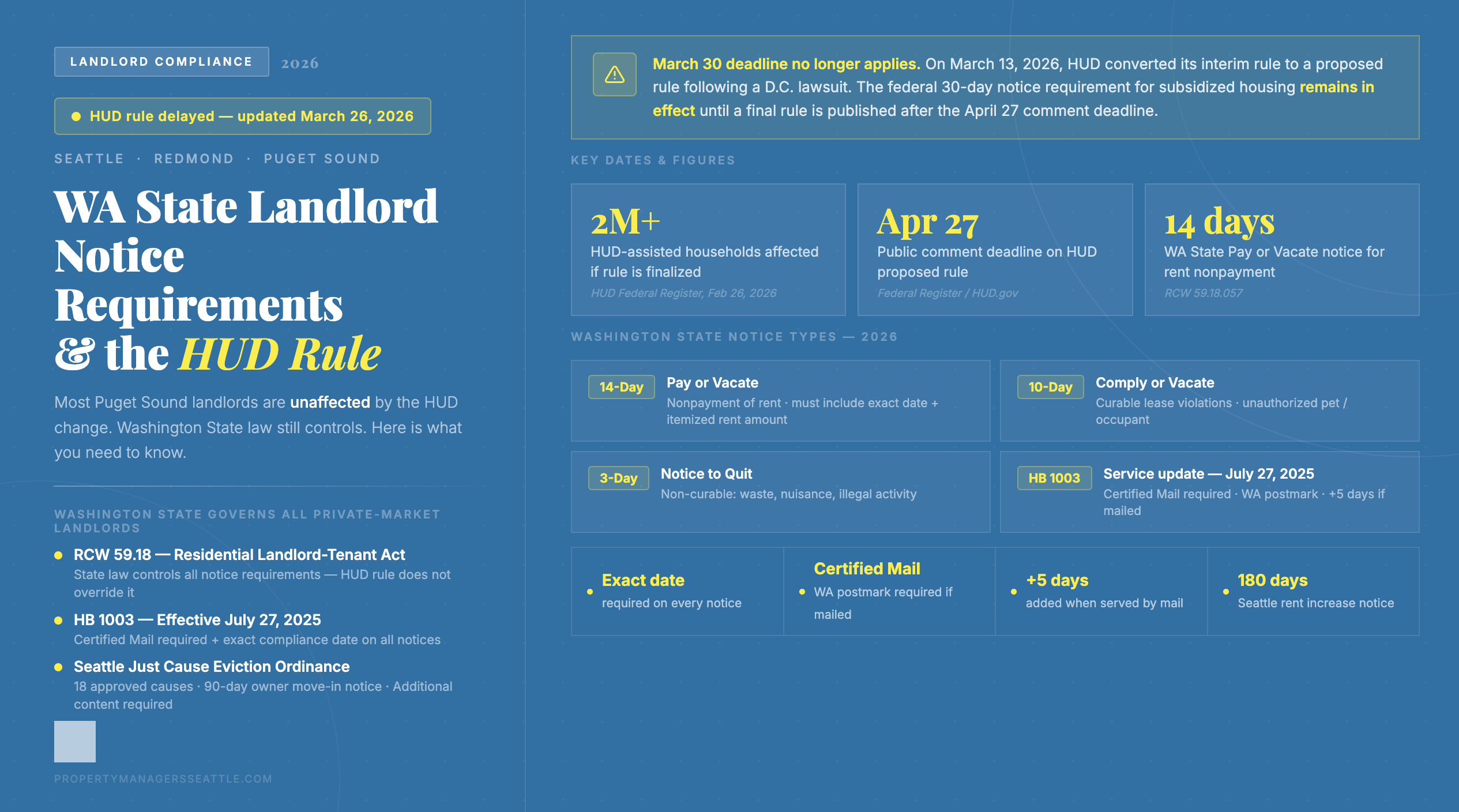
On March 13, 2026, HUD converted the interim final rule to a proposed rule, citing the litigation as the basis for delay. This means the March 30 effective date is no longer valid. The rule will not take effect until HUD completes the full public comment process, reviews comments received by the April 27, 2026 deadline, and publishes a final rule.
On March 16, 2026, the National Apartment Association moved to intervene as a defendant in the lawsuit in support of HUD’s original position. On the same day, the plaintiffs voluntarily withdrew their lawsuit, citing HUD’s delay action as the reason. The court formally dismissed the case on March 17. The proposed rule remains pending.
Current status: The federal 30-day notice requirement for nonpayment of rent in public housing and PBRA-assisted properties remains in effect. HUD’s proposal to eliminate it is pending final rulemaking. No effective date has been established for the change.
What This Means for Most Puget Sound Landlords: Nothing Has Changed
The most important point for private-market landlords in Redmond, Bellevue, Kirkland, Sammamish, Bothell, and Seattle: the HUD rule change does not apply to you. It applies exclusively to landlords participating in HUD’s public housing programs and project-based rental assistance programs. If your property has a conventional mortgage, a standard market-rate tenancy, and no participation in a HUD subsidy program, the federal rule change has no effect on your notice obligations.
Washington State notice law governs your eviction process entirely, and Washington State law has not changed as a result of HUD’s action. The Washington State Residential Landlord-Tenant Act (RCW 59.18) controls your notice requirements. For King, Snohomish, and Pierce County landlords, that means the same state law framework that has been in place — updated for HB 1003 in 2025 — continues to govern.
Washington State Landlord Notice Requirements in 2026
14-Day Pay or Vacate Notice for Nonpayment of Rent
Washington’s Residential Landlord-Tenant Act requires a 14-Day Pay or Vacate notice before a landlord can file an unlawful detainer action for nonpayment of rent under RCW 59.12.030. This notice must:
- State the exact amount of rent owed, broken out by month, late fees and attorney fees cannot be included in the rent demand amount
- Include the statutory language required under RCW 59.18.057, including notice of the tenant’s right to legal representation and reference to the Attorney General’s website
- State the exact calendar date by which the tenant must pay or vacate, a new requirement under HB 1003 effective July 27, 2025
- Be served by a legally sufficient method — personal service is preferred; if mailing is used, it must be USPS Certified Mail postmarked from within Washington State under HB 1003, with five additional days added before filing
A notice that omits any of these elements does not start the eviction clock. It gives the tenant grounds to challenge the eviction before it even begins, and courts in Washington have consistently ruled against landlords on defective notice grounds.
HB 1003: Updated Service Requirements (Effective July 27, 2025)
House Bill 1003, signed into law in 2025 and effective July 27, amended RCW 59.12.040 to require stricter mailing standards when personal service is not accomplished:
- Certified Mail required: If the notice is not personally served, it must be sent by USPS Certified Mail, postage prepaid
- Washington postmark required: The mailing must be postmarked from within Washington State
- Five additional days: When service is by mail rather than in-person, five additional days must be allowed before filing an unlawful detainer action
- Exact date on every notice: All termination notices must specify the exact date by which the tenant must comply or vacate, not just “within X days”
Seattle's Just Cause Eviction Ordinance
For properties within Seattle city limits, the compliance burden extends beyond state law. Seattle’s Just Cause Eviction Ordinance requires that any eviction be based on one of 18 specific approved causes. Nonpayment of rent is among them. However, Seattle also imposes:
- Additional notice content requirements beyond the state baseline
- Specific just cause language that must appear in the written notice
- 90 days’ notice for owner move-in or intent-to-sell evictions
- 180 days’ notice before any rent increase takes effect
King County Unincorporated Areas
If Your Property Does Participate in a Federal HUD Program
If your property participates in public housing, Section 8 project-based vouchers, Section 202/162 PAC, Section 202 PRAC, Section 811 PRAC, Section 236, or certain FHA-insured programs subject to HUD regulatory agreements, your notice obligations are currently governed by both state law and the existing 2024 HUD final rule.
As of March 2026, the 2024 HUD final rule remains in effect for covered properties. This means you are still required to:
- Provide at least 30 days’ written notice before filing a judicial eviction for nonpayment of rent
- Include an itemized ledger showing how the balance was calculated
- Include instructions on how the tenant can cure the nonpayment
- Include information on income recertification
- Include information on requesting a minimum rent hardship exemption
- Serve the notice no earlier than the day after rent is due
The proposed rule that would eliminate these requirements is pending. Until a final rule is published, these obligations remain. If you are a PHA or PBRA property owner and you were already updating your notice procedures in anticipation of the March 30 change, do not implement those changes. Continue using notices that comply with the 2024 final rule until HUD publishes a new final rule following the comment period
Common Notice Failures That Void Washington Eviction Proceedings
The following errors regularly result in case dismissals in King County and surrounding courts.
All apply regardless of the HUD situation:
- Wrong notice period for nonpayment: Using a 3-day notice for nonpayment of rent. Washington law requires 14 days for rent nonpayment. The 3-day notice applies only to non-curable violations.
- Missing exact compliance date: Any notice that states “within 14 days” without specifying the actual calendar date does not comply with HB 1003 and is subject to challenge.
- First Class mail instead of Certified Mail: After July 27, 2025, notices not personally served must go by USPS Certified Mail with a Washington postmark. First Class mail is insufficient.
- Wrong rent amount: Late fees, attorney fees, and other charges cannot be included in the rent amount stated on a Pay or Vacate notice. Only recurring charges defined as rent under RCW 59.18.030 may be demanded.
- Outdated notice form: Using a form from 2024 or earlier that does not include HB 1003 exact-date language or the statutory tenant resource language now required in 14-day notices.
- Serving the notice too early: A notice served before rent is legally past due under the lease terms is invalid. Confirm the rent due date and any grace period specified in the lease before serving.
- Seattle-specific omissions: Omitting just cause language, tenant resource referral content, or Seattle Just Cause Eviction Ordinance required disclosures for Seattle properties.
What Puget Sound Landlords Should Do Right Now
For private-market landlords across the Eastside and Puget Sound:
- Do not change your notice process based on the HUD rule. The HUD change applies only to federally assisted housing and is not yet final. Washington State law controls your eviction notices, and it has not changed.
- Use only current 2026-compliant notice forms. Every 14-Day Pay or Vacate notice must include the exact compliance date, current statutory language under RCW 59.18.057, and be served by Certified Mail if personal service is not accomplished.
- Document everything. The date of service, method of service, identity of the person served or location where notice was posted, the exact form version used, and the rent amount stated must all be documented and retained.
- Confirm your property’s federal program status. If you are uncertain whether your property participates in any HUD-assisted program, resolve that uncertainty before serving any eviction-related notice. Program participation changes your compliance obligations materially.
- Monitor the HUD proposed rule. Public comments on the proposed rule are due April 27, 2026. The final rule may be published later in 2026. If you own subsidized housing, watch for the final rule and update your notice procedures only after it is published.
- For active nonpayment situations: If you have a tenant who is currently behind on rent, contact SJA before serving any notice. Getting the notice right the first time is far less expensive than restarting a dismissed eviction case.
Why SJA's Attorney-Founded Background Protects Owners on Exactly This Issue
SJA Property Management was founded by attorneys with deep expertise in Washington State landlord-tenant law. When a regulatory development like the HUD rule change creates confusion in the market, our owners do not navigate it themselves. Our team analyzes the applicable law, confirms which requirements govern each property in our portfolio, updates our notice templates and processes as law changes, and ensures that every action we take holds up in court.
Every notice SJA serves reflects current statutory requirements, uses legally sufficient service methods, includes all required content for the property’s jurisdiction, and is documented in our management system with a complete paper trail. Our owners in Redmond, Bellevue, Kirkland, Seattle, Bothell, and Sammamish benefit from that process automatically, without having to track regulatory changes themselves.
If you are managing your Eastside or Seattle property independently and you have a nonpaying tenant, or if you want to ensure your notice process is sound before a problem arises, contact SJA Property Management for a consultation. You can also review our full-service property management, pricing and services, and 8 client guarantees. Or get an instant free rental estimate for your property.