
So you have a rental property. Maybe you just bought your first investment home. Maybe you inherited a house. Or maybe you are moving out of your starter home and want to rent it instead of selling it. Whatever the reason, you are now asking the same question every new landlord asks: How do I manage a rental property?
The honest answer is that it takes more time, knowledge, and effort than most people expect. But the good news is that you do not have to figure it out alone. At SJA Property Management, we have managed over 1,000 residential properties across King and Snohomish Counties. With $500M+ in real estate assets under management, our team has seen just about every situation a landlord can face.
This guide will walk you through everything you need to know. We will cover the basics, the Washington State rules you must follow, and the smartest options for protecting your investment.
TL;DR
Managing a rental property means screening tenants, collecting rent, handling repairs, staying current on Washington State law, and keeping up with a lot of moving parts. It takes more time than most people expect. The steps are learnable, but the legal risks are real. For new landlords, remote owners, and anyone who values their time, hiring a local property manager is often the smartest and most cost-effective choice.
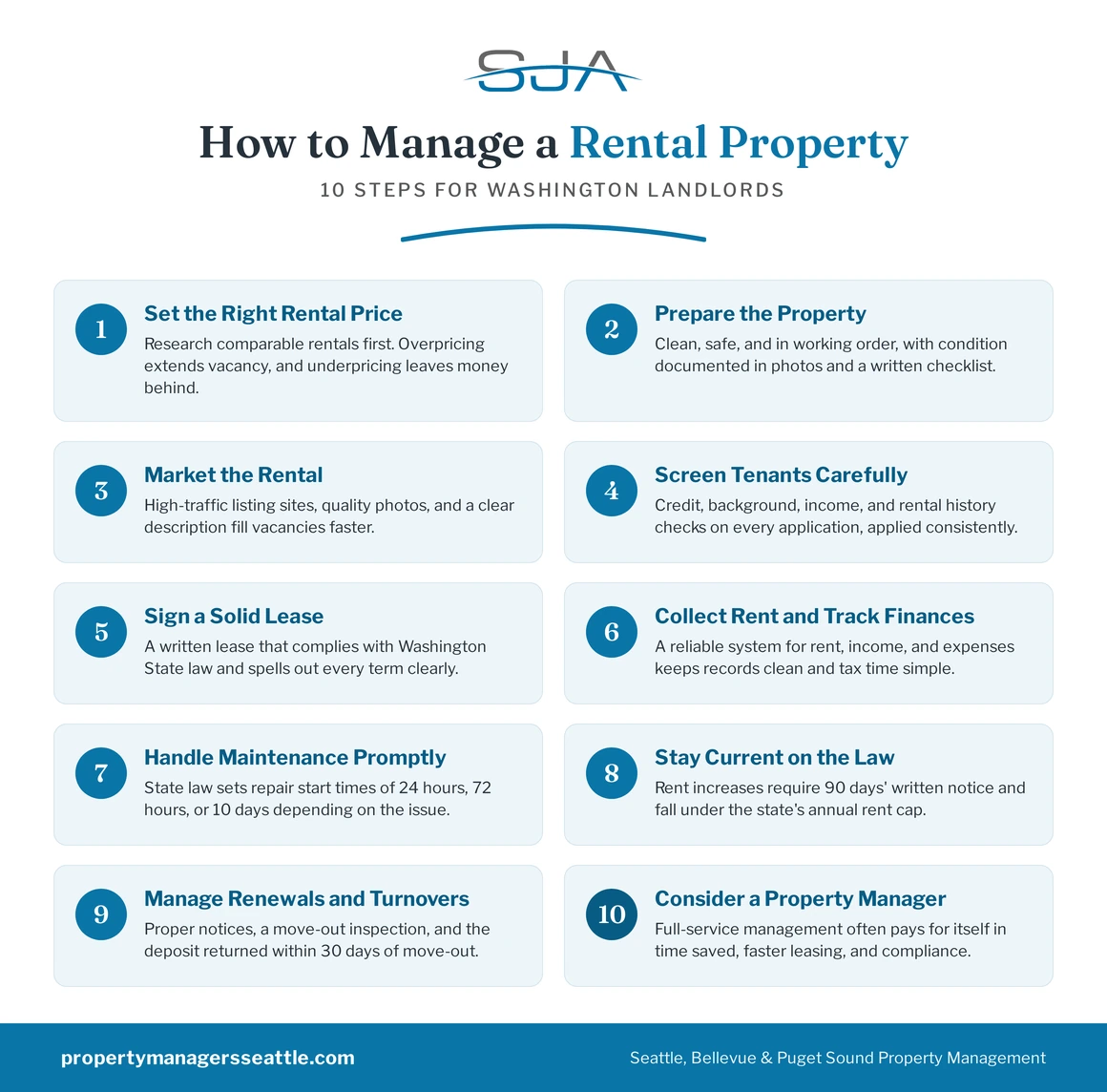
How to Manage a Rental Property: Step-by-Step
Here is a quick overview of the full process. We will dive into each step in more detail throughout this guide.
Step 1: Set the right rental price. Research comparable rentals in your area. Pricing too high means longer vacancies. Pricing too low leaves money on the table. Use our free tool to Figure out how much your property is worth before you list.
Step 2: Prepare the property. Make sure the home is clean, safe, and in working order before tenants move in. Fix any maintenance issues, change the locks, and document the property's condition with photos and a written checklist.
Step 3: Market your rental. List the property on high-traffic rental sites like Zillow, Apartments.com, and Craigslist. Write a clear description and include quality photos. A well-marketed listing fills vacancies faster.
Step 4: Screen tenants carefully. Review applications, run credit and background checks, verify income, and check rental history. A thorough screening process is one of the best ways to protect your investment. Learn how to Screen tenants the right way.
Step 5: Sign a solid lease agreement. Use a written lease that complies with Washington State law. It should clearly spell out the rent amount, due date, late fees, security deposit terms, and tenant responsibilities.
Step 6: Collect rent and track finances. Set up a reliable system for collecting rent and tracking income and expenses. This makes tax time much easier. Visit our Property Manager Tax Deduction Tips to make sure you are capturing every deduction.
Step 7: Handle maintenance and repairs promptly. Respond to repair requests quickly and keep detailed records. Washington State law sets specific timelines for repairs. Staying on top of maintenance and repairs also helps retain good tenants.
Step 8: Stay current on landlord-tenant laws. Washington State and local cities regularly update rental regulations. It is your responsibility as a landlord to know and follow the rules. One missed notice requirement can cost you significantly.
Step 9: Manage lease renewals and turnovers. When a tenancy ends, follow the proper notice requirements, conduct a move-out inspection, return the security deposit on time, and prepare the unit for the next tenant.
Step 10: Consider hiring a property manager. If any of these steps feel overwhelming, or if you are managing from out of state, a licensed property manager can handle all of it for you. More on that below.
Is It Hard to Manage a Rental Property?
Yes, it can be. Managing a rental property is not just collecting rent each month. It involves legal knowledge, financial tracking, tenant communication, maintenance coordination, and more.
New landlords are often surprised by how much is involved. According to the National Apartment Association, landlord turnover is one of the biggest issues in the rental industry, largely because of the steep learning curve.
With 17+ years of managing Seattle-area rentals, we have seen well-meaning landlords make costly mistakes simply because they did not know the rules. That is not a criticism. It is just the reality of a complex business.
That said, managing a rental property is absolutely doable, especially if you prepare well from the start.
How Much Time Does It Take to Manage a Rental Property?
Most landlords underestimate the time commitment. Here is a realistic breakdown:
Tenant search and screening: 5 to 20+ hours per vacancy, depending on the market.
Lease signing and move-in: 2 to 4 hours per new tenant.
Monthly rent collection and bookkeeping: 1 to 3 hours per month.
Maintenance coordination: Varies widely. A single emergency repair can eat an entire weekend.
Tenant communication: Ongoing. Tenants expect fast responses, sometimes at inconvenient times.
Legal compliance and renewals: Several hours per year to stay current on changing laws.
Add it all up, and a single rental property can easily take 5 to 10 hours per month under normal conditions, and much more when problems arise. If you have a full-time job, a family, or multiple properties, that time adds up fast.
Washington State Laws You Need to Know
If you own a rental property in Washington, you are subject to the Washington State Residential Landlord-Tenant Act. This law covers everything from security deposits to eviction procedures.
Here are some key rules you must follow:
Security deposits: Washington law requires you to provide a written checklist of the property’s condition at move-in. You must return the deposit, or an itemized statement of deductions, within 30 days of move-out.
Ending a tenancy: Washington’s statewide just cause law, RCW 59.18.650, requires a legally recognized reason to end most tenancies, and the required written notice period varies by cause, with some reasons requiring 60 or 90 days. Seattle and several other cities layer stricter rules on top of the state law.
Habitability standards: You are legally required to maintain the property in a livable condition. This includes working heat, plumbing, and structural safety.
Rent increase notices: Washington State requires at least 90 days’ written notice before any rent increase under HB 1217, and increases within a tenancy are capped at the state’s published annual limit.
Seattle and many surrounding cities also have their own local ordinances that go beyond state law. Our team’s 50+ years of combined experience in Washington property management means we stay on top of these changes so our clients do not have to.
How to Screen Tenants the Right Way
Finding a reliable tenant is one of the most important things you will do as a landlord. A bad tenant can cost you thousands of dollars in unpaid rent, property damage, and legal fees.
A strong screening process typically includes:
- A written rental application
- Credit check (with applicant consent)
- Background check
- Rental history and references
- Income verification (most landlords require income of 2.5 to 3 times the monthly rent)
You must also follow the Fair Housing Act, which prohibits discrimination based on race, color, religion, sex, national origin, disability, and familial status. Washington State adds additional protected classes, including source of income statewide under RCW 59.18.255, along with marital status, sexual orientation, and veteran or military status.
For a deeper look at this process, read our guide on how to Screen tenants the right way.
How to Handle Maintenance and Repairs
Maintenance is one of the biggest time drains for landlords. It is also one of the areas where small mistakes lead to big legal problems.
Here are a few best practices:
Respond quickly. Washington law, RCW 59.18.070, requires landlords to start repairs within 24 hours for loss of heat, water, or electricity or for hazardous conditions, within 72 hours for a broken refrigerator, range, oven, or major plumbing fixture, and within 10 days for all other repairs after receiving written notice.
Document everything. Keep records of all repair requests and the actions you took. This protects you if a dispute ever arises.
Hire licensed contractors. DIY repairs can void insurance policies or lead to liability issues if something goes wrong.
Do seasonal maintenance. Check gutters, HVAC filters, and weatherstripping regularly. Preventative care is far cheaper than emergency repairs.
Our resource on maintenance and repairs for rental properties covers this topic in much more detail.
How Much Does It Cost to Manage a Rental Property?
There are two ways to look at this question: the cost of managing it yourself, and the cost of hiring a professional property management company.
Managing It Yourself
Even self-management has real costs:
- Your time (at whatever value you place on it)
- Software tools for screening, leases, and rent collection
- Legal fees if something goes wrong
- Missed rent or vacancy time due to slower response
Hiring a Property Management Company
Most property management companies in the Seattle area charge between 8% and 12% of monthly rent, plus a leasing fee (often equal to half to one full month's rent when a new tenant is placed).
Some companies also charge for lease renewals, maintenance coordination, or monthly inspections. Always ask for a full fee breakdown before signing.
For context, if your property rents for $2,500 per month, a 10% management fee equals $250 per month. For many landlords, that fee is well worth the time saved and the legal protection gained.
Also keep in mind: property management fees are typically tax deductible. For tips on what you can write off, visit our Property Manager Tax Deduction Tips page. You can also review IRS Publication 527 for official guidance on deducting rental property expenses.
Before you make any financial decisions, Figure out how much your property is worth with our free rental estimate tool.
Self-Management vs. Hiring a Property Manager
Still not sure which path is right for you? Here is a side-by-side comparison to help you decide.
| Self-Management | Hiring a Property Manager | |
|---|---|---|
| Monthly Cost | Low upfront, but your time has real value | 8% to 12% of monthly rent, typically tax deductible |
| Time Required | 5 to 10+ hours per month per property | Minimal; manager handles day-to-day tasks |
| Legal Risk | High if you are unfamiliar with WA State law | Low; manager stays current on all regulations |
| Tenant Response Time | Depends on your availability | Fast; professional managers respond promptly |
| Maintenance Coordination | You find and schedule all vendors | Handled by the manager's vetted contractor network |
| Vacancy Fill Time | Slower without established marketing systems | Faster with professional listing and screening tools |
| Best For | Landlords with one nearby property and flexible time | New landlords, remote owners, and growing portfolios |
As you can see, self-management works well in limited circumstances. For most landlords, the time savings and legal protection that come with professional property management more than offset the monthly fee.
How to Manage a Rental Property Remotely or From Out of State
More and more landlords are managing properties from a distance. This could be because you relocated for work, retired to another state, or simply purchased an out-of-market investment.
Remote management is possible, but it comes with real challenges:
- You cannot inspect the property or respond to emergencies quickly
- You rely entirely on contractors and vendors you may not know well
- Communication delays can frustrate tenants
- Local law changes can catch you off guard
If you are in this situation, read our guide on How to Rent Out Your Home When You Have to Move for Work for practical tips.
Ultimately, the best way to manage a rental property from out of state is to hire a trusted local property management company. A good property manager handles everything on the ground, from tenant communication to maintenance, while you stay informed with regular reports. It removes the guesswork and the stress of managing from far away.
The Best Way to Manage a Rental Property
Here is the truth: the best way to manage a rental property depends on how much time, knowledge, and risk you are comfortable taking on.
If you enjoy the hands-on process and have the time to learn the law, handle tenant issues, and coordinate maintenance, self-management can work. It is especially reasonable if you own one property nearby and have flexible working hours.
But for most landlords, especially those who are new, remote, or growing their portfolio, hiring a reputable property manager is the smarter long-term choice. If you need help finding a good company we made a guide the best property managers in Seattle.
A professional property manager brings:
- In-depth knowledge of local landlord-tenant law
- Established systems for tenant screening, leasing, and rent collection
- A network of trusted, licensed vendors for repairs
- Faster vacancy fill times, often reducing your income loss between tenants
- Legal protection and documentation in case of disputes
The SJA team was named the Seattle Times 2024 People’s Choice Award winner for best property management company in Seattle. That recognition reflects what our clients experience every day: professional, transparent, and responsive service.
If you own or are considering a multi-unit building, our guide on Multi-family property management tips for new landlords is a great next read.
And if you are still in the investment phase, check out our in-depth article on How to invest in rental property to make sure you are buying the right asset from the start.
Signs You Need a Property Manager
Not sure if professional management is right for you? Here are some clear signs it is time to make the call.
You just inherited a property. Suddenly becoming a landlord is stressful. You may not know the local laws, the property's history, or where to start. A property manager can step in immediately and handle everything while you get your bearings.
You are moving out of your first home. You want to hold onto the property, but you cannot be a hands-on landlord from your new location. A local property manager keeps things running smoothly while you settle in somewhere new.
You have a demanding job or a busy family. Tenant calls do not follow a 9-to-5 schedule. If a maintenance emergency or lease issue would create real stress in your life, management support is worth every dollar.
You are managing from out of state. Distance makes everything harder, from responding to repair requests to keeping up with changing city ordinances. A local manager is your eyes and ears on the ground.
You have had a bad tenant experience. A difficult eviction, unpaid rent, or damaged property is often the wake-up call landlords need. The right property manager can help you avoid repeating those situations.
You own more than one property. The more units you manage, the more complicated everything becomes. Screening, maintenance, accounting, and lease renewals multiply quickly. Professional management keeps it all organized.
You are not confident about Washington State law. The rules change regularly. If you are not certain about notice requirements, deposit handling, or just cause eviction rules, you are exposed to legal risk. Our team's 50+ years of combined experience in Washington property management means you have experts in your corner.
If any of these sound familiar, it may be time to explore what a property manager can do for you.
Frequently Asked Questions
Who can manage my rental property?
You can manage it yourself, or you can hire a licensed property management company. In Washington State, property managers who collect rent or sign leases on behalf of owners are required to hold a real estate broker's license. Always verify credentials before signing a management agreement.
How hard is it to manage a rental property?
It is more complex than most people expect. The difficulty comes from legal compliance, tenant relations, maintenance coordination, and financial management. It gets easier with experience, but the learning curve is real. For many landlords, working with a property manager from the start saves significant time and money.
Can I manage my rental property from another state?
Yes, but it is challenging. You need reliable local vendors, strong communication systems, and a solid understanding of Washington State and local laws. Most out-of-state landlords find that hiring a local property manager is the most practical and least stressful option.
How do I know if my rental price is right?
Pricing your rental correctly affects how fast you fill vacancies and how much income you earn. A price that is too high leads to longer vacancies. A price that is too low leaves money on the table. Use our free tool to Figure out how much your property is worth before you list.
What is included in a property management fee?
This varies by company. Most management fees cover rent collection, tenant communication, and maintenance coordination. Leasing fees, lease renewals, and inspection fees may be charged separately. Always ask for a full list of fees upfront.
Is property management worth the cost?
For most landlords, yes. The fee is often offset by faster tenant placement, fewer costly mistakes, and the value of your own time. Add in the legal protection and peace of mind, and most clients tell us it is one of the best decisions they made.
Ready to Take the Next Step?
Managing a rental property well is a full-time responsibility. You do not have to do it alone.
SJA Property Management has been serving landlords across King and Snohomish Counties for over 17 years. With $500M+ in assets under management and a record of excellence recognized by the Seattle Times, we bring the experience and systems that protect your investment and your time.
Whether you own one property or ten, our team is ready to help. Contact SJA Property Management today to learn more about our services and get a free rental estimate.