
Key Takeaways
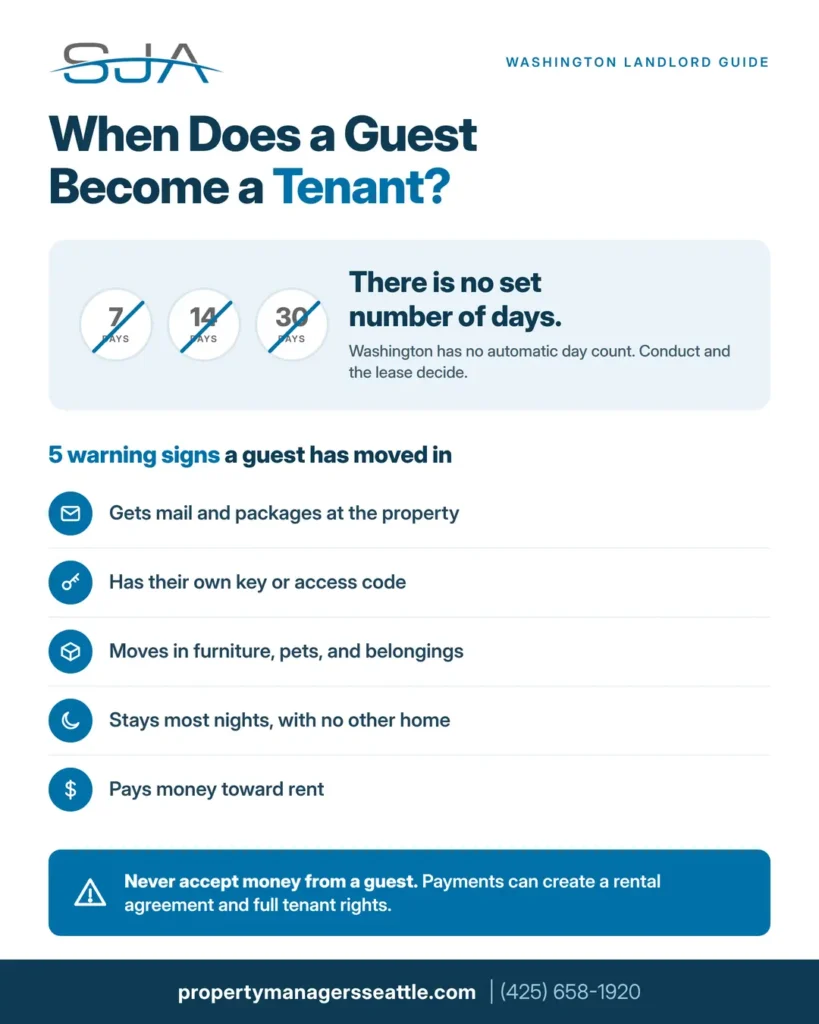
- Washington has no set number of days that turns a guest into a tenant. There is no automatic 7, 14, or 30 day rule.
- A tenant is anyone entitled to occupy the home under a rental agreement, and agreements can be written, oral, or created by conduct.
- Never accept money from a guest. Payments can support an argument that a rental agreement exists.
- Put a clear guest limit in the lease and require every new adult occupant to complete screening before moving in.
- Never change locks or shut off utilities. Removing someone without a court order can expose you to damages, attorney fees, and court costs.
- Seattle has its own roommate rules, including protections for immediate family members that go beyond state law.
When does a guest become a tenant in Washington State? The answer is not based on a set number of days. Instead, it depends on the rental agreement, the landlord's actions, and whether the person has gained the right to live in the home. At SJA Property Management, our attorney-founded, 40-person team has managed more than 1,000 Washington homes and over $500 million in real estate assets during 17 years in the Puget Sound region. We have seen how an unclear guest situation can quickly turn into a costly legal problem.
Washington does not have a statewide rule saying that a guest automatically becomes a tenant after 7, 14, or 30 days. However, a long-term guest may become an unauthorized occupant. In some cases, the landlord's words or actions may also create an oral or implied rental agreement.
That is why landlords should act early, document the situation, and follow the lease and local law.
Is There a Set Number of Days Before a Guest Becomes a Tenant in Washington?
No. Washington State law does not provide a fixed number of days after which every guest becomes a tenant.
Under RCW 59.18.030, a tenant is a person who is entitled to occupy a home for living purposes under a rental agreement. The law also defines a rental agreement as any agreement that sets or changes the rules for using and occupying a rental home.
A rental agreement may be written, oral, or supported by the conduct of the people involved. Therefore, a guest does not become a tenant simply because they stayed for a certain amount of time. The more important question is whether the person has been given the right to live there.
For example, a landlord could create a serious problem by:
- Accepting rent directly from the guest
- Telling the guest they may live at the property
- Giving the guest ongoing access without enforcing the lease
- Treating the guest as a permanent resident
- Allowing the situation to continue after learning that the guest moved in
A weekend visitor is still a guest. On the other hand, someone who lives at the property full time, pays the landlord, and has the landlord's permission may be treated very differently.
Guest, Occupant, Tenant, Subtenant, or Squatter?
These terms are often used as though they mean the same thing. However, they describe different situations.
Guest
A guest is temporarily invited to the property by a tenant. The guest usually has another primary home and does not have an agreement with the landlord.
Authorized occupant
An authorized occupant has the landlord's permission to live at the property but may not be a party to the lease. For example, a child or approved family member might be listed as an occupant instead of a financially responsible tenant.
Tenant
A tenant has the right to occupy the property under a rental agreement. Tenants normally have direct rights and responsibilities under Washington landlord-tenant law.
Subtenant
A subtenant rents all or part of the property from the original tenant. Whether subleasing is allowed depends on the lease and the landlord's approval.
Squatter
A squatter occupies a property without the owner's permission or a valid rental agreement. A guest who was invited into an occupied rental is not automatically a squatter. You can learn more about the difference in our guide to squatter rights in Washington State.
Correctly identifying the person's status is important. The steps needed to address an unauthorized guest may be different from the steps used for a tenant, subtenant, remaining occupant, or true squatter.
Warning Signs That a Guest May Have Moved In
No single fact proves that a guest has become a tenant. Instead, landlords should consider the full situation.
Common warning signs include:
- The person stays at the property most nights
- The property appears to be the person's primary home
- The person keeps most of their clothing and belongings there
- The person has their own key, parking space, or access code
- The person receives regular mail or packages at the address
- Utilities or services are placed in the person's name
- The person has no clear home elsewhere
- The person pays rent directly to the landlord
- The named tenant refers to the person as a roommate
- Neighbors, vendors, or maintenance workers report that the person lives there
Receiving mail does not, by itself, make someone a tenant. Neither does having a key or staying for several weeks. However, several of these facts together may show that the person is no longer a temporary visitor.
Landlords should also avoid making decisions based only on a neighbor's report. First, confirm the facts and review the lease.
Tenant Rights to Have Guests in Washington
Tenants generally have the right to use their rental home as a home. That normally includes having social visitors and overnight guests.
However, landlords may create reasonable rules about how guests use the property. RCW 59.18.140 requires tenants to follow reasonable restrictions on the use, occupancy, and care of a rental home when those rules are lawful and are included in the rental agreement.
A reasonable guest policy may limit:
- The number of consecutive nights a guest may stay
- The total number of guest nights within a set period
- The number of people who may occupy the unit
- Guest parking
- Access to shared areas or building amenities
- Conduct that creates noise, damage, or safety problems
- Whether landlord approval is required before someone moves in
These rules should be written clearly and applied consistently.
A landlord should not enforce guest limits differently based on race, religion, national origin, sex, familial status, disability, or another protected characteristic. Guest policies may also need exceptions when a tenant requests a reasonable accommodation related to a disability.
Can a Landlord Say No to Overnight Guests?
A landlord may set reasonable limits on overnight guests. However, a complete ban on all overnight visitors may be harder to defend than a clear policy aimed at preventing unauthorized occupancy.
For example, a lease could require written approval when a guest stays more than:
- A certain number of consecutive nights
- A certain number of nights in one month
- A certain number of total nights during a six-month or one-year period
Those numbers are lease terms, not rules created by Washington law.
The policy should give tenants enough freedom to have normal visitors while protecting the property from unapproved residents. It should also explain what the tenant must do when a guest plans to stay longer.
Landlords who are managing a rental property should review guest rules before the lease is signed. Adding a new restriction during an active tenancy can require notice, mutual agreement, or waiting until the lease term ends.
What Should a Tenant Guest Policy Include?
A strong guest policy should answer four basic questions:
- How long may a guest stay without approval?
- When must the tenant notify the landlord?
- What must a long-term guest do to become an approved occupant?
- What happens if the tenant violates the policy?
Here is sample language landlords can use as a starting point:
Guests may stay at the premises for no more than [number] consecutive nights or [number] total nights during any [month, six-month period, or 12-month period] without the landlord's prior written approval. Any person who intends to use the premises as a primary residence must submit an application and receive written approval before moving in. The tenant remains responsible for the conduct of all guests and occupants. Approval is subject to applicable Washington law, local ordinances, occupancy rules, screening requirements, and fair housing obligations.
This is only sample language. A Washington landlord-tenant attorney should review a guest policy or tenant guest policy addendum before it is used.
A well-written policy also cannot replace consistent enforcement. If the lease says guests are limited to 14 nights but the landlord knowingly allows someone to live there for six months, the landlord's actions could weaken the policy.
What Should a Landlord Do When a Guest Appears to Have Moved In?
Avoid starting with threats or accusations. Instead, take a clear and documented approach.
1. Review the lease
Confirm what the rental agreement says about guests, occupants, subleasing, approval, and notice.
The lease should clearly identify every approved tenant and occupant. It should also explain when a guest must apply.
2. Document the facts
Write down what caused the concern. Keep dates, tenant communications, maintenance notes, parking records, and other lawful documentation.
Do not enter the property without proper notice just to look for evidence. Washington's landlord entry rules still apply.
3. Contact the named tenant in writing
Ask whether the guest is visiting temporarily or has moved into the home.
Keep the message neutral. For example:
We have received information that an additional person may be residing at the property. Please confirm whether this person is a temporary guest or intends to use the property as their residence. If they intend to reside at the property, please contact us so we can review the application and approval process.
A calm approach is often the best first step when handling tricky tenant relationships.
4. Offer a clear path to compliance
When appropriate, give the tenant two options:
- The guest applies and is approved as a tenant or occupant
- The guest stops residing at the property by a stated date
Any adult who will become financially responsible for the lease should normally complete the same lawful tenant screening process used for other applicants.
Screening may include income, credit, rental history, identification, and other lawful criteria. Seattle landlords must also comply with the city's First-in-Time and Fair Chance Housing rules.
5. Sign a lease addendum
If the person is approved, put the arrangement in writing.
The addendum should state:
- Whether the person is a tenant or authorized occupant
- The date the person may begin living at the property
- Whether the person is responsible for rent and lease obligations
- Whether the security deposit or other lawful charges will change
- That all existing lease rules remain in effect
Do not rely on a handshake or text message for a major change in occupancy.
6. Use the proper notice if the violation continues
If an unauthorized person remains after the tenant has been told to correct the issue, the landlord may have grounds to serve a notice for a material lease violation.
Under RCW 59.18.650, a substantial breach of a material lease term may support a notice that gives the tenant at least 10 days to correct the violation or face the end of the tenancy.
However, the facts, notice wording, service method, deadline, and local requirements all matter. Review our current guide to serving eviction notices in Washington before taking action.
Landlords should never change the locks, remove belongings, shut off utilities, or physically force someone out when the person's right to occupy the property is disputed. Washington law generally prohibits landlords from removing or excluding a tenant without a court order. Depending on the circumstances, a wrongful removal may expose the landlord to actual damages, statutory damages, attorney fees, and court costs. Because the correct process depends on whether the person is a guest, tenant, subtenant, or remaining occupant, landlords should obtain legal guidance before taking action.
Does Accepting Rent From a Guest Create a Tenancy?
It can create evidence of a rental agreement.
Washington law recognizes more than formal, signed leases. An oral or implied agreement may be enough to establish the right to occupy a home.
For example, suppose a landlord learns that an extra adult has moved in. The landlord then accepts a separate monthly payment from that person and allows them to remain. Those facts could support an argument that the landlord approved a rental arrangement.
Landlords should therefore avoid accepting money directly from an unapproved guest before deciding how the person will be treated.
If payment has already been accepted, speak with a qualified attorney before serving a notice or trying to remove the occupant.
What Happens When the Named Tenant Moves Out but the Guest Stays?
Washington law provides a special process for certain remaining occupants.
Under RCW 59.18.650, when the tenant permanently leaves for reasons other than the landlord ending the tenancy, the landlord must give certain remaining occupants a notice to apply for the rental agreement or leave.
This rule applies when the occupant lived with the tenant for at least six months before the tenant left. The occupant generally has 30 days after receiving the notice to apply or vacate.
The landlord may require the remaining occupant to meet the same screening, background, and financial standards used for other prospective tenants. If the person does not apply or fails to qualify, the landlord may begin an unlawful detainer action.
This six-month rule is sometimes mistaken for a general rule saying every guest becomes a tenant after six months. That is not what the statute says. It applies to qualifying occupants who remain after the original tenant has permanently left.
Seattle Has Separate Rules for Adding Roommates
Landlords with property inside Seattle city limits must follow additional local rules.
According to the City of Seattle's official Adding Roommates guidance, tenants may generally add immediate family members and one additional non-family roommate, along with that roommate's immediate family, subject to applicable occupancy limits and screening procedures.
Important Seattle rules include:
- A tenant must notify the landlord in writing within 30 days after a roommate moves in.
- A non-family roommate may be screened using the same criteria used for the original tenant.
- A non-family roommate may be denied if they do not meet the screening criteria.
- A landlord may require a non-family roommate to join the rental agreement.
- Immediate family members generally cannot be denied occupancy or required to join the rental agreement, although they may be screened and listed as authorized occupants.
- Except for a permitted screening fee, the landlord generally cannot charge new move-in fees solely because a roommate was added.
- Occupancy and housing code limits still apply.
Seattle's roommate rules are more protective than the general rules in many other Washington cities. Landlords should review all applicable Seattle landlord-tenant laws before denying a roommate or serving a violation notice.
Other cities may also have local protections. Always confirm which city has legal authority over the property.
How Landlords Can Prevent Guest Problems
The easiest guest dispute to manage is the one that never becomes unclear.
Use these practices from the start of every tenancy:
- List every approved adult and child in the lease
- Separate financially responsible tenants from authorized occupants
- Include a reasonable guest limit
- Require written approval before a new resident moves in
- Explain the application and screening process
- State that the tenant is responsible for guest conduct and damage
- Inspect the property only as allowed by law
- Respond promptly when unauthorized occupancy is reported
- Keep every approval, warning, and agreement in writing
- Apply the same policy consistently to every tenant
Clear communication at move-in can prevent confusion later. It also makes enforcement easier if the tenant ignores the rules.
Frequently Asked Questions
How long can a guest stay before being considered a tenant in Washington State?
Washington has no automatic 7-day, 14-day, or 30-day rule. A person becomes a tenant when they gain the right to occupy the property under a rental agreement. A lease may still set its own reasonable guest limits.
How long can someone stay in your home before they can claim residence in Washington?
There is no set period that automatically gives a guest tenant rights. Staying for a long time may be evidence that the person lives there, but the rental agreement, payments, consent, and conduct of the parties are more important.
Does receiving mail at an address make someone a tenant?
No. Receiving mail is one sign that a person may live at the property, but it does not create a tenancy by itself.
Can a landlord say no to overnight guests?
A landlord may create reasonable limits for overnight guests. However, a total ban may be more difficult to enforce and must not violate fair housing laws, local ordinances, or a tenant's right to use the home.
Can a landlord remove an unauthorized guest?
A landlord should not personally remove or lock out the guest. The landlord should address the issue through the named tenant, the lease, proper notices, and the court process when necessary.
Can a landlord screen a guest who wants to move in?
In many cases, yes. An adult who wants to become an approved tenant or occupant may be required to complete lawful screening. However, Seattle has special rules for family and non-family roommates.
Does an unauthorized guest count as just cause for eviction?
A serious or continuing violation of a material guest or occupancy rule may provide just cause under RCW 59.18.650. The landlord must use the correct notice, give the tenant an opportunity to comply when required, and follow state and local procedures.
Is a long-term guest the same as a squatter?
No. A guest was originally invited by a tenant. A squatter occupies property without legal permission. The correct removal process depends on how the person entered the property and whether any rental agreement or right of occupancy exists.
When Guest Issues Become Property Management Issues
A guest dispute may seem small at first. However, it can affect screening, insurance, occupancy limits, utilities, parking, property damage, lease enforcement, and eviction rights.
The wrong response can also create a larger legal problem. Accepting rent from the wrong person, using an outdated notice, denying a protected family member, or attempting a lockout may expose the landlord to delays and liability.
Notice how much is packed into one simple question. There is no set day count to rely on. A landlord's words, payments, and conduct may support an argument that an oral or implied rental agreement exists. Guest policies bump into fair housing rules, Seattle adds its own roommate protections, and one wrong notice or lockout can expose you to damages, attorney fees, and court costs.
This is exactly the gray area where professional property management earns its keep. At SJA Property Management, our leases include clear, attorney-informed guest policies designed around Washington requirements, our team documents and handles occupancy issues the right way, and our processes have kept our eviction rate below .01% on tenants we place. You are also protected by our Happiness Guarantee, so there is no risk in trying us.
Have a guest situation brewing right now, or just want a lease that prevents one? Call us at (425) 658-1920 or book a free 20-minute consultation with our team today.
This article is for general educational purposes and is not legal advice. Rental laws can change, and local ordinances may provide additional protections. Consult a qualified Washington landlord-tenant attorney about your specific situation.