

Key Takeaways
- A property management agreement outlines the services, fees, responsibilities and cancellation terms between a rental owner and a management company.
- Washington requires written management agreements signed by the owner and the firm’s designated broker.
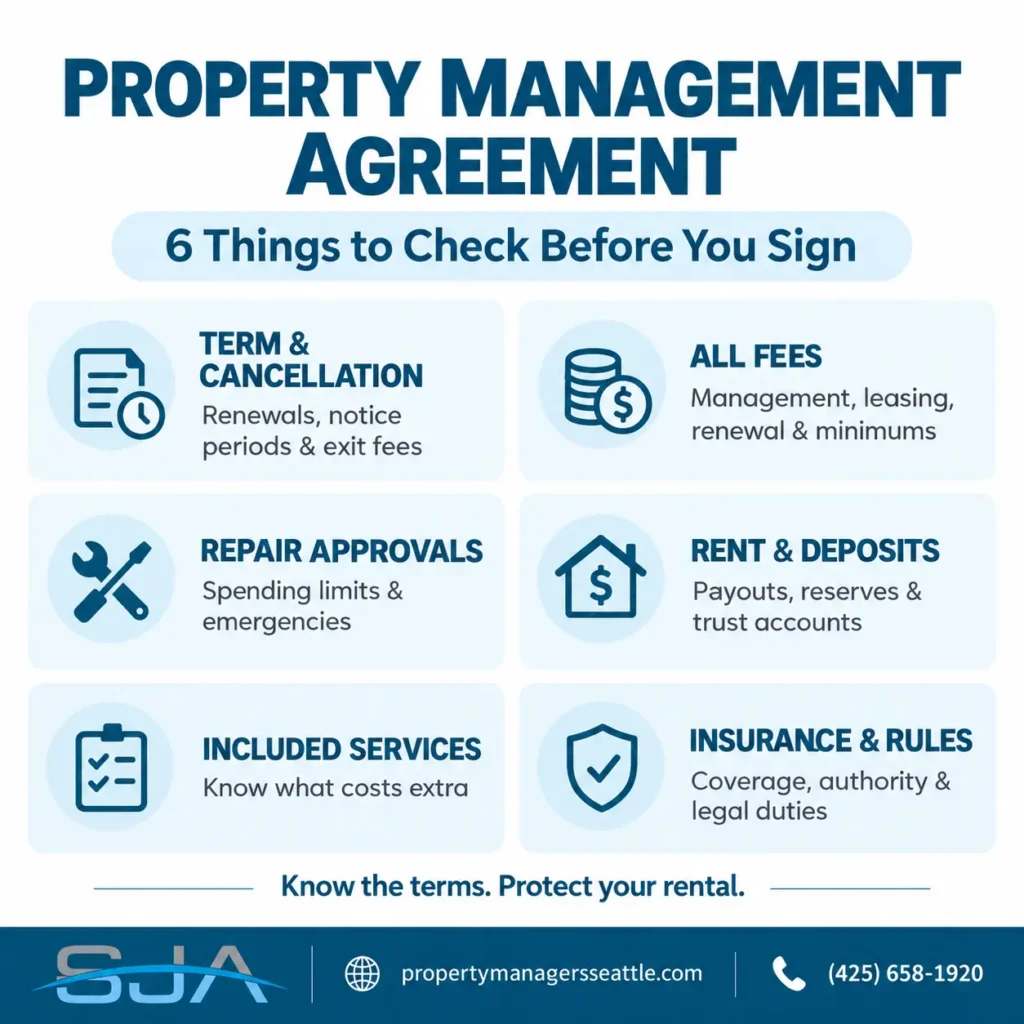
- Before signing, review the full fee schedule, repair approval limits, deposit handling and termination requirements.
- SJA publishes its management fees and allows owners to cancel without cancellation penalties.
A property management agreement is the contract between you and the company managing your rental home. At SJA Property Management, we bring 17 years of experience managing rentals across Seattle and the Puget Sound region. Today, we manage more than 1,000 homes. We've seen how unclear fees, repair limits and cancellation terms can create problems for owners. This guide explains what belongs in a property management agreement, what to watch for and how to protect your investment before signing.
Some companies call it a property management contract. Either way, read it closely before you sign, because the real fees and exit terms live here, not on a pricing page.
What Is a Property Management Agreement?
A property management agreement is a written contract between a rental owner and a property management company. It lists the company's services and the fees you will pay. It also covers how the company handles rent and deposits, how much it can spend on repairs and how the agreement ends.
In Washington, managing rental properties for others in exchange for compensation generally falls under real estate brokerage services. State law lists marketing, leasing and the financial upkeep of a property as brokerage services (RCW 18.85.011). Some licensing exemptions apply. Still, when you hire a professional management firm, check its license and its designated broker.
You can look up both with the Washington State Department of Licensing before you sign.
Who Signs a Property Management Agreement?
A property management agreement has two parties: you, the owner, and the management company. In plain terms, it is an agreement between the landlord and the agent who runs the home for them. In Washington, the firm's designated broker signs for the company (WAC 308-124D-215).
If your rental has co-owners or sits in an LLC, ask who needs to sign.
Your tenant is not part of this contract. Instead, the lease is a separate agreement between you and the tenant. However, your manager often signs the lease for you as your agent. At SJA, for example, we can sign leases on an owner's behalf.
Does a Property Management Agreement Need to Be in Writing?
Yes. Washington requires a written management agreement for every property a firm manages. You and the firm's designated broker both sign it, and the firm keeps it on file (WAC 308-124D-215). At a minimum, the agreement must state:
- The firm's pay
- The type of property and the number of units
- Whether the firm can collect and pay out money, and for what
- Whether the firm can hold security deposits, and how it may pay them out
- How often you will get a statement
Any change to the agreement must also be in writing and signed by both sides. In addition, a firm that offers extra services, such as repairs through a related company, must tell you about that tie in writing. It must also share those fees up front and get your OK.
Your broker must give you a state pamphlet called Real Estate Brokerage in Washington before you sign the services agreement. The broker must also get your acknowledgment that you received it. The pamphlet explains the duties a licensed firm owes you (RCW 18.86).
What Should Be Included in a Property Management Agreement?
Most residential property management agreements cover similar topics. Below, we'll explain each major clause, what owners should watch for and how SJA approaches it. The sample wording only shows the kind of language you may see, so don't copy it into a contract.
Term and Renewal
The term clause sets when the agreement starts and how long it lasts. Many agreements run for 12 months and then renew on their own unless you give notice in a set window.
Sample wording: "This Agreement starts on [date] and renews for 12-month terms unless either party gives written notice 30 days before the term ends."
Watch for: Long lock-ins and short cancel windows. If you miss the window, you may be stuck for another full year.
At SJA: We don't use long-term contracts, so there is no lock-in period to track.
Termination and Cancellation Fees
This clause explains how either side can end the agreement. It usually sets a notice period, often 30 to 90 days, and lists any fees for leaving early. It should also say what the manager returns when you leave, such as keys, records, deposits and leftover funds.
Sample wording: “Either party may end this Agreement with 30 days’ written notice. If Owner ends it within the first 12 months, Owner will pay a fee of $_.”
Watch for: Fees that don’t match any real work, and fees for keeping a tenant the manager placed. We often hear from owners who never read this clause until they wanted out.
At SJA: You can cancel anytime with no fees or penalties. Plus, if you’re not happy in the first 3 months, we refund your paid monthly management charges. For the steps to leave any manager, see our guide on how to cancel a property management contract.
Management Fee
This is the monthly fee for ongoing management. Most managers charge a percentage of rent, while some charge a flat amount. In Washington, 8% to 12% of the monthly rent is a common range.
Sample wording: “Owner will pay Manager _% of the monthly rent collected, with a minimum of $_ per unit.”
Watch for: Whether the fee comes out of rent collected or rent due. If it’s based on rent due, you could pay a fee for a month your tenant never paid. Also check for monthly minimums.
At SJA: 8.9% of collected rent for single-family homes, with a $235 monthly minimum per unit. Multifamily runs 6.9% to 8.9%, with a $185 minimum per unit. Those minimums still apply while a home is vacant. Our guide to Seattle property management fees compares pricing models in more detail.
Leasing Fee
A leasing fee, also called a tenant placement fee, pays the manager to find and sign a new tenant. It usually covers photos, ads, showings, screening and the lease signing. Most fall between 50% and 100% of one month's rent.
Sample wording: "For each new lease, Owner will pay Manager a leasing fee equal to __% of one month's rent."
Watch for: Extra charges for ads or screening on top of the fee. Also check whether you pay again if a new tenant breaks the lease early.
At SJA: 60% of one month's rent, with a $1,850 minimum. For example, 60% of $3,000 rent is $1,800, so the $1,850 minimum applies instead. If a tenant we placed breaks the lease in the first 12 months, we waive the leasing fee to find a replacement.
Renewal, Setup and Other Fees
Smaller fees add up over time, so a low monthly rate can still cost more overall. Look for each of these by name, and ask what it covers.
| Fee | Common range | SJA |
|---|---|---|
| Lease renewal | 25% to 40% of one month's rent | 25% of one month's rent ($500 minimum) |
| Setup for a home with a tenant in place | $150 to $400 | $385 per home; $200 per unit for multifamily |
| Maintenance markup | 10% to 15% of each vendor bill | None |
| Vacancy fee | $50 to $100 a month, or 5% to 7% of expected rent | No separate fee, but the monthly minimum still applies ($235, or $185 per multifamily unit) |
Scope of Services
The scope clause lists what the monthly fee covers. Vague wording, like "general management," makes it hard to know what you're paying for. So ask for a full list, then compare it with the fees above.
| Often in the monthly fee | Often billed separately |
|---|---|
| Rent collection and payouts | Finding a new tenant |
| Monthly owner statements | Lease renewals |
| Maintenance coordination | Setup for a home with a tenant in place |
| Tenant requests and questions | Evictions |
| Year-end tax statements | Inspections or 24/7 emergency service at some firms |
At SJA: Our monthly fee for full-service property management also covers annual inspections, 24/7 emergency response, HOA communication and utility management. See the full list on our pricing page.
Repair Spending Limit and Owner Approval
This clause sets how much the manager can spend on a repair without asking you first. It also covers emergencies, when the manager may need to act right away.
A limit that's too low can slow urgent fixes. Washington gives landlords as little as 24 hours to start some repairs, such as a loss of heat or water. The clock starts when the tenant gives written notice (RCW 59.18.070).
Sample wording: "Manager may spend up to $___ per repair without Owner's approval. In an emergency, Manager may spend more and will notify Owner as soon as possible."
Watch for: No limit at all, or a vague definition of an emergency. Ask whether the limit applies per repair, per incident or over a set period. Also confirm that you'll get an invoice for every repair.
At SJA: You set the spending threshold, and we get your approval before any repair above it. In our experience, a clear limit heads off most surprise repair bills.
Reserve Funds
Many managers hold a small reserve from your rent to pay routine bills and repairs. The agreement should state the amount and when the manager refills it.
Keep in mind that a reserve can shrink your first payout, even though your monthly rate stays the same. Also ask what happens when a repair costs more than the reserve.
Before signing, ask how much money the manager requires you to keep in reserve and when those funds will be returned.
Rent Collection, Payouts and Reporting
This clause covers when you get paid and what your statements show. In Washington, each statement must list the starting balance, rent received, other money in, every expense and the ending balance (WAC 308-124D-215).
Watch for: Vague payout dates and fees taken from your rent without a line item.
At SJA: Once your tenant pays, we deposit the rent by ACH by the 15th of the month. You also get itemized monthly statements, year-end reports and an online owner portal.
Security Deposits and Trust Accounts
Washington landlords must keep tenant deposits in a trust account at a financial institution or a licensed escrow agent located in Washington. The tenant must also get a written receipt and the name and address of where the deposit is held (RCW 59.18.270).
Your agreement must say whether the manager can hold deposits and how it may pay them out. For other rules every landlord must follow, see our Washington rental law compliance guide.
Before signing, ask who will hold your tenant's deposit and in which trust account.
Leasing Authority and Tenant Screening
This clause says what the manager can decide for you. For example, can it sign leases, set the rent or approve a tenant without asking? It should also set screening standards that follow fair housing laws and local rules, such as Seattle's First-in-Time rule.
That rule generally requires offering the home to the first qualified applicant who submits a complete application. So for a covered Seattle rental, the agreement shouldn't promise you free choice of tenants.
Sample wording: "Manager may sign leases of up to 12 months at or above the rent Owner approves."
SJA can sign leases as your agent, and we recommend leases of at least 12 months.
Insurance and Indemnification
The agreement should state the landlord insurance you need, the coverage limits and whether the manager must be named as an additional insured. Ask your insurance agent to confirm your policy meets those terms. An indemnification clause then sets who pays if someone files a claim.
Watch for: One-sided clauses that make you cover the manager even for its own mistakes.
SJA requires at least $1 million in landlord coverage, with SJA named as an additional insured.
Legal Compliance and Evictions
This clause covers who serves legal notices, who tracks new Washington and Seattle laws and who runs an eviction. It should also say who pays court and attorney costs.
At SJA: For single-family homes, we handle an eviction at no charge for our time. We also waive management fees while it's underway. This covers our time and fees, not necessarily attorney fees, court costs or unpaid rent, so ask which costs stay with you.
How Long Is a Typical Property Management Contract?
A typical property management contract lasts 12 months and often renews automatically. To leave, you usually need to give 30 to 90 days' written notice, sometimes with a fee. However, some managers offer month-to-month terms or let you cancel anytime.
At SJA, owners can cancel anytime. Even so, the average SJA owner has stayed with us for 8.4 years. In our view, good service should keep owners, not a contract.
Red Flags to Look for Before You Sign
Watch for these red flags in any property management agreement:
- Unclear exit charges. Ask exactly what's due when you cancel and whether any charges continue after management ends.
- Fees on uncollected rent. Check whether management fees continue during nonpayment or vacancy, and count them when you compare costs.
- A vague scope of services. Anything not listed may cost extra.
- Hidden markups or related vendors. Washington requires written disclosure of a firm's ties to other service providers and their fees.
- Unclear repair authority. Confirm the spending threshold, the approval process and any emergency exceptions.
- Tenant "ownership" clauses. These charge you for keeping a tenant after you leave the manager.
- Auto-renewal with a short cancel window. If you miss the date, you could be locked in for another year.
- No license or designated broker. Ask to see both, since a professional management firm generally needs them in Washington.
None of these automatically makes an agreement bad, but each one is worth a question before you sign.
Questions to Ask a Property Manager About Their Agreement
Ask these before you commit, and make sure the answers match the agreement.
- What would I pay in a normal year, including leasing and renewal fees?
- What does the monthly fee include, and what costs extra?
- Is your fee based on rent collected or rent due?
- How much can you spend on a repair without asking me?
- How do I cancel, and what will it cost?
- If I leave, how will leases, deposits, keys and records move to the next manager?
- Who holds the security deposit, and in which account?
- Do you mark up repair bills or use vendors you own?
- When will I get paid each month, and what will my statement show?
For more on choosing a manager, read our guide to hiring a property management company. If you already have one, these signs of a bad property manager can help you decide whether to switch.
What to Expect From SJA Property Management
At SJA Property Management, we believe owners should understand their costs and responsibilities before signing. That’s why we publish our management fees, explain our services and offer eight guarantees designed to give rental owners greater confidence.
| Term | SJA |
|---|---|
| Monthly fee | 8.9% single-family ($235 minimum); 6.9% to 8.9% multifamily ($185 minimum per unit); minimums apply when vacant |
| Leasing fee | 60% of one month’s rent ($1,850 minimum) |
| Renewal fee | 25% of one month’s rent ($500 minimum) |
| Setup for a home with a tenant | $385; $200 per unit for multifamily |
| Cancellation | Anytime, with no fee |
| Rent payout | By ACH, by the 15th once the tenant pays |
| Included | Annual inspections, 24/7 emergency response, maintenance coordination, monthly and year-end reports |
Our eight guarantees include the Happiness Guarantee, no-fee cancellation, a 24-business-hour response time and a 30-day leasing guarantee for new vacant homes. Others cover tenant placement, pet damage, evictions and on-time rent deposits. Terms can vary by location and local rules, including Seattle’s First-in-Time rule.
A property management agreement should give you confidence, not leave you guessing about fees, responsibilities or how to cancel. At SJA, we believe in clear expectations and straightforward pricing from the start. If you’re considering professional management for your rental, schedule a call with our team to learn how our services and agreement work.
Property Management Agreement FAQs
What should be in a property management agreement?
It should cover the term, every fee and the services included. It should also set a repair approval limit and explain how the manager handles rent, deposits, reports, insurance and cancellation.
Is a property management agreement the same as a lease?
No. A property management agreement is between you and your manager, while a lease is between you and your tenant. Your manager may sign the lease for you, but the tenant never signs the management agreement.
Can I cancel a property management agreement early?
Most agreements let you, but check the termination clause for the notice period and any fee. Many require 30 to 90 days' written notice. SJA owners, on the other hand, can cancel anytime with no fee.
Can I get a sample property management agreement?
Ask any manager you're considering for a copy of their full agreement before you sign. Then use the clauses in this guide to review it line by line. Be careful with generic templates, because they often aren't written for Washington law.
Can a property manager change the agreement after I sign?
Not on its own. In Washington, any change must be in writing and signed by you and the firm's designated broker. Ask for a signed copy of every change instead of relying on a verbal promise.
This article is general information, not legal advice. Agreement terms and Washington rules can change, and your situation may differ. Before you sign any contract, talk with a Washington real estate attorney.