

Key Takeaways
- Most Washington rentals built before 1978 need a lead-based paint disclosure before the tenant is bound by the lease, unless an exemption applies.
- Landlords must give tenants the EPA pamphlet, disclose any known lead paint or hazards, share available lead reports, and include a signed Lead Warning Statement.
- Washington follows the federal rule, so landlords can use the EPA’s sample rental form or a lease addendum with the same required elements.
- Exemptions are narrow and come with conditions. For example, a short lease qualifies only if it is 100 days or less and cannot be renewed or extended.
- Keep signed disclosures for at least three years from the start of the lease. Repairs that disturb paint in a pre-1978 home may also require a Washington-certified RRP firm.
- Violations can bring civil penalties of up to $22,263 each, and knowing violations can mean paying up to three times the tenant’s damages.
At SJA Property Management, we have helped Washington landlords for 17 years. Today, we manage over 1,000 homes across the Seattle and Puget Sound area. Because so many homes here were built before 1978, the lead-based paint disclosure is a routine part of our leasing process. In our experience, it is also one of the rules self-managing owners miss most often.
The short answer is simple. If your rental was built before 1978 and no exemption applies, federal law requires a few steps before your tenant signs the lease. You must give them a signed disclosure form, the EPA lead pamphlet, and any lead records you have. Skipping these steps can lead to fines and lawsuits.
Below, we cover the rules, the exemptions, the form, and common mistakes.
Does Lead Paint Disclosure Apply to Rentals?
Yes. A lead paint disclosure for rental property is required for most homes built before 1978. Many owners assume the lead paint disclosure only matters when a home is sold. However, the federal rule covers leases too, including subleases.
The requirement comes from Section 1018 of the Residential Lead-Based Paint Hazard Reduction Act of 1992, often called Title X. The EPA and HUD enforce it together. Under the EPA's lead disclosure rule, landlords and property managers share responsibility for getting it right.
The cutoff is construction before 1978, the year the Consumer Product Safety Commission banned lead-based paint for home use. The rule calls these older homes "target housing."
Single-family homes, condos, townhomes, duplexes, and apartment units all count if the building went up before 1978.
A remodel does not change the rule, either. A fully updated 1960s home still counts, unless a certified inspector has tested it and found it free of lead-based paint.
Timing matters, too. You must complete the disclosure before your tenant is bound by the lease, which in practice means before they sign. If an applicant has already applied or agreed to terms, give them the disclosure and time to review it before you sign the lease.
What about Washington law? Washington's Residential Landlord-Tenant Act (RCW 59.18) does not add its own lead disclosure. Washington landlords follow the federal disclosure requirements and can use the EPA's sample rental form. Washington does require other move-in disclosures, such as mold and fire safety information. Our Washington rental law compliance guide covers those, and our post on the new Washington flood risk disclosure explains the 2026 addition.
How to Check Your Home's Build Year
The easiest way is to look up your parcel on your county assessor's website. In King County, the Assessor's online property records list the year built, and Snohomish and Pierce counties offer similar searches. Your purchase paperwork, such as the appraisal or home inspection report, may also show it.
If the records are unclear, treat the home as pre-1978 until you confirm otherwise. Giving a disclosure you did not need costs you nothing. Skipping one you did need can cost you a great deal.
Who Is Exempt From the Lead-Based Paint Disclosure?
Only a few types of rentals are exempt. Under the federal rule, you do not need a lead disclosure for:
- Homes built in 1978 or later. These are not target housing.
- Leases of 100 days or less where no renewal or extension can happen. A furnished 90-day rental with a firm end date can qualify. A month-to-month rental usually does not, because it keeps renewing. Our guide to short term rentals explains how these leases differ.
- Zero-bedroom units, such as studios, lofts, and efficiencies, unless a child under 6 lives there or is expected to.
- Housing reserved for seniors or people with disabilities, unless a child under 6 lives there or is expected to.
- Homes tested and found lead-free by a certified lead inspector. Keep that report in your files for good.
- Lease renewals, but only if you already gave the full disclosure and have learned nothing new about lead since.
Note that federal guidance treats a rent change as a lease renewal. So if you learned anything new about lead since the last lease, you must share it before the renewal. That includes a new test result or a contractor's report.
When in doubt, disclose anyway, since it takes only a few minutes. Also, a regular pre-1978 rental is not exempt just because only adults live there.
What Landlords Must Give Tenants Before the Lease Is Signed
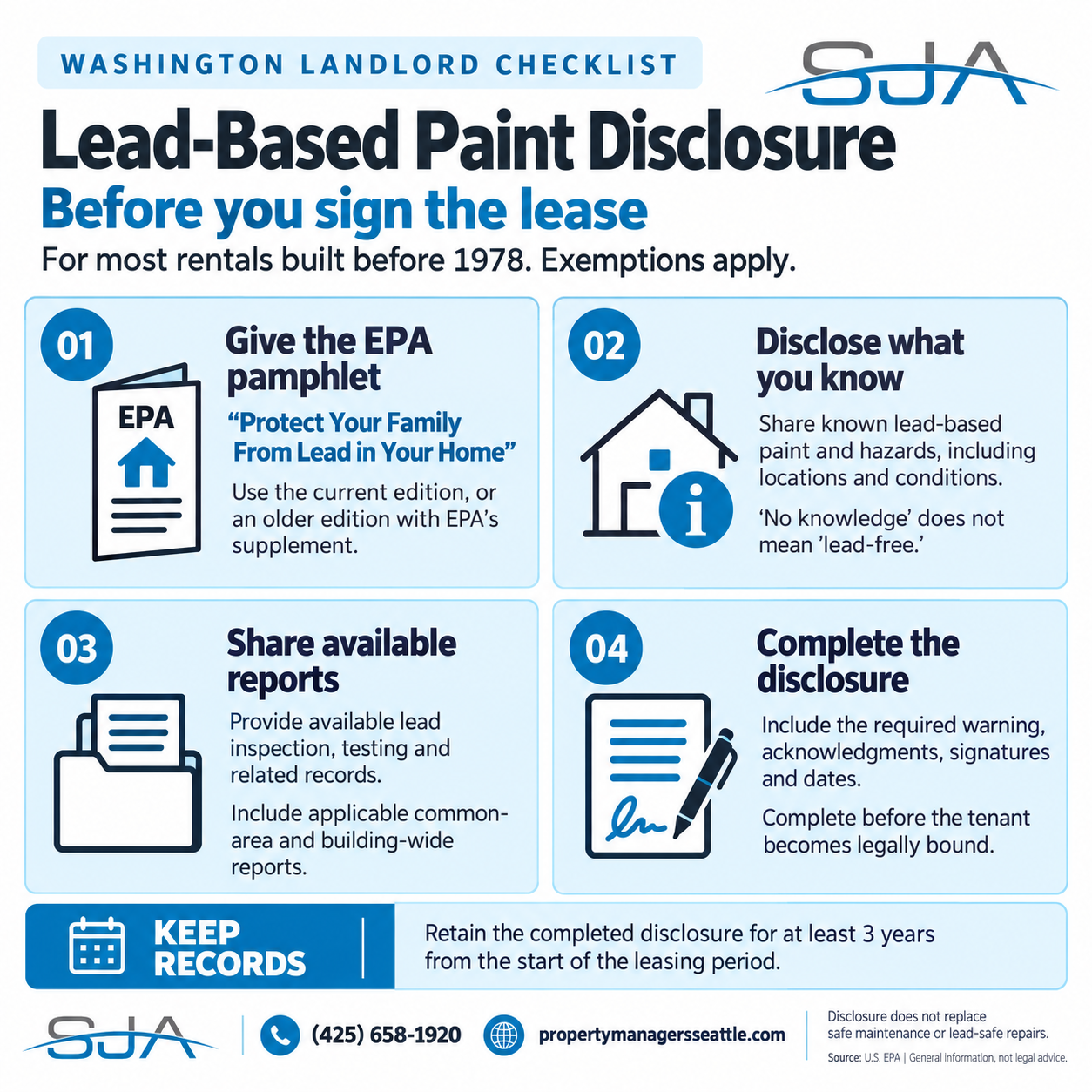
Unless an exemption applies, federal law requires four things for a pre-1978 rental before your tenant signs:
- The EPA lead pamphlet. Give every tenant a copy of Protect Your Family From Lead in Your Home. We cover the current edition below.
- What you know about lead in the home. Disclose any known lead-based paint or lead hazards, including where they are and what condition they are in. If you know of none, you say so on the form. However, "no knowledge" does not mean the home is lead-free.
- Any lead records or reports you have. This includes lead tests, inspections, risk assessments, and abatement reports. In multi-unit buildings, it also covers reports on common areas and building-wide testing.
- A signed Lead Warning Statement. The federal warning language must be attached to the lease or written into it. You, your tenant, and any agent then sign and date it.
There are also two rules that owners often overlook. First, you must keep a signed copy for at least three years from the start of the lease. That is only a minimum, so never purge files for current tenants. If you use a property manager, they must keep one too. Second, you must share what you know about lead with your agent, not just with your tenant.
In our experience, record keeping is the most common gap. We have seen owners who handed over the form but could not find a signed copy years later, when a question came up.
Unlike home buyers, tenants do not get a 10-day window to test for lead. A tenant can ask for an inspection, but this disclosure rule does not require you to provide one.
The Lead-Based Paint Disclosure Form, Explained
You do not need to write your own lead paint disclosure form. The EPA offers a free sample lessor disclosure form (PDF), which runs two pages. Include both pages in the lease package. Many lease packages include their own version instead, which is fine as long as it contains the same required parts.
Here is what each section of the lead based paint disclosure form asks for:
| Form section | What it asks | Our tip |
|---|---|---|
| Lead Warning Statement | Pre-printed federal warning about lead in older housing | Do not edit or shorten it. Keep it in the same language as the lease. |
| Lessor's Disclosure (a) | Whether you know of any lead-based paint or hazards | Answer based on what you actually know. If you know of lead paint or hazards, describe where they are and their condition. |
| Lessor's Disclosure (b) | Whether you have lead records or reports | List and provide every lead report you have. Make sure your answers match their findings. |
| Lessee's Acknowledgment (c) and (d) | Tenant confirms they received the records and the pamphlet | Have every adult on the lease initial and sign. |
| Agent's Acknowledgment (e) and (f) | (e) Your agent, such as your property manager, confirms they explained your duties. (f) The tenant's agent signs only if you pay them. | Write "N/A" if no agent is involved. |
| Certification of Accuracy | Signatures and dates from everyone involved | Finish every signature before the tenant is bound by the lease. A matching date alone does not prove the order. |
Timing is where we see the most mistakes, such as forms signed weeks after move-in. That does not meet the rule, because the disclosure must come before the tenant is bound by the lease.
Electronic delivery is allowed, but the EPA sets conditions. Tenants must consent in a way that shows they can open the files. They must also be told how to get paper copies, how to withdraw consent and what happens if they do, and how to access and keep the records. If you are renting out a home for the first time, our first time landlord checklist walks through the rest of the paperwork you need before move-in.
The Protect Your Family From Lead in Your Home Pamphlet (2026 Update)
The pamphlet you must give tenants is called Protect Your Family From Lead in Your Home. You can download it free from the EPA's Protect Your Family pamphlet page.
In January 2026, the EPA released a new edition. It reflects stricter federal standards for lead in household dust, which took effect January 12, 2026, along with an updated definition of lead abatement.
Do you have to throw out old copies? No. The EPA does not require landlords to discard older versions. However, if you hand out an older pamphlet, the EPA asks you to include its short supplement so tenants still get the updated information.
One more tip: do not confuse this pamphlet with Renovate Right. That is a separate EPA pamphlet tenants must receive before certain repairs, which we explain next.
Repairs and Turnovers: The RRP Rule Landlords Often Miss
The EPA's Renovation, Repair and Painting (RRP) rule covers paid work that disturbs paint in pre-1978 homes, and work you do on your own rental counts as paid work. It applies when a job disturbs:
- More than 6 square feet of painted surface in a room inside the home
- More than 20 square feet of painted surface on the outside
- Any window replacement or demolition of painted surfaces, no matter the size
- Any work using prohibited or restricted methods, such as open-flame burning, heat guns at 1,100°F or higher, or power sanding without HEPA dust controls
Non-emergency jobs in the same room within 30 days count as one job, so splitting a project into small visits does not help. The rule may not apply if a certified professional has documented that the affected surfaces are free of lead-based paint.
When the rule applies:
- A certified firm does the work, using a certified renovator.
- The Renovate Right pamphlet goes out no more than 60 days before work starts, to the owner and, in an occupied rental, an adult occupant. Delivery must be documented, usually with a signed receipt, though a certificate of mailing and other methods are allowed. Common-area work has separate notice rules.
- The crew uses lead-safe work practices, such as containing dust and verifying cleanup. Certification never makes prohibited methods allowed.
Doing the work yourself does not exempt a rental, and the rules can apply when you rent out part of your own home.
Turnover is where we see owners get caught most often. Scraping or sanding before repainting, fixing a sticky painted window, or prepping damaged walls can disturb enough paint to trigger the rules. Lead-safe work also takes longer, so see our guide to turnover cost to budget for it.
Washington and Seattle Rules That Go Further
Federal rules set the floor. However, Washington and Seattle add a few requirements that local landlords should know.
Washington Runs Its Own RRP Program
In Washington, lead-safe renovation work is certified by the Department of Commerce, not the EPA. Commerce offers a firm certification for businesses, property managers, and landlords who do repair or painting work on pre-1978 homes. The firm must employ at least one certified renovator who has completed approved training.
You can get certified yourself or hire a Commerce-certified firm. In our experience, most individual owners are better off hiring a certified firm for anything beyond small touch-ups.
A Signed Form Does Not End Your Duty to Maintain
Under RCW 59.18.060, Washington landlords must keep rentals fit to live in. So if a tenant reports peeling paint or suspected lead dust, take it seriously and arrange an assessment. A signed disclosure never excuses unsafe conditions.
Seattle's RRIO Inspections Check for Lead Paint
If you own a rental in Seattle, Seattle's Rental Registration and Inspection Ordinance adds another layer. Its inspection checklist includes a lead paint item for pre-1978 units. Peeling or chipped paint over 2 square feet per room, or over 10% of a part like a window frame, can fail the inspection. To clear it, you must show a Washington-certified lead-safe contractor made the repair, or prove there is no lead hazard. These inspection limits are separate from the RRP renovation limits above. Our guide to Seattle landlord laws covers the city's other rules.
Voucher Units Have Extra Steps
If a voucher tenant with a child under 6 will live in a pre-1978 unit, HUD's Lead Safe Housing Rule usually adds steps, unless an exemption applies. These typically include a check for deteriorated paint and lead-safe repairs. Requirements depend on the program, so confirm them with your housing authority. Our article on Section 8 tenants explains the basics.
What Happens If You Skip the Lead Paint Disclosure?
The penalties are serious, and they can reach property managers as well as owners.
- Federal fines. The EPA can seek civil penalties of up to $22,263 per violation, based on its 2025 inflation adjustment. That is a maximum, not an automatic fine. Each missed requirement on each lease can count as a separate violation, so fines add up fast.
- Tenant lawsuits. If you knowingly skip the disclosure, a tenant can sue you for three times their actual damages. A court can also award the tenant attorney fees, court costs, and expert witness fees.
- Criminal charges. Knowing violations can also lead to criminal penalties.
In our experience, missing disclosures usually come to light during a dispute, such as a deposit claim or an eviction case. At that point, a missing signature can become leverage for the other side. That is why we treat the signed lead form as seriously as the lease itself.
How SJA Handles Lead Disclosure for Our Owners
Lead compliance is part of our standard leasing process. For every pre-1978 rental, our team:
- Confirms the build year before the home is listed
- Includes the disclosure form and the current EPA pamphlet in every lease packet
- Keeps signed disclosures on file for the life of the tenancy and beyond
- Coordinates with Washington-certified lead-safe vendors for turnover work that may disturb paint
If you own an older rental and want one less thing to worry about, our full service property management team can take this off your plate. Prefer to manage on your own? Our free landlord checklist bundle can help you keep the rest of your paperwork organized.
Frequently Asked Questions
What does lead-based paint disclosure mean?
It is the federal requirement to tell tenants and buyers what you know about lead in a pre-1978 home before they sign. For rentals, it means a signed disclosure form with a lead warning, the EPA pamphlet, and copies of any lead reports you have.
What year does lead-based paint need to be disclosed?
Any home built before 1978 needs a disclosure, unless an exemption applies. Homes built in 1978 or later are not covered, because lead-based paint was banned for home use that year.
Do all homes built before 1978 have lead paint?
No. Older homes are more likely to have it, but only testing by a certified professional can confirm it. That is why the rule focuses on build year, not on testing.
Do I have to test my rental for lead before I rent it?
The federal disclosure rule itself does not require testing. It only requires you to share what you already know. However, if you do test, you must share the results with future tenants. A certified inspection that finds no lead-based paint can also exempt the home from future disclosures.
Can a tenant sue a landlord over lead paint?
Yes. If a landlord knowingly fails to disclose, a tenant can sue for three times their actual damages, plus attorney fees. Tenants may also bring claims if lead hazards cause harm. A timely, complete disclosure meets your disclosure duty, but safe maintenance and lead-safe repairs are separate responsibilities.
What should I do if a tenant already signed without the disclosure?
Give the tenant the missing documents right away, and talk to a Washington landlord-tenant attorney about correcting the file. Never backdate signatures. A late disclosure does not erase the earlier violation.
Should landlords be worried about lead paint disclosure?
Not if you follow the steps. The disclosure takes only minutes. The real risk comes from skipping it, losing the signed copy, or doing paint work without lead-safe practices.
This article is for general information only and is not legal advice. Lead rules and penalty amounts can change, so confirm current requirements with a Washington landlord-tenant attorney before you act.