A tenant sends you a photo of mouse droppings under the kitchen sink. Before you call anyone, you need one answer: who is responsible for pest control in a rental property? In Washington, the law puts the first duty on the landlord. However, the answer changes with the type of home and the cause of the problem. SJA Property Management has managed rentals across King and Snohomish Counties since 2009. Today our licensed team of 40 oversees more than 1,000 homes, and pest reports are a routine part of that work. We are a property management company, not a pest control company, so we coordinate WSDA-licensed vendors rather than treating pests ourselves. This guide explains the rules, the exceptions, and the steps that protect your property. It pairs with our free Rental Property Pest Response Checklist, which you can download right here.
The Free Rental Property Pest Response Checklist
This article answers the responsibility question. The Rental Property Pest Response Checklist handles the response itself, from the first tenant report to the final follow-up. It is a 12-page working tool built on the same Respond, Resolve, Prevent structure as our companion checklist on mold and our fire in a rental checklist.
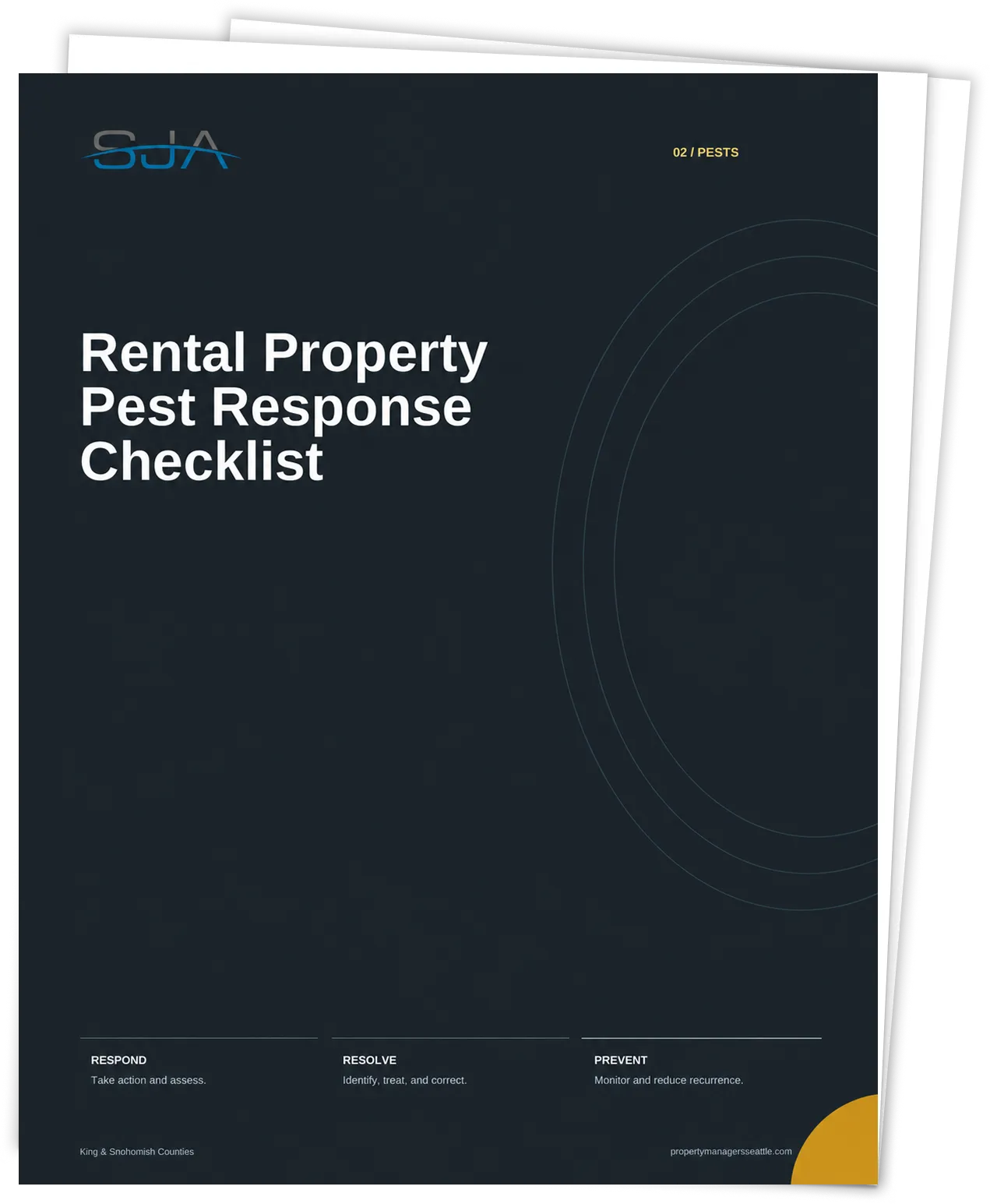
Rental Property Pest Response Checklist: Free Downloadable PDF
Fill out the form below to instantly download our rental property pest response checklist.
Inside: a one-page quick response checklist, move-faster triggers, tenant intake questions with a sample first message, a pest identification matrix for six common Puget Sound pests, vendor questions, a fillable incident log, a prevention checklist, and a close-the-loop page with official source links. Print a blank copy for each property, or use the interactive version on screen.
For the full set of owner tools, SJA’s free landlord checklist bundle covers pricing, rent-ready preparation, move-in and move-out condition, maintenance compliance, and vacancy marketing.
Who is Responsible? The Short Answer
In Washington, the landlord must provide a reasonable pest control program at the start of every tenancy. After move-in, the landlord must also control infestations in apartments, duplexes, and other multi-unit buildings, unless the tenant caused the problem. Single-family homes are the exception. State law does not require an ongoing program during a single-family tenancy, although local codes, your lease, and your repair duties can still apply. Tenants, for their part, must keep the home clean and pay to exterminate any infestation they cause.
What Washington Law Says About Pest Control in Rentals
The rule comes from the Residential Landlord-Tenant Act. RCW 59.18.060 lists what a landlord must do to keep a rental fit to live in. Item four covers pests, and it is worth reading word for word:
“Provide a reasonable program for the control of infestation by insects, rodents, and other pests at the initiation of the tenancy and, except in the case of a single-family residence, control infestation during tenancy except where such infestation is caused by the tenant;”
That sentence has three parts. First, every landlord must deliver a pest-free unit at the start of the tenancy, whether it is a house, a condo, or an apartment. Second, in a multi-unit building, the landlord’s duty continues for the whole tenancy. If mice show up in month eight of a duplex lease, the landlord handles it. Third, there are two exceptions to that ongoing duty: single-family residences, and infestations caused by the tenant.
Tenants have duties too. Under RCW 59.18.130, a tenant must keep the part of the home they occupy as clean and sanitary as conditions allow. They must also dispose of garbage properly and at regular intervals, and “assume all costs of extermination and fumigation for infestation caused by the tenant.”
Timing matters as well. Once a tenant gives written notice, RCW 59.18.070 sets deadlines for the landlord to start repairs: 24 hours for conditions that are imminently hazardous to life, 72 hours for a lost refrigerator, range, or major plumbing fixture, and 10 days for most other defects. Pests are not named in the statute, so the underlying condition sets the clock. In practice, a wasp nest inside a bedroom or rodents in a kitchen call for a much faster response than the outer limit.
The Single-Family Exception Most Owners Miss
Many Washington landlords own one rental house, and this exception applies directly to them. For a single-family rental, Washington's statewide ongoing pest control requirement is different. RCW 59.18.060(4) excludes single-family residences from the landlord's specific duty to control infestations throughout the tenancy.
That does not automatically make the tenant responsible. Local codes, the lease, the cause of the infestation, and the landlord's separate duties to maintain the structure can still affect the answer. In Seattle, for example, local housing rules require property owners to control pests in rental units and allow extermination costs to be charged to a renter only when the renter caused the infestation.
In other words, if ants appear in a single-family rental in July, state law does not automatically put the bill on the owner or on the tenant. If the lease is silent, the question often turns into a dispute. For that reason, spell out pest responsibility in every single-family lease, including who schedules routine treatments and who pays. Then keep handling entry points and moisture yourself, because those are owner repairs no matter who pays the exterminator. A rotted door sweep is a repair under the Act, even if the ants that came through it are a lease question. A rodent infestation that comes from a foundation gap is rarely a tenant-only issue, even in a house.
When the Tenant Is Responsible, and How to Show It
Under the Act, a tenant pays for extermination when the tenant caused the infestation. The hard part is proving cause. Landlords and tenants disagree about this constantly, so evidence matters more than opinion.
Tenant-caused infestations usually look like this: fleas in a home with dogs and no prevention, roaches that trace back to food waste, or bed bugs that arrive with secondhand furniture. Even then, you need a record.
Start with the move-in condition report. If it shows no pest activity and the tenant reports fleas six months later, you have a timeline. Add the inspection findings, which often name the source, and the tenant's own statements about pets, travel, and used furnishings. Then compare all of it to the lease.
A clean home can still have bed bugs, and a tidy tenant can still get mice through a gap in the siding. Identify the pest and the contributing conditions first, and let the evidence assign the cost.
Do Landlords Have to Pay for Pest Control? Common Scenarios
The table below shows how the rules usually play out. Treat these as starting points, not rulings.
| Scenario | Who usually pays | Why |
|---|---|---|
| Cockroaches found the first week after move-in, any property type | Landlord | The Act requires a pest-free unit at the start of every tenancy |
| Mice in a duplex or apartment mid-lease, entering through a foundation gap | Landlord | Ongoing duty in multi-unit housing, and the entry point is a structural repair |
| Fleas in a single-family home with two dogs and no flea prevention | Tenant may be responsible if inspection establishes tenant causation | Tenant sanitation and pet duties, supported by the move-in report and inspection findings |
| Ants in a single-family home in month five, no lease clause | Review local law, cause, and separate repair duties | The Act does not require an ongoing program in a single-family residence, but other duties can still apply |
| Bed bugs in a multi-unit building, source unclear | Landlord, usually | Cause is hard to prove in shared buildings, and treatment often needs several units |
| Wasp nest in the eaves of any rental | Landlord | Exterior structure and safety issue, not tenant conduct |
| Roaches traced to food waste and trash in one unit | Tenant, if documented | Tenant sanitation duty under RCW 59.18.130 |
Two notes on the table. First, keep the service decision separate from the billing decision. Even when the tenant will owe the cost, the landlord usually needs to arrange treatment so the problem does not spread. A payment dispute should never become the response plan. Second, bill a tenant with a written explanation and receipts, not a surprise deduction at move-out.
Are Landlords Responsible for Rodent Control?
Rodents are the pest question we hear most from owners, and the same rules apply. At move-in, the landlord must deliver a home without an active rodent problem. In multi-unit buildings, the landlord must keep controlling rodents during the tenancy unless the tenant caused the issue. In a single-family home, local rules, the lease, and the cause decide ongoing control.
However, rodents almost always come with a structural cause. The CDC notes that mice can fit through a hole the width of a pencil. Gaps under doors, torn screens, open utility penetrations, and foundation cracks are all landlord repairs under the Act. As a result, the owner is nearly always involved in a rodent problem. Public Health Seattle and King County has a practical guide to removing the food and shelter that draw rodents and checking the building for gaps.
Cleanup also has safety rules. The Washington State Department of Health says not to sweep or vacuum rodent droppings, because that can stir up hantavirus. Instead, air out the area for at least 30 minutes, wear rubber gloves, wet the droppings and nesting material with a disinfectant such as a 10 percent bleach solution, let it soak for 10 minutes, then wipe it up. Share those instructions with tenants before anyone cleans.
Bed Bugs, Fleas, and Other Pests That Raise Responsibility Questions
Bed bugs are the hardest case. They travel in luggage, furniture, and clothing, so proving how they arrived is difficult. In a multi-unit building, treatment usually needs to cover adjacent units, and the landlord typically carries the cost. In a single-family home, local rules, the lease, and the evidence decide. Ask the vendor whether follow-up visits cost extra, since bed bug work rarely ends after one treatment.
Before anyone argues about cause, confirm the pest. Public Health Seattle and King County explains how to check in, under, and around beds and nearby furniture for live bugs, dark fecal spots, blood smears, and shed skins. Bites alone cannot prove an infestation. The only way to be sure is to find and identify a live bed bug.
Fleas usually trace to pets. If your lease allows pets, require veterinary flea prevention as a condition of the pet agreement. Our guide to pet policies for Seattle rentals covers how to structure that clause. Keep in mind that service animals and assistance animals are not pets under fair housing law. Any damage from those animals runs through the standard security deposit rather than a pet deposit.
Pest Control Clauses That Belong in Your Lease
A standard lease cannot waive the landlord’s duties under the Act. RCW 59.18.230 makes those provisions unenforceable, apart from a narrow written exemption process that requires outside approval. So a duplex lease cannot shift all pest control to the tenant, no matter how it is worded.
What a lease can do is make the tenant’s side of the deal clear. Consider clauses that:
- Require the tenant to report pest activity and leaks within a set number of days.
- Prohibit foggers, bug bombs, and unapproved pesticides before an inspection.
- Require cooperation with treatment preparation and reasonable access.
- Set sanitation and trash expectations that match RCW 59.18.130.
- Require flea prevention for approved pets.
- State that tenant-caused infestations are the tenant’s cost, with documentation.
- For single-family homes, state who schedules routine pest control and who pays.
Have an attorney review your lease language. Washington adds new rental rules most years, and Seattle applies its own standards on top of state law. Seattle’s housing code says renters who report pests cannot be charged for extermination unless they caused the infestation, with no carve-out for single-family homes, so a Seattle house is treated differently from one in Everett. Our overview of Seattle landlord-tenant laws explains the rest of the city layer. In addition, our guide to who is responsible for repairs in a Seattle rental covers the broader repair rules that pest problems often touch.
The Puget Sound Pest Calendar
Pest pressure here shifts through the year, and knowing the pattern helps you plan inspections. Carpenter ants commonly swarm in spring, mainly from April to early June, which is when owners first notice winged ants indoors. WSU PestSense notes that these ants do not eat wood but excavate it for nesting and can weaken a structure. They favor damp wood, so a spring sighting is a signal to check for moisture problems, not a nuisance to spray and forget. Yellowjackets become especially aggressive in late summer and fall, and WSU’s yellowjacket fact sheet warns that they sometimes sting without being provoked. Nests turn up in wall voids, attics, and the ground, so eaves and vents deserve a look before fall. Rodents, by contrast, are a year-round concern anywhere they can find food, shelter, and an entry point, with activity often rising as temperatures drop.
A spring exterior check for wood damage and a late-summer look at eaves and vents prevent more problems than any treatment.
Choosing a Pest Control Vendor in Washington
Anyone applying pesticides for hire in Washington must be licensed. Before you authorize work, verify the company and the applicator through the Washington State Department of Agriculture license lists, and ask for the service report and product information afterward.
Look for a vendor who talks about causes, not just sprays. A good pest professional will tell you what conditions are supporting the activity and what repairs are needed. That approach is called integrated pest management, and the EPA's IPM principles explain why it keeps problems from returning. Get the scope, price, preparation steps, re-entry timing, and follow-up plan in writing before work starts.
Property Management Pest Control: How SJA Handles a Pest Report
SJA Property Management is a licensed property management company (Broker License #91565) and a NARPM member firm. We are not a pest control company, and we do not apply pesticides. Instead, we coordinate WSDA-licensed vendors, handle tenant communication and entry notice, manage the repairs that stop a recurrence, and document every step in the property file.
When a tenant reports pest activity, our team acknowledges the report and asks for photos and details. We check the red flags that call for faster action, such as bed bugs, rodents in living areas, or stinging insects indoors. Next, we arrange the inspection with proper notice and confirm whether connected units need checking. Once the vendor confirms the pest, we coordinate treatment and repairs together, because sealing the entry point matters as much as the treatment. Finally, we schedule the follow-up and record the results before closing the incident.
That last step is the one most owners skip. A pest incident is over when monitoring shows no new activity and the condition that allowed it has been corrected. If you would rather hand the whole process to a team that does this every week, professional property management is built for exactly that.
If you’re tired of dealing with complicated matters like this in your rental give us a call today to see how we can take the burden off.
Frequently Asked Questions
Is the Landlord Responsible for Pest Control in Washington?
Yes, at the start of every tenancy. During the tenancy, the landlord must also control infestations in multi-unit housing unless the tenant caused the problem. In a single-family residence, the Act does not require an ongoing program after move-in, so local rules, the lease, the cause, and the landlord's repair duties decide.
Is the Tenant Automatically Responsible for Pests After the First 30 Days?
No. RCW 59.18.060(4) sets no 30-day cutoff. It separates the start of the tenancy from ongoing control, and the ongoing duty turns on property type and cause. A lease deadline cannot override the landlord's nonwaivable duties or local rules.
What If the Tenant Will Not Prepare for Treatment or Allow Entry?
First, confirm the instructions and appointment were clear, and ask whether the tenant needs help preparing. Tenants cannot unreasonably refuse access for necessary work, but landlords must still follow Washington's entry notice rules. Document each refusal and get legal guidance rather than entering without a lawful basis.
Can a Tenant Break the Lease Because of Pests?
Potentially, but not because of a single sighting. If a condition falls within the landlord's duties and goes unrepaired after proper written notice, RCW 59.18.090 gives the tenant remedies that can include ending the tenancy. Respond promptly and document every step.
Who Pays for Bed Bug Treatment in a Rental?
In multi-unit buildings, the landlord usually pays, because cause is hard to prove and treatment often covers several units. In a single-family home, local rules, the lease, and the evidence decide. Confirm the pest with an inspection first, not bites alone.
How Fast Does a Landlord Have to Respond to a Pest Complaint?
After written notice, RCW 59.18.070 requires the landlord to start fixing most conditions within 10 days, and within 24 hours for conditions that are imminently hazardous to life. A prompt acknowledgment and an inspection within a few days is a reasonable standard for most pest reports.
Can a Landlord Charge the Tenant for Pest Control?
Yes, when the tenant caused the infestation and the landlord can document it. Use the move-in condition report, the inspection findings, and the tenant's own statements. Bill with a written explanation and receipts, and follow Washington's deposit rules if you deduct from a security deposit.
What Should a Tenant Do Before Pest Control Arrives?
Follow the vendor's preparation instructions exactly. Do not use foggers or store-bought sprays before the inspection, and do not move infested belongings to another room or unit. Do not sweep or vacuum rodent droppings. The checklist includes a sample message that covers all of this.
Sources
- RCW 59.18.060, Landlord duties
- RCW 59.18.070, Landlord failure to remedy, repair timelines
- RCW 59.18.130, Tenant duties
- RCW 59.18.090, Tenant remedies after landlord failure to remedy
- RCW 59.18.230, Waiver of rights prohibited
- Seattle SDCI, Pests in rental units
- Washington State Department of Health, Rodents
- CDC, Seal up to prevent rodents
- Public Health Seattle and King County, Preventing rodents
- Public Health Seattle and King County, Bed bug detection
- Washington State Department of Agriculture, Pesticide license lists
- U.S. EPA, Integrated pest management principles
- WSU PestSense, Carpenter ants
- WSU PestSense, Yellowjackets
This article is general information about what Washington's statutes say, not legal advice for a specific tenancy. Lease terms, local ordinances, and the facts of each situation change the answer.